 Win VIP Access to Two Step Inn Georgetown.
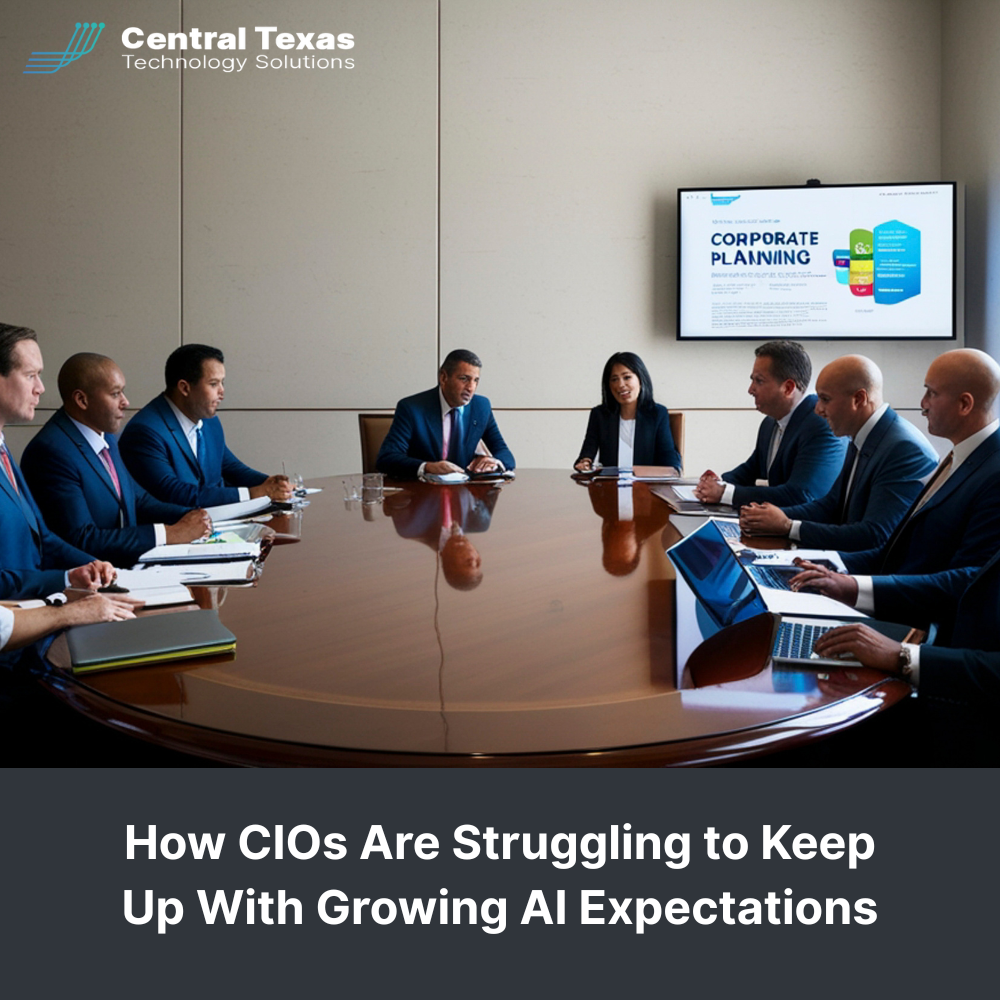
 Many organizations across Central Texas are facing a hard reality. Growing AI expectations are accelerating faster than internal processes, budgets, and governance models can keep up. While executives see artificial intelligence as a path to efficiency and competitive advantage, the responsibility for making it all work is landing squarely on the shoulders of CIOs.
In cities like Austin, Georgetown, Cedar Park and Taylor, CIOs are being asked to deliver faster innovation, stronger security, regulatory compliance, and measurable return on investment from AI initiatives, often without the structure or support required to succeed. This challenge spans every industry, from Healthcare and Legal to Construction, Manufacturing, Professional Services, and Nonprofits.
The result is frustration, rising risk, and stalled progress.
Why Growing AI Expectations Are Reshaping the CIO Role
Recent research from Salesforce highlights a growing disconnect. CIOs are increasingly accountable for everything AI touches, including ethics, risk management, compliance, security, and performance. Yet many organizations have not updated leadership roles, job descriptions, or decision making authority to match those expectations.
AI has quietly become part of daily operations, even when leadership has not formally acknowledged it. CIOs are now expected to manage:
- AI strategy and alignment with business goals
- Data security and privacy across AI tools
- Infrastructure readiness and performance
- Regulatory and compliance exposure
- Vendor oversight and cost control
- Proof of ROI tied to AI investments
These responsibilities were not added gradually. They appeared almost overnight.
Growing AI Expectations From the C Suite Create Pressure Without Clarity
Executives want AI driven results quickly. Faster workflows. Smarter insights. Reduced costs. Better customer experiences.
What is often missing is clarity around ownership, funding, and risk tolerance.
CIOs are expected to move fast while also protecting the business from mistakes that could damage trust, violate regulations, or expose sensitive data. In regulated industries like Healthcare, Legal, and Nonprofits, the margin for error is especially small. Construction and Manufacturing firms face similar challenges tied to intellectual property, operational data, and supply chain visibility.
When expectations rise without clear guardrails, technology teams spend more time stabilizing systems than innovating.
Shadow AI Is Fueling Risk and Burnout
One of the most dangerous side effects of growing AI expectations is shadow AI. Employees often adopt generative AI tools on their own to speed up work, solve problems, or meet leadership demands.
This creates serious risks:
- Sensitive data shared with unapproved AI platforms
- No visibility into where data is stored or processed
- Inconsistent outputs that affect decision making
- Compliance violations tied to privacy and retention rules
CIOs are left chasing tools they did not approve and workflows they did not design. The stress compounds as leadership continues to push for broader AI adoption without addressing governance.
AI governance must be treated as a company wide responsibility, not a technical afterthought.
The Hidden Cost of Growing AI Expectations
AI adoption rarely stops at one tool. Costs accumulate quickly through infrastructure upgrades, licensing, integrations, monitoring platforms, security controls, and compliance workflows.
CIOs are then expected to justify spend while also delivering measurable outcomes.
Boards, insurers, and auditors are asking sharper questions about AI risk management. Regulations are evolving. Documentation expectations are rising. When budgets remain flat, frustration is inevitable.
Without a clear strategy, organizations risk overspending on disconnected tools while underdelivering on real business value.
How Businesses Can Support CIOs and Succeed With AI
Organizations that succeed with AI do not leave CIOs to absorb the pressure alone. They take intentional steps to align expectations with reality.
Smart leadership teams focus on:
- Making AI accountability explicit with clear authority and funding
- Establishing approved AI tools and usage policies
- Closing the expectation gap through regular conversations about goals, cost, and outcomes
- Treating AI security and governance as foundational, not optional
AI is no longer experimental. It is operational. Leadership structures must evolve accordingly.
Why CTTS Is the Trusted Partner for Managing Growing AI Expectations
This is where CTTS becomes the obvious choice for business leaders across Central Texas.
CTTS helps organizations navigate growing AI expectations by acting as a strategic IT partner, not just a support vendor. We work with Healthcare, Legal, Professional Services, Construction, Manufacturing, and Nonprofit organizations to align AI adoption with security, compliance, and real business outcomes.
Our approach helps CIOs and executive teams:
- Build practical AI strategies grounded in business goals
- Establish governance and security frameworks that reduce risk
- Control costs and improve visibility across AI investments
- Support internal teams without burnout or guesswork
For businesses in Austin, Round Rock, Georgetown, and surrounding communities, CTTS provides clarity where AI complexity threatens progress.
Growing AI expectations do not have to overwhelm your leadership team. With the right partner, they become a competitive advantage.
Frequently Asked Questions About Growing AI Expectations
Why are growing AI expectations causing stress for CIOs?
CIOs are being held accountable for AI outcomes without always receiving clear authority, budget, or governance support. This creates pressure to deliver results while managing rising risk and complexity.
What is shadow AI and why is it dangerous?
Shadow AI refers to employees using unapproved AI tools without oversight. It increases the risk of data exposure, compliance violations, and inconsistent decision making.
How can an IT partner help manage growing AI expectations?
A strategic IT partner like CTTS provides governance, security, cost control, and clear AI roadmaps that align leadership goals with operational reality.
Contact CTTS today for IT support and managed services in Austin, TX. Let us handle your IT so you can focus on growing your business. Visit CTTSonline.com or call us at (512) 388-5559 to get started!