 Win VIP Access to Two Step Inn Georgetown.
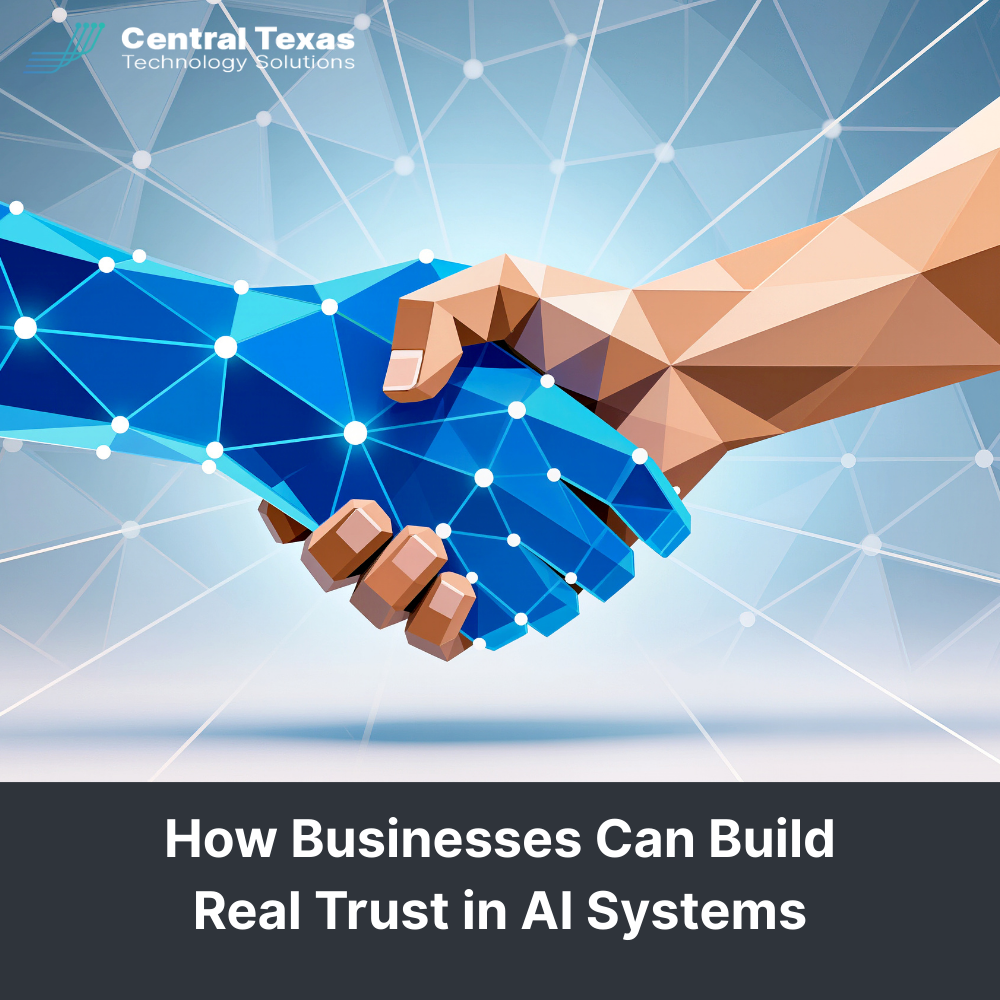
 Just a few years ago, the idea that technology could anticipate customer needs before anyone picked up the phone felt unrealistic. Today, artificial intelligence is doing exactly that for businesses across Austin, Round Rock, Georgetown, and Leander. AI is helping organizations personalize experiences, predict demand, and uncover insights faster than any human team could on its own.
But with that power comes a growing concern that business leaders cannot ignore. AI relies on data, and often that data is the most sensitive information a company owns. Client records, financial details, intellectual property, and operational insights all flow through these systems. Without clear safeguards, trust erodes quickly. That is why trust in AI has become a defining issue for organizations that want to grow without putting their reputation at risk.
Why Trust in AI Matters for Modern Businesses
Business leaders in Healthcare, Legal, Professional Services, Construction, Manufacturing, and Nonprofits are under increasing pressure to adopt AI tools. Patients expect efficiency. Clients expect accuracy. Donors expect accountability. AI promises all of this, but only when it is implemented responsibly.
Trust in AI is not about slowing innovation. It is about making sure the technology supports your business instead of creating hidden risks. Customers and partners are asking smarter questions. They want to know how their data is used, where it is stored, and who has access to it.
When companies cannot answer those questions clearly, confidence fades.
Moving Fast With AI Without Losing Trust
Many organizations rush to deploy AI platforms without fully understanding what happens behind the scenes. Data can be shared with third-party vendors, processed in unfamiliar cloud environments, or used to train external models without clear consent. These gaps often go unnoticed until something goes wrong.
Building trust in AI means treating transparency as a feature, not an afterthought. When customers hear phrases like “AI-powered personalization,” they naturally want to know what information makes that possible. Clear communication protects your brand and reinforces credibility.
Strong trust signals include:
- Clear explanations of how AI tools use customer and employee data
- Well defined data ownership policies
- Vendor agreements that limit how information can be reused
- Security controls that match the sensitivity of the data
Businesses that get this right earn confidence instead of suspicion.
Trust in AI Requires Algorithmic Accountability
Every AI system makes decisions based on algorithms. These decisions influence hiring, pricing, marketing strategies, and operational planning. For leaders, the most important question is often the simplest one. Why did the system make that choice?
Algorithmic accountability ensures that AI outputs can be explained and reviewed. If a system flags unusual activity, predicts a downturn, or recommends a strategic move, decision makers should understand the reasoning behind it.
Reliable AI systems share common traits:
- Transparent decision logic
- Clear documentation from vendors
- Auditable data sources
- Regular reviews to confirm outputs remain accurate
When AI behaves like a black box, risk increases. When it is explainable, trust grows.
Practical Steps to Strengthen Trust in AI
Trust in AI is built through consistent actions, not marketing language. Business leaders can take meaningful steps today to reduce uncertainty and reinforce confidence.
Consider these practical moves:
- Maintain an inventory of all AI tools in use across the organization
- Review vendor contracts to confirm data usage limitations
- Update privacy policies to clearly state how AI systems are trained
- Limit access to sensitive data based on roles and responsibilities
- Partner with an IT provider who understands AI security and compliance
A simple statement like “We never train third-party AI models on your data without explicit consent” can go a long way when it is backed by real controls.
Ethical AI Is a Business Responsibility
AI is no longer experimental. It is embedded in daily operations across industries. That shift has changed the conversation. Leaders are no longer asking if they can use AI. They are asking if they are using it responsibly.
Ethical AI considers fairness, security, and long-term impact. In Healthcare, it protects patient trust. In Legal and Professional Services, it safeguards confidentiality. In Construction and Manufacturing, it ensures reliable forecasting and safety planning. In Nonprofits, it preserves donor confidence and mission integrity.
Organizations that invest in ethical, transparent AI systems position themselves ahead of competitors who cut corners. Trust becomes a competitive advantage rather than a liability.
Why CTTS Is the Right Partner for Trust in AI
Building trust in AI requires more than software. It requires guidance, planning, and ongoing oversight. CTTS helps business leaders across Central Texas adopt AI with confidence. From Austin to Georgetown, Round Rock, and Leander, CTTS works alongside organizations to ensure technology supports growth without exposing unnecessary risk.
CTTS helps businesses:
- Evaluate AI readiness and infrastructure
- Secure sensitive data across cloud and local environments
- Select vendors that prioritize transparency and accountability
- Align AI strategies with industry compliance requirements
When AI is implemented correctly, it strengthens trust instead of challenging it. CTTS serves as the guide that helps businesses move forward with clarity and control.
Frequently Asked Questions About Trust in AI
What does trust in AI really mean for businesses?
Trust in AI means having confidence that systems use data responsibly, produce reliable results, and align with your organization’s values and obligations. It also means being able to explain how decisions are made.
How can businesses reduce risk when adopting AI tools?
Risk is reduced by understanding data flows, choosing transparent vendors, enforcing security controls, and partnering with an experienced IT provider who can oversee implementation and governance.
Is trust in AI more important for regulated industries?
Yes. Industries like Healthcare, Legal, Manufacturing, and Nonprofits face higher expectations around data protection and accountability. Trust in AI helps meet compliance requirements while maintaining credibility with clients and stakeholders.
Contact CTTS today for IT support and managed services in Austin, TX. Let us handle your IT so you can focus on growing your business. Visit CTTSonline.com or call us at (512) 388-5559 to get started!