
What Austin Businesses Need to Know About Supply Chain Cyber Risk
 Most business owners believe a simple truth.
If we install the right security tools, we are covered.
Antivirus is running. Updates are enabled. Dashboards are green. Everyone gets back to work.
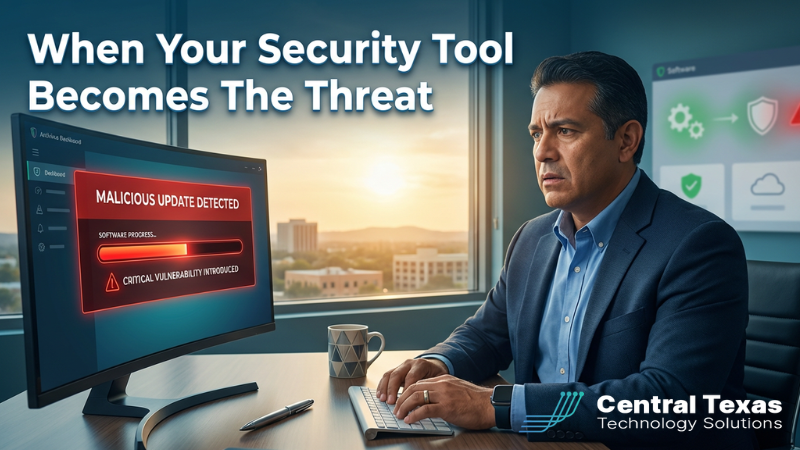
That belief was shaken this week when investigators confirmed that a major antivirus vendor’s own update system was compromised. Attackers used the trusted update process to push malicious code directly onto customer machines.
No phishing email.
No user mistake.
No warning pop-ups.
The software that businesses trusted to protect them became the way in.
If this can happen to a global security company with massive resources, what does it mean for a 25 to 200 person business in Austin or Central Texas that relies on a stack of tools it rarely reviews?
That question is where real cybersecurity planning starts.
The Real Risk Is Not Hackers
It Is Assumptions.
Most cyber conversations focus on attackers.
Hackers. Ransomware groups. Foreign actors.
But for most local businesses, the bigger risk is what happens when leadership assumes the tools alone equal protection.
Here is what supply chain compromise actually looks like inside a growing business.
Malware arrives through a trusted update
Endpoints quietly change while reports still show healthy
Security teams spend weeks figuring out what was touched
Leadership realizes they do not fully understand their own stack
The scariest part is not the attack itself.
It is the moment when the question becomes
I thought we were covered. What else do we not know?
This is not a fear tactic. It is the reality of modern IT environments where dozens of vendors have deep access to your systems.
Why Supply Chain Attacks Hit Mid-Sized Businesses Harder
Large enterprises expect vendor compromise. They design around it.
Mid-sized businesses often do not.
In Central Texas, we see organizations with
One security tool doing too many jobs
One vendor with admin access everywhere
Backups controlled by the same platform they are protecting
No visibility into what changes during updates
When a trusted vendor gets compromised, these environments have no shock absorbers.
Everything depends on one layer staying perfect.
And perfection is not a strategy.
This Is Where a Trusted Cybersecurity Company Makes the Difference
At CTTS, we tell business owners something that initially feels uncomfortable.
Assume one of your vendors will get breached.
Not because they are bad.
Because complex systems fail.
When you plan for that reality, your security posture changes.
Instead of asking
Do we have antivirus
You start asking
What happens when antivirus is the problem
That mindset shift is the difference between buying tools and building resilience.
Our role as a cybersecurity company in Austin is not just to install software. It is to validate that your entire stack makes sense together, is monitored intelligently, and does not create a single point of failure.
A Simple Framework for Austin Business Leaders
You do not need to be technical to reduce supply chain risk. You just need the right questions.
Here is how we coach Central Texas leaders to think about it.
1. List Your Critical Vendors and Tools
Start with visibility.
Write down every vendor and platform that has deep access to your business.
Email systems
Endpoint protection
Remote access tools
Backup platforms
Line of business applications
Cloud administrators
Next to each one, write what they can touch.
If you are not sure, that is already valuable information.
This exercise alone often reveals how much power has been delegated without clear oversight.
2. Treat Vendor Compromise as Expected
Hope is not a control.
Assume that one of those tools will eventually be compromised.
When you do, a few priorities become obvious.
Multi-factor authentication everywhere
Limited administrative privileges
Allow-listing where possible
Alerts when new agents or tools appear
These are not complex technologies. They are leadership decisions about risk tolerance.
Layered security means no single tool can take the business down.
3. Plan for a Bad Update Day
This is the step most businesses skip.
Ask yourself
How would we know if a legitimate update behaved strangely
Who gets alerted when something changes unexpectedly
Can we roll back quickly without relying on the same vendor
Are backups isolated from the tools protecting them
If the answer is not clear, the plan does not exist yet.
Testing rollback and recovery is not pessimism. It is professionalism.
4. Separate Detection From Trust
One of the hardest lessons in modern cybersecurity is this.
A tool can be trusted and still monitored.
Just because something is approved does not mean it should be invisible.
Good security architecture assumes verification, not blind trust.
This is where experienced oversight matters more than brand names.
5. Review the Stack, Not Just the Alerts
Most dashboards look great until they do not.
A periodic stack review looks beyond green checkmarks and asks
Are these tools overlapping
Are we paying for false confidence
Is one vendor holding too many keys
Would a single compromise cascade across systems
This is strategic work, not emergency response.
Why Local Context Matters in Austin and Central Texas
Austin is a unique business environment.
Fast-growing companies
Remote and hybrid teams
Manufacturing and professional services side by side
Nonprofits operating with lean resources
We regularly see businesses scaling faster than their IT strategy.
What worked at 15 employees breaks at 75.
What felt manageable at one location fails across multiple sites.
Cybersecurity is not about fear. It is about alignment between growth and protection.
A local cybersecurity company understands that reality better than a national help desk.
CTTS as Your Guide, Not Just Your Vendor
Our clients tell us the same thing over and over.
I do not want more tools. I want confidence.
Confidence comes from knowing
What you have
Why you have it
How it is monitored
What happens when something fails
At CTTS, we focus on being the guide who helps you see the full picture, reduce hidden risk, and make clear decisions without technical overload.
You should not have to lie awake wondering whether the software meant to protect you is quietly putting you at risk.
Ready for a Stack Check Conversation
If you are an Austin or Central Texas business owner and this topic hits close to home, the next step does not have to be complicated.
We offer a short, non-salesy security stack review.
We will walk through
What tools you are using
Who has access to what
Where the biggest single points of failure exist
What to prioritize next
No pressure. No scare tactics. Just clarity.
Schedule a free strategy session and get an honest look at how your security tools work together, not just individually.
Frequently Asked Questions
How common are supply chain cyber attacks?
They are becoming more common as attackers target trusted vendors instead of individual businesses. It is often more efficient for them.
Does this mean security tools cannot be trusted?
No. It means no single tool should be trusted blindly or operate without oversight and layered controls.
How often should businesses review their security stack?
At least annually, and anytime there is major growth, a merger, or a change in core systems.
Contact CTTS today for IT support and managed services in Austin, TX. Let us handle your IT so you can focus on growing your business. Visit CTTSonline.com or call us at (512) 388-5559 to get started!