 Win VIP Access to Two Step Inn Georgetown.
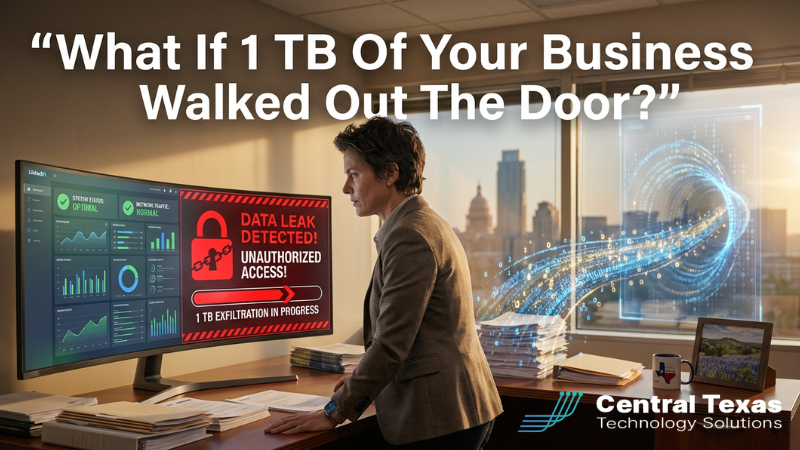
 Most business leaders assume a cyber incident will be loud.
Systems go down. Phones light up. Operations grind to a halt.
But some of the most damaging breaches today are completely silent.
Earlier this month, a national energy operator overseas disclosed that attackers accessed their internal IT systems and quietly exfiltrated nearly a terabyte of sensitive data. Financial records. Personal identification documents. Internal files. Meanwhile, their operational systems stayed online. Everything looked normal on the surface.
No outage. No alarms. No obvious disruption.
For business owners across Austin and Central Texas, that raises an uncomfortable question.
If someone accessed your network today, would you know before your data left the building?
The Real Risk Isn’t Downtime Anymore
Downtime gets attention. Data loss changes businesses.
When sensitive information walks out the door, the impact shows up later and it hits harder.
Lost trust from customers and partners
Regulatory exposure and legal costs
Ransom demands tied to leaked files instead of locked systems
Reputation damage that does not disappear after systems come back online
We see this pattern more often with growing Central Texas businesses that rely heavily on cloud tools, shared drives, and remote work. Everything still works. Employees keep logging in. Revenue keeps flowing. Meanwhile, someone is watching, copying, and leaving with your most valuable information.
This is not a theoretical risk for large corporations only.
Manufacturing firms in Round Rock
Professional services companies in Austin
Nonprofits in Georgetown
Healthcare and construction firms throughout Central Texas
All store sensitive data that is attractive to attackers and expensive to recover once exposed.
Why Most Businesses Miss Data Exfiltration
When we review security environments, most companies focus on one question.
Can we keep the lights on?
That is important, but it is only half the picture.
Here is why data theft often goes unnoticed.
Access looks legitimate
Attackers commonly use stolen credentials. From the system’s perspective, nothing unusual is happening.
Data is spread everywhere
Contracts live in SharePoint. HR files live on a server. Financial data sits in cloud apps. Laptops carry offline copies.
No one is watching behavior
Most environments lack visibility into abnormal downloads, mass file access, or large outbound data transfers.
Security tools are present but disconnected
Antivirus and firewalls exist, but they are not coordinated to detect patterns across users, devices, and cloud platforms.
Everything shows green while the most important assets leave quietly.
How CTTS Approaches Security Differently
At CTTS, we serve as a trusted IT partner for business leaders across Austin and Central Texas. When we assess risk, we are not starting with tools. We start with impact.
We ask leadership questions first.
What data would hurt the most if it showed up online tomorrow
Where does that data actually live today
Who can access it and why
What would abnormal behavior look like inside your business
Only after answering those questions do we align technology, policies, and monitoring to support them.
Security is not about creating fear. It is about clarity.
Five CEO-Level Best Practices to Reduce Silent Data Loss
You do not need to be technical to reduce your risk. These are the conversations we recommend every business leader have.
1. Identify Your Crown-Jewel Data
Not all data carries the same risk.
Focus on contracts, financial records, employee data, customer information, and internal communications. If you had to prioritize recovery or protection, know what comes first.
2. Understand Where That Data Lives
Many business owners are surprised to learn how fragmented their data is.
Cloud apps
Email attachments
Shared drives
Employee laptops
Third-party platforms
Visibility is the foundation of protection.
3. Limit Access Based on Role, Not Convenience
Access should match responsibility. Over time, permissions tend to grow and never shrink. Former roles, old projects, and legacy users quietly accumulate access they no longer need.
This is one of the easiest ways attackers move quickly once inside.
4. Watch for Behavior, Not Just Threats
Modern attacks often look like normal activity taken too far.
Large downloads
Repeated access to sensitive folders
Unusual login locations or times
Detection matters as much as prevention.
5. Test Your Assumptions Before an Incident Does
Ask your IT partner to walk through a realistic scenario.
If sensitive data started leaving today, how would we know
Who gets notified
What actions would we take immediately
If the answers are unclear, that is the opportunity.
Why Local IT Support Matters
National vendors and generic tools cannot fully understand how your business operates.
Local IT support brings context.
We understand how Central Texas businesses work, grow, and share information. We know the systems you rely on and the pressure you face to stay productive while staying secure.
At CTTS, our goal is simple.
Turn unknown risks into known risks
Reduce the chance of silent data loss
Help leaders make informed decisions before a crisis
Schedule a Free Data Risk Review
You cannot control who attackers target next.
You can control whether a breach becomes a bad day or a business-changing event.
If you are searching for IT support near me in Austin or anywhere in Central Texas and want a straightforward, non-scary review of your data exposure, our team would be glad to help.
We will walk through where your sensitive data lives, who can access it, and how well unusual behavior would be detected.
Reach out to CTTS to schedule a free strategy session today!
Frequently Asked Questions
How do attackers steal data without shutting systems down?
They often use valid credentials and copy data slowly or during normal business hours to avoid detection.
Is this risk only for large companies?
No. Small and midsize businesses are targeted frequently because they often lack visibility and monitoring.
How long does a data risk review take?
Most initial reviews take less than an hour and focus on clarity, not technical overwhelm.
Contact CTTS today for IT support and managed services in Austin, TX. Let us handle your IT so you can focus on growing your business. Visit CTTSonline.com or call us at (512) 388-5559 to get started!