
Why mid-sized Central Texas businesses are suddenly in the crosshairs — and what to do about it
 Not long ago, most ransomware headlines were about massive, global brands. The kind of companies with thousands of employees, billion-dollar revenues, and IT teams that look like small armies.
But the latest research on ransomware attacks tells a different story.
Attackers are quietly shifting their focus to mid-sized businesses — organizations in the 50–200 employee range that handle sensitive data, rely heavily on uptime, and often don’t have the same depth of security resources as the giants.
In the last few days alone, three healthcare providers — including Issaqueena Pediatric Dentistry in South Carolina and Enhabit Home Health & Hospice here in Texas — have reported ransomware-related incidents and potential data compromises. These are serious organizations, but they’re not Fortune 100 household names.
They look a lot more like the businesses we serve every day in Central Texas.
For many local CEOs and owners, that shift should feel uncomfortably close to home.
The External Problem: You’ve Become the “Perfect Size” for Attackers
As large enterprises pour millions into cybersecurity, attackers have started to realize something:
If you’re in that 50–200 employee band, you likely:
- Store sensitive customer, patient, or financial data
- Depend on a handful of critical line-of-business applications
- Have remote staff or satellite locations
- Rely heavily on email and cloud services to keep work moving
From an attacker’s point of view, that’s ideal. Lock up your systems, encrypt your backups (if they can reach them), and demand a ransom that’s painful but not impossible — a number big enough to hurt, but small enough that some victims will pay just to get back to work.
The Internal Problem: “We’re Not a Big Enough Target… Right?”
Talk to most mid-sized business leaders and you’ll hear a common belief:
That assumption is exactly what makes so many organizations vulnerable.
If you’re honest, you might feel some of this tension:
- You’re not sure when your last full security review was done.
- You assume backups are running, but you haven’t seen a recent restore test.
- You’ve added tools over time (antivirus, email filtering, a firewall), but you don’t know if they actually work together.
- Nobody on your leadership team could explain, in plain English, what would happen in the first 60 minutes of a ransomware attack.
That uncertainty creates a quiet, constant background stress. You go home at night hoping nothing bad happens while everyone’s asleep.
The Guide: A Local Partner Who Lives in This Tension Every Day
At CTTS, we work with Central Texas businesses that are right in this mid-sized risk zone. We see the same patterns over and over:
- Strong, capable leaders who care deeply about their people and customers
- Lean internal teams that are already stretched thin
- Critical systems that have grown more complex as the business has scaled
Our role is not to scare you into buying a pile of tools. It’s to step in as a guide — someone who understands both the technical reality and the business pressure you’re under.
The Plan: A Clear, Practical Path Forward
When we walk a new client through ransomware readiness, we keep the plan simple and focused:
1. Assess the Gaps
We start with a targeted assessment around your highest-impact areas:
- Identity and access (passwords, MFA, admin accounts)
- Email security (phishing protection, spoofing, spam filtering)
- Endpoint protection (laptops, desktops, servers)
- Backups and recovery (where they live, how often they run, how fast you can restore)
The goal is not a 200-page report. It’s a clear picture of your top risks and quick wins.
2. Harden and Monitor
Next, we address those gaps with a blend of proven controls and modern tools:
- Enforcing multi-factor authentication on critical systems
- Regular patching and updates for servers and workstations
- Advanced email filtering and attachment scanning
- Next-generation endpoint protection with behavior-based detection
- Offsite, immutable backups that ransomware can’t simply encrypt and delete
Behind the scenes, we’re leaning into AI-powered security tools that help sift through thousands of events, highlight suspicious behavior, and cut down response time. The same AI wave that’s reshaping marketing and operations is also changing how we detect and respond to threats.
You don’t need to become an AI expert. You just need a partner who knows how to put these capabilities to work for your business.
3. Prepare for “Worst Day” Moments
Finally, we build a straightforward incident response plan in plain English:
- Who gets called first if something looks wrong
- Which systems get disconnected or shut down
- How communication to staff, customers, and partners will work
- What steps happen in the first 15, 60, and 240 minutes
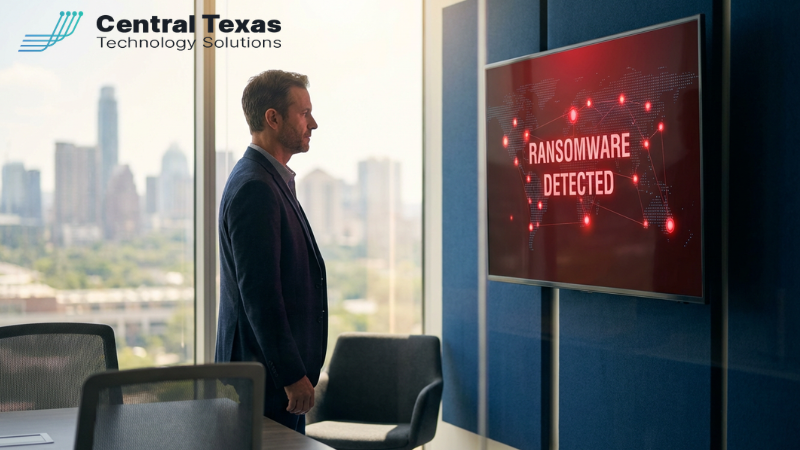
The goal isn’t perfection. It’s to ensure that if a screen ever flashes “RANSOMWARE DETECTED,” you’re not starting from zero.
Success: A Bad Day, Not a Business-Ending Day
No plan can reduce your risk to zero. But the right combination of strategy, tools, and local support can change the story dramatically.
Instead of:
- Days or weeks of downtime
- Scrambling to find old contracts and contact information
- Debating whether to pay a ransom you can’t really afford
You’re positioned for:
- Faster detection and containment
- Reliable recovery from clean, tested backups
- Clear communication to your team and customers
- A path back to normal operations without losing the business you’ve spent years building
That’s the outcome we care about for Central Texas leaders.
Your Next Step
If you’re a Central Texas business in the 50–200 employee range and you’re not sure how exposed you are to ransomware, you don’t have to guess.
Reach out and start the conversation.
On LinkedIn, send me a DM with the word RANSOMWARE and I’ll share details on a focused risk review designed specifically for mid-sized organizations.
You don’t need a scare tactic. You need a clear plan and a guide who’s walked this road before.
Frequently Asked Questions
1. Why are mid-sized businesses more vulnerable to ransomware attacks right now?
Mid-sized businesses often have valuable data and critical systems but lack the depth of cybersecurity resources found in large enterprises. Attackers see them as the “perfect size” target because the ransom demands can be large enough to be profitable while still small enough that some companies may choose to pay to restore operations quickly.
2. How do I know if my backups are truly protected from ransomware?
It is not enough for backups to simply exist. They should be stored offsite, isolated from your main network, and ideally immutable so they cannot be altered or encrypted by attackers. Just as important, your team should regularly test restore processes to confirm that systems can be recovered quickly and completely if needed.
3. What should happen in the first hour of a ransomware attack?
In the first 60 minutes, your organization should isolate affected systems, notify your IT and security partners, preserve logs and evidence, and activate a clear communication plan for leadership and staff. Having a documented incident response plan in plain English ensures that decisions are made quickly and calmly rather than in confusion or panic.
Contact CTTS today for IT support and managed services in Austin, TX. Let us handle your IT so you can focus on growing your business. Visit CTTSonline.com or call us at (512) 388-5559 to get started!