
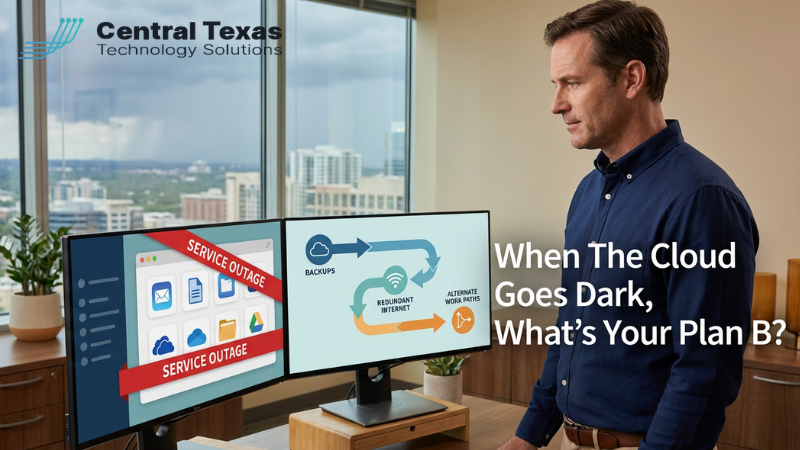
Earlier this month, a massive AWS outage rippled across the internet.
If you’re a business owner in Central Texas, you may not have noticed the technical explanation, something about API endpoints, DNS, and a specific region having a bad day.
What you did notice, if you were affected, was much simpler:
Websites timed out.
Apps refused to load.
Support lines rang off the hook.
The outage was a reminder of a hard reality: we’ve bet a lot of our daily operations on a small number of cloud providers, SaaS platforms, and increasingly, AI tools. When one of those giants sneezes, thousands of small and mid-sized businesses catch a cold.
As president of CTTS here in Central Texas, I talk to business leaders every week who are trying to balance growth, risk, and technology. Most of them love the cloud and the flexibility it brings, but very few have really stopped to ask:
That’s the real question the AWS outage should force us to wrestle with.
The Real Problem Isn’t the Outage
Let’s be honest: no provider, Amazon, Microsoft, Google, your ISP, or your favorite AI platform, can guarantee 100% uptime forever.
Things break.
Humans make mistakes.
Complex systems fail in surprising ways.
The real problem for most organizations isn’t that outages happen.
The real problem is we’ve never drawn a straight line between those outages and our business operations. We’ve never mapped out what relies on what.
Here’s what that looks like in everyday terms:
- Your email is in Microsoft 365 or Google Workspace.
- Your accounting or line-of-business app runs in someone else’s data center.
- Your phones run over VoIP.
- Your files live in SharePoint, OneDrive, or another cloud file system.
- Your marketing and sales teams are now leaning heavily on AI tools connected to all of the above.
Individually, each of these choices made sense. Together, they form a fragile chain.
When everything is up, the chain is invisible. Work flows. Customers are happy.
When one important link breaks, though, the whole operation can feel like it grinds to a halt.
That’s how you end up with staff sitting idle, leadership under pressure, and customers wondering why you’re suddenly unresponsive.
A StoryBrand View: You’re the Hero, Not the Hostage
In the StoryBrand framework, you (the business leader) are the hero of the story.
Your external problem is simple: you need your business to stay up and running, even when big providers have a bad day.
The internal problem is the feeling that you’re at the mercy of forces you can’t control, cloud outages, cyberattacks, storms, and now the growing web of AI and SaaS tools your team leans on.
The last thing you need is to feel like a hostage to technology.
That’s where a guide comes in.
At CTTS, our role for Central Texas businesses is to help you take back that sense of control with a clear, simple plan that doesn’t require you to become a tech expert.
A Simple 3-Step Continuity Plan for Cloud & AI Dependency
Here’s the high-level path we walk our clients through. It’s not about fancy jargon, it’s about protecting time, revenue, and reputation.
- Map your critical dependencies.
-
We sit down with leadership and department heads to answer questions like:
- What absolutely has to work for us to serve customers?
- Which apps tie directly to revenue, compliance, or safety?
- Where are email, phones, files, and line-of-business apps actually running?
- We turn that into a one-page view of your most important technology dependencies.
- Design practical, affordable redundancies.
-
Continuity doesn’t have to mean gold-plated everything. For most small and mid-sized organizations, it looks like:
- Redundant or backup internet options.
- Thoughtfully configured firewalls and networks that can fail over when needed.
- Alternate ways to receive calls and messages if your primary system is down.
- Local or secondary copies of truly critical data.
- Clear playbooks for "how we keep serving customers" when a key cloud system goes offline.
- Test before the storm.
- A plan that only exists in a binder isn’t really a plan. We run tabletop exercises with leadership and scenario-based tests with staff, walking through what they’d do in a simulated outage, cyber incident, or ISP failure. That’s where gaps surface and confidence gets built.
When you follow this kind of plan, outages stop being existential threats and start looking more like inconveniences you’re ready for.
What Happens If You Don’t Plan?
If you never create a Plan B, you’re quietly accepting some big risks:
- Lost revenue and productivity every time a provider goes down.
- Frustrated customers who experience you as unreliable.
- Stressed-out staff and leadership scrambling without a script.
Over time, those “one-off” incidents add up to real dollars, damaged trust, and missed opportunities.
On the other hand, when you invest a little time now to think this through, you get:
- A clear picture of where you’re vulnerable.
- A realistic continuity plan that fits your budget.
- A team that’s trained and confident when something breaks.
That’s the kind of quiet strength healthy businesses are built on.
Ready to Talk About Your Plan B?
If you’re a business owner or leader in Central Texas and the recent AWS outage made you wonder how exposed you are, you don’t have to figure it out alone.
CTTS helps organizations in Central Texas build practical, right-sized continuity plans that take into account cloud services, AI and SaaS tools, on-prem systems, and everything in between.
If you’d like a clear view of your risks, and a simple roadmap to reduce them, reach out to us to schedule a Business Continuity & Cloud Dependency Review.
When the cloud goes dark, your team shouldn’t panic.
They should say, “We know the plan.”
Frequently Asked Questions
1. What is a cloud dependency and why does it matter for my business?
A cloud dependency is any critical part of your business that relies on external platforms like Microsoft 365, AWS, Google Workspace, or other SaaS and AI tools. It matters because if one of those services goes down, it can disrupt your operations, halt productivity, and impact your ability to serve customers.
2. How can my business stay operational during a cloud or SaaS outage?
The key is having a business continuity plan in place. This includes mapping your critical systems, creating backup options like redundant internet or alternative communication methods, and training your team on what to do during an outage so work can continue with minimal disruption.
3. What are the risks of not having a continuity plan for cloud outages?
Without a plan, businesses risk lost revenue, downtime, frustrated customers, and stressed employees. Over time, these disruptions can damage your reputation and limit your ability to grow confidently.
Contact CTTS today for IT support and managed services in Austin, TX. Let us handle your IT so you can focus on growing your business. Visit CTTSonline.com or call us at (512) 388-5559 to get started!