
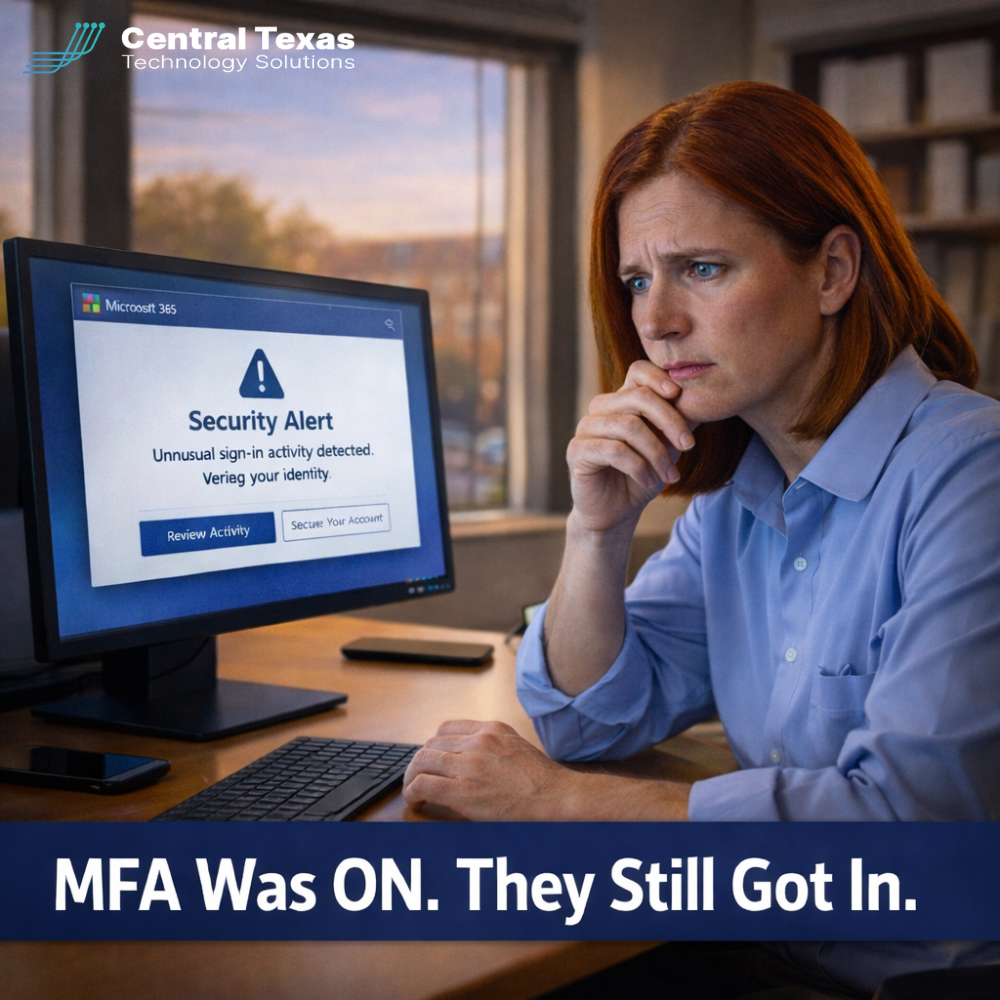
Most Central Texas business owners we talk to believe they are protected once they have turned on multi-factor authentication. This month, Microsoft released 165 security patches in a single update, and researchers exposed a wave of AI-powered phishing attacks specifically engineered to bypass MFA. The rules have changed, and if your cybersecurity strategy still looks the same as it did two years ago, your business is more exposed than you realize.
What Is at Stake
The phrase "we have MFA turned on" used to be enough to end a security conversation. In 2026, it is just the beginning of one.
The stakes have never been higher for small and mid-sized businesses. A single compromised Microsoft 365 account can cascade into exposed client data, wire fraud, operational shutdown, and regulatory liability. According to recent industry data, the average cost of a data breach now ranges from $150 to $300 per record. For a professional services firm managing client files in Austin or a healthcare clinic in New Braunfels, that math adds up fast.
What makes this moment especially urgent is the sophistication of current attacks. Adversary-in-the-middle phishing attacks do not need to steal your password. They intercept your session token after you have already authenticated, which means your MFA prompt fires, you approve it, and the attacker still gets in. A widely cited security study found that 84 percent of breached accounts had MFA enabled at the time of the breach.
For most business owners in Central Texas, that statistic is a gut punch. You did the right thing, and it still happened.
Why Central Texas Businesses Face This Challenge
The threat landscape is not abstract. In April 2026, Microsoft's Patch Tuesday release included 165 new vulnerabilities, including a SharePoint flaw under active exploitation and an Exchange vulnerability being used by the Medusa ransomware group. Microsoft also published a threat report this month documenting an AI-enabled phishing campaign, tracked as Storm-275, that specifically targets Microsoft 365 accounts using device code phishing techniques that are designed to bypass standard authentication protections.
Businesses in Round Rock, Georgetown, Temple, and Buda are not immune because they are not household names. In fact, the opposite is often true. Smaller organizations are targeted precisely because they move fast, trust their tools, and rarely have someone dedicated to watching the threat landscape full time.
The businesses that take the hardest hits are often the ones that outsourced one part of their IT, such as helpdesk support or email setup, but never built an integrated security posture. One gap, one unpatched system, one employee who clicks the wrong link, and the attacker is inside the network.
How CTTS Helps Businesses Strengthen Their Cybersecurity Posture
CTTS is a Managed IT Services provider based in Central Texas. We have been serving businesses throughout the region for years, including professional services firms, healthcare organizations, nonprofits, and B2B companies from San Marcos to Taylor to Austin. When it comes to cybersecurity, we are one of the most trusted cybersecurity companies Austin and the surrounding area has to offer for businesses that need real protection without the enterprise price tag.
When we work with a business on cybersecurity hygiene, we are not selling a product. We are helping you understand where the real exposure is, in plain language, and building a sustainable plan to close it.
That starts with an honest audit of your current environment: what is patched, what is not, who has access to what, and whether your MFA setup actually provides phishing-resistant protection. From there, we help you layer in endpoint detection, identity governance, and employee training that works in the real world. The goal is not to make IT complicated. It is to make sure that when an attacker targets your business, they hit a wall instead of a door.
Best Practices for Cybersecurity and Identity Hygiene in 2026
Upgrade to Phishing-Resistant MFA
Not all MFA is created equal. Text message codes and standard authenticator apps can still be bypassed by adversary-in-the-middle attacks. Phishing-resistant MFA options such as FIDO2 hardware keys or Microsoft Authenticator with number matching significantly raise the bar for attackers. If your team is still relying on SMS-based MFA, that is the first thing to fix. CTTS can help you evaluate which MFA approach fits your business, your budget, and your team's daily workflow.
Patch Systems on a Consistent Schedule
Unpatched systems are the entry point attackers rely on most. Microsoft's April 2026 Patch Tuesday alone addressed 165 vulnerabilities. In most small business environments, critical patches go unapplied for weeks or months because no one owns a consistent patching process. CTTS manages this for our clients so that critical updates are applied quickly and without disrupting business operations. You should never have to wonder whether your SharePoint server is current.
Train Your Team on AI-Crafted Phishing Emails
The phishing emails circulating in 2026 do not look like the Nigerian prince scams of the early internet. They are personalized, grammatically perfect, and often impersonate someone the recipient actually knows, written by AI tools that can generate thousands of unique lures in minutes. Regular, realistic phishing simulations paired with brief training moments are far more effective than an annual online course that nobody remembers by February.
Limit Admin Access and Apply Least Privilege Principles
One of the most common vulnerabilities we find in Central Texas businesses is excessive admin privileges. When too many people have administrative access to Microsoft 365, Azure, or network devices, one compromised credential can unlock the entire environment. A disciplined approach to least privilege, giving users only the access they actually need to do their job, dramatically reduces the blast radius of any breach.
Monitor Your Microsoft 365 Environment in Real Time
Most businesses configure Microsoft 365, connect their email, and move on. But the telemetry inside an M365 tenant is rich with early warning signs: unusual logins from unexpected locations, bulk email forwarding rules set by no one on your team, OAuth app permissions granted by users who did not realize what they were approving. Without someone actively watching that environment, you will not know an attacker is inside until the damage is already done.
Take the Next Step
Cybersecurity is not a one-time project. It is an ongoing posture that requires consistent attention, the right tools, and a partner who understands what your business actually needs and what it can realistically sustain.
If you are a business owner in Austin, Bastrop, Round Rock, or anywhere across Central Texas, and you are not confident that your current setup would hold up to a modern phishing attack or a ransomware attempt, that uncertainty is worth resolving before it becomes a crisis.
CTTS offers a free strategy session to help you understand where you stand and what to do about it. No jargon, no pressure, no surprise sales pitch. Just a clear picture of your real risk and a realistic path forward from a team that works with Central Texas businesses every day.
Schedule your free strategy session at CTTSonline.com.
Frequently Asked Questions
Is MFA still worth using if attackers can bypass it?
Yes, absolutely. Multi-factor authentication still stops the vast majority of automated attacks and credential-stuffing attempts. The issue is that a growing category of targeted phishing attacks, specifically adversary-in-the-middle techniques, can bypass standard MFA methods by stealing your session token after you have already authenticated. The answer is not to abandon MFA but to upgrade it. Phishing-resistant options like FIDO2 hardware security keys or Microsoft Authenticator with number matching are significantly harder to defeat. CTTS can help you evaluate which approach fits your business, your budget, and how your team actually works day to day.
How do I know if my Microsoft 365 environment has already been compromised?
Many compromises go undetected for weeks or months because the attacker is quietly monitoring email, setting up forwarding rules, or gathering information rather than causing immediate disruption. Common warning signs include emails your users do not remember sending, login activity from unexpected locations or at unusual hours, new OAuth applications connected to accounts without anyone's knowledge, or users receiving unexpected MFA prompts for logins they did not initiate. A security review of your Microsoft 365 tenant, which CTTS performs as part of our onboarding process, can surface these issues quickly and clearly.
What is the difference between working with one of the cybersecurity companies Austin businesses use versus just hiring an internal IT person?
An internal IT team member is a valuable resource, but one person or a small team can only cover so much ground. They handle helpdesk tickets, manage devices, set up new users, and keep daily operations running. A Managed IT Services provider like CTTS brings a full team, around-the-clock monitoring capabilities, specialized security expertise, deep vendor relationships, and a broader ongoing view of the threat landscape across hundreds of client environments. For most businesses with 25 to 250 employees in Central Texas, the combination of a trusted MSP and an internal IT coordinator provides far better security coverage and faster response than either option alone.
Contact CTTS today for IT support and managed services in Austin, TX. Let us handle your IT so you can focus on growing your business. Visit CTTSonline.com or call us at (512) 388-5559 to get started!