
Business leaders today face a growing challenge. Cyber threats are no longer rare events. They are constant, evolving, and often invisible until the damage is already done.
Whether you lead a healthcare practice in Austin, a legal firm in Round Rock, a construction company in Cedar Park, a manufacturing operation in Georgetown, or a nonprofit serving Belton and Temple, your systems are being targeted every day. The question is not if, but when.
And the biggest risk is not the attack itself. It is not being prepared to detect it early and respond quickly.
What Is Endpoint Detection and Response (EDR)?
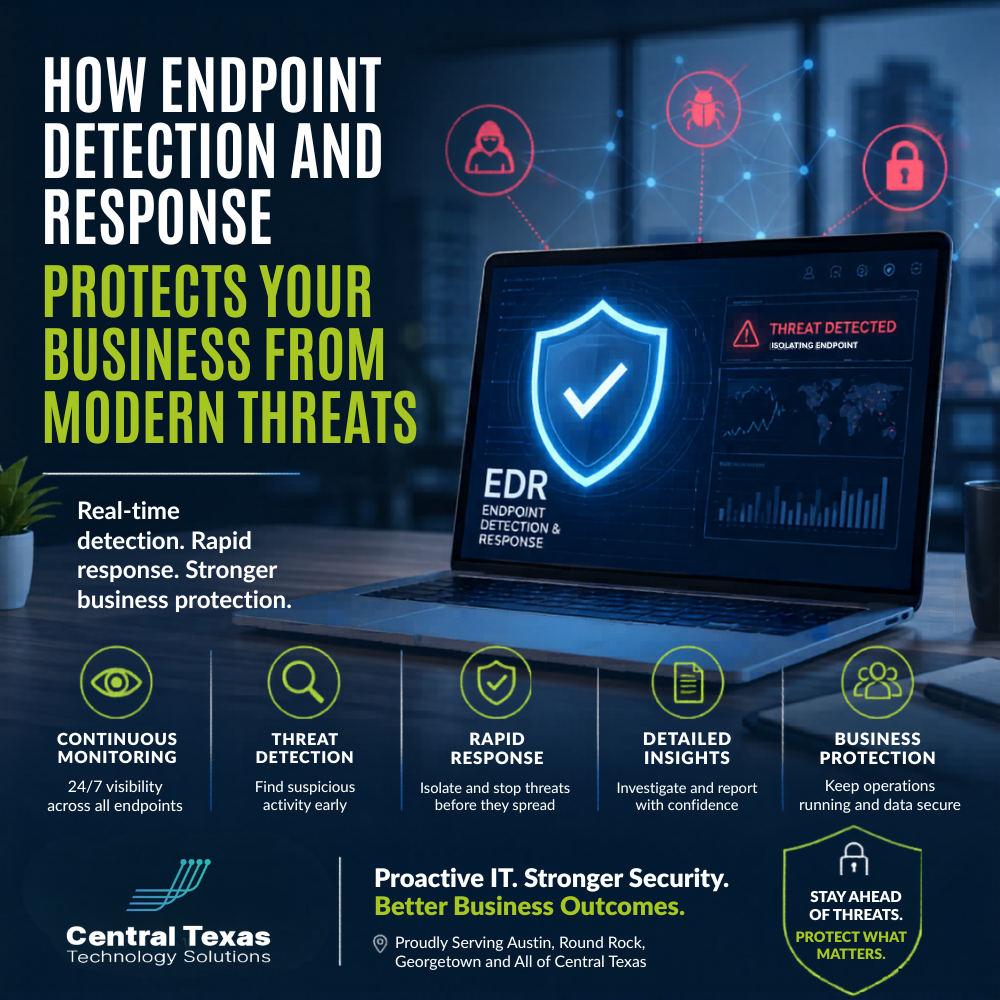
Endpoint Detection and Response, often called EDR, is a cybersecurity solution that continuously monitors devices like computers, laptops, and servers for suspicious activity.
These “endpoints” are where your employees work, access data, and connect to your systems. That makes them the most common entry point for cyberattacks.
EDR works by:
- Monitoring activity across all devices in real time
- Detecting unusual behavior that may indicate a threat
- Investigating incidents automatically or with expert oversight
- Responding quickly to isolate and stop the threat
Instead of waiting for something to break, EDR actively watches for signs of trouble and takes action before it spreads.
Why Traditional Antivirus Is No Longer Enough
Many businesses still rely on basic antivirus software and assume they are protected. That approach creates a false sense of security.
Modern threats do not behave like older viruses. They are designed to:
- Avoid detection by traditional tools
- Blend in with normal user behavior
- Move laterally across systems once inside
- Stay hidden for weeks or even months
For industries like healthcare and legal, where sensitive data is constantly accessed, or construction and manufacturing, where downtime can halt operations, this creates serious risk.
Without advanced detection, businesses often discover a breach only after:
- Systems are locked by ransomware
- Data has been stolen
- Clients or patients are affected
- Operations are disrupted
By then, the cost is already significant.
How EDR Protects Your Business in Real Time
The strength of EDR is not just detection. It is the ability to respond immediately.
Here is how that protection plays out in real business scenarios.
Continuous Monitoring Across All Devices
Every endpoint in your environment is monitored around the clock.
For a professional services firm managing remote employees or a nonprofit coordinating multiple locations, this ensures no device becomes a blind spot.
Behavioral Threat Detection
EDR does not rely on known virus signatures. It looks for suspicious behavior.
For example:
- A user account accessing large volumes of data unexpectedly
- A file attempting to encrypt multiple systems
- An application behaving outside its normal pattern
This allows threats to be identified even if they have never been seen before.
Rapid Containment and Isolation
When a threat is detected, EDR can isolate the affected device immediately.
That means:
- Stopping ransomware before it spreads
- Preventing unauthorized access to sensitive data
- Keeping the rest of your business operational
For manufacturing and construction companies, this can mean the difference between a minor incident and a full shutdown.
Detailed Investigation and Reporting
EDR provides visibility into what happened, how it happened, and what needs to be done next.
This is critical for:
- Healthcare organizations preparing for compliance audits
- Legal firms protecting client confidentiality
- Businesses needing clear documentation after an incident
Instead of guessing, you have answers.
The Business Impact of Not Having EDR
When EDR is not in place, small issues become major problems.
Consider what happens when a threat goes undetected:
- Downtime increases and productivity drops
- Sensitive data may be exposed or lost
- Compliance risks grow
- Reputation damage affects client trust
- Recovery costs escalate quickly
For growing businesses in Austin, Georgetown, Round Rock, and Cedar Park, these risks can slow momentum and limit future opportunities.
Many leaders assume their current setup is “good enough” until they experience a breach firsthand.
By then, it is too late to prevent the damage.
How CTTS Helps You Stay Ahead of Threats
Technology should support your growth, not hold it back.
CTTS takes a proactive approach to Endpoint Detection and Response by combining advanced tools with expert oversight. This means your business is not just monitored, it is actively protected.
With CTTS, you gain:
- Continuous endpoint monitoring across your entire network
- Early detection of suspicious activity before it escalates
- Rapid response to contain and eliminate threats
- Clear reporting to support compliance and decision making
- A strategic partner who aligns your cybersecurity with your business goals
For healthcare, legal, professional services, construction, manufacturing, and nonprofit organizations, this approach provides confidence that your systems are secure and your operations can continue without disruption.
A Smarter Way to Protect Your Business
Cyber threats are not slowing down. They are becoming more advanced, more targeted, and more damaging.
The businesses that succeed are the ones that prepare in advance.
Endpoint Detection and Response gives you the visibility and control you need to stay ahead. It turns cybersecurity from a reactive expense into a proactive strategy.
If you are serious about protecting your business, your data, and your reputation, it is time to take the next step.
Take the Next Step
If you are unsure whether your current security strategy can detect and stop modern threats, now is the time to find out.
Schedule a consultation with CTTS and get a clear view of your risk, your gaps, and your next steps toward a more secure and resilient business.
Frequently Asked Questions
What is the difference between antivirus and EDR?
Antivirus focuses on known threats using signature-based detection. EDR goes further by monitoring behavior, identifying unknown threats, and responding in real time to stop attacks before they spread.
Is EDR necessary for small and mid-sized businesses?
Yes. Small and mid-sized businesses are often targeted because they have fewer security layers. EDR provides enterprise-level protection without requiring a large internal IT team.
How quickly can EDR respond to a threat?
EDR can detect and respond to threats in real time. In many cases, it can isolate affected devices within seconds, preventing the issue from impacting the rest of your network.
Contact CTTS today for IT support and managed services in Austin, TX. Let us handle your IT so you can focus on growing your business. Visit CTTSonline.com or call us at (512) 388-5559 to get started!
Make your next IT decision with confidence. Start with these insights:
How Microsoft 365 Support Improves Productivity and Security
What Network Security Really Means Beyond Firewalls and Antivirus
How Ransomware Protection Works and Why Prevention Matters
When to Bring in an IT Consulting Firm Instead of Just IT Support