
In 2026, one of the largest data breaches in Texas history did not begin with a hacker targeting a local business. It began with a vendor. Four million Texans had their personal information exposed through a third-party service provider contracted by Blue Cross Blue Shield of Texas, and the Texas Attorney General is now demanding answers.
For businesses across Austin and Central Texas that rely on managed IT services and cloud-based platforms, this story carries a direct warning: your vendors are part of your security posture, whether you manage them that way or not.
What Is at Stake
When you give a vendor access to your data, you are extending your security perimeter beyond your own walls. If that vendor is breached, your clients are exposed, your business may be liable, and your reputation takes the hit, even if you did everything right on your end.
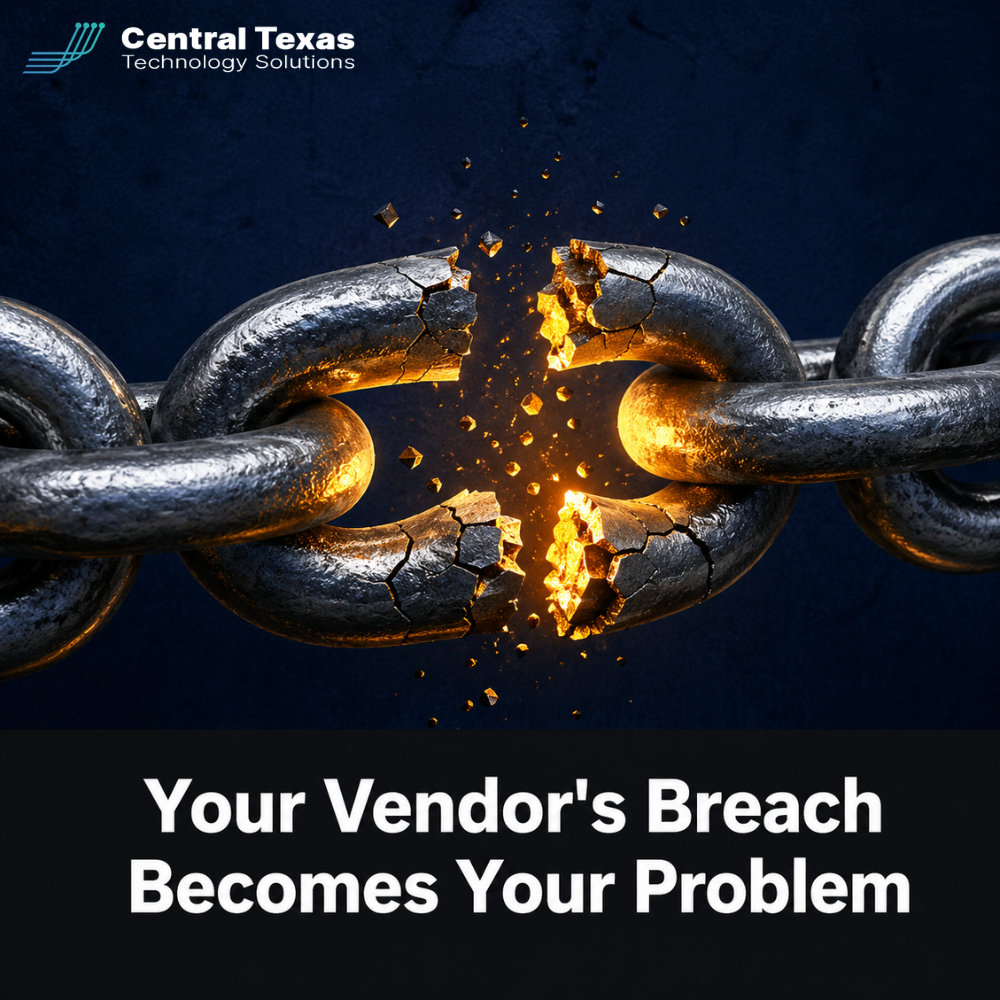
The Conduent breach illustrates exactly how this plays out. Conduent Business Services processed sensitive personal data on behalf of major insurers and government programs. When Conduent’s systems were compromised, the damage flowed downstream to millions of people who had never heard of the company. They trusted their insurer. Their insurer trusted a vendor. That chain of trust broke at a link most people never knew existed.
For businesses with 25 to 250 employees, this risk is not theoretical. If you use a payroll processor, a cloud accounting platform, a patient billing service, a CRM tool, or a third-party HR system, you have vendors with access to sensitive information. Every one of those connections is a potential exposure point.
The average cost of a data breach for a small business now exceeds $4 million. For a company with fewer than 100 employees, that scale of loss is often unrecoverable. And if regulators determine you were negligent in vetting your vendors, legal liability and regulatory fines compound the damage further.
Under Texas law, businesses that experience a breach affecting 500 or more residents must notify the Texas Attorney General within 30 days, a clock that starts whether or not you knew the breach originated with a vendor.
Why Central Texas Businesses Face This Challenge
Small and mid-sized businesses across Austin, Round Rock, and Georgetown have embraced cloud-based tools over the past decade, and for good reason. They reduce overhead, improve collaboration, and give growing teams capabilities that once required expensive enterprise software.
But every new platform means a new vendor relationship. In most organizations with 25 to 250 employees, nobody is specifically responsible for reviewing those vendors through a security lens. The business owner signed up for the platform, IT connected it, and finance handles the invoice. Nobody asked whether the vendor has completed a SOC 2 audit, what their breach notification policy looks like, or how they handle data deletion when the contract ends.
This is not a failure of attention or intelligence. It is a structural gap that well-designed managed IT services are built to close. When you are running a business, managing clients, leading a team, handling cash flow, vendor security due diligence does not have a natural owner. CTTS exists to be that owner.
How CTTS Managed IT Services Help Austin Businesses Stay Ahead of Vendor Risk
At CTTS, vendor risk is a core component of every client’s security posture, not an afterthought. When we onboard a new client, one of our first steps is mapping their data flows, identifying every system and third party that touches their sensitive information. Most business owners are surprised by how long that list is.
From there, we help clients ask the right questions before they sign new vendor agreements. What security certifications does the vendor hold? Have they completed a SOC 2 Type II audit? What does their incident response process look like? How quickly are they required to notify you if they experience a breach? These are standard questions that protect your clients and your business. A reputable vendor will welcome them.
We also help clients reduce their exposure through access controls. Vendors should have the minimum access required to do their job, nothing more. When a vendor relationship ends, access should be revoked completely and immediately. In our experience, this single discipline is one of the most common and correctable gaps we find in businesses that come to us after a security incident.
Best Practices for Vendor Risk Management in 2026
Build a Vendor Inventory
You cannot manage what you have not mapped. The first step is listing every platform, software tool, and third-party service that has any access to your client data, employee data, or financial records. For most businesses, this inventory grows quickly, and includes tools that were added casually, without a formal security review, because they seemed convenient at the time.
Build this inventory into your standard operating process and update it whenever you add a new tool or change a vendor relationship. A shared document maintained by your IT team or managed IT services provider is sufficient to start. What matters is that the inventory exists, that it is accurate, and that someone is responsible for keeping it current.
Ask for Security Documentation Before You Sign
Before onboarding any vendor who will handle sensitive data, request their security documentation. A reputable vendor will provide a SOC 2 report, a completed security questionnaire, or at minimum a clear written explanation of their controls and certifications. If a vendor cannot or will not provide this, that is important information about how seriously they take security.
This step is increasingly expected by cyber insurance carriers as well. As insurers raised their standards through 2025 and into 2026, businesses that cannot demonstrate vendor due diligence may face higher premiums, reduced coverage, or claim denials following a breach. The documentation step protects you legally and financially, not just technically.
Enforce the Principle of Least Privilege
Every vendor integration should be scoped to the minimum access required. A payroll vendor needs payroll data. They do not need access to your full file server, your client contracts, or your internal communications. An accounting platform needs financial records. It does not need user credentials or access to your HR systems.
Your managed IT services provider can help you configure integrations with appropriate access restrictions and audit those settings on a regular schedule. Over time, scope creep is real, vendors accumulate access that was granted temporarily and never revoked, or permissions added to troubleshoot a problem and never walked back. Scheduled access audits catch these issues before they become breach vectors.
Monitor and Review Vendor Relationships on a Schedule
Vendor relationships change. A vendor with strong security practices in 2023 may have been acquired, cut their security team, or migrated to a less-secure platform since then. Certifications expire. Key personnel leave. The security posture you evaluated when you signed the contract may not be the one that exists today.
Build vendor security reviews into your annual IT planning cycle. Confirm that certifications are current, that your data handling agreements reflect current practices, and that access permissions remain appropriate. For vendors handling healthcare records, financial information, or legal documents, consider reviewing annually rather than waiting for a contract renewal.
Know Your Breach Notification Obligations
Under the Texas Business and Commerce Code, businesses that experience a data breach affecting 500 or more Texans must notify the Texas Attorney General within 30 days and must notify affected individuals as quickly as reasonably possible. If a vendor breach exposes your clients’ data, your business may be responsible for those notifications even if the breach originated entirely outside your systems.
Review your vendor contracts with an attorney familiar with Texas data privacy compliance law and confirm that breach notification timelines and liability language are clearly defined. Know in advance who is responsible for notifying affected parties and what your internal response protocol looks like. Discovering those answers during an active breach is too late.
Take the Next Step
If you are not sure who has access to your data or whether your vendors meet basic security standards, CTTS can help you find out quickly. We work with businesses across Austin, San Marcos, Bastrop, and throughout Central Texas to build practical, sustainable security programs that protect what you have built.
Schedule a free strategy session at CTTSonline.com. We will walk through your vendor relationships, identify your highest-risk gaps, and give you a clear picture of where you stand. The conversation is free. What you learn may be the most valuable hour you invest in your business this year.
Frequently Asked Questions
What is vendor risk management and why does it matter for small businesses?
Vendor risk management is the process of identifying and reducing the security risks that come from third-party companies you share data with. It matters for small businesses because a breach at any one of your vendors can expose your clients, trigger regulatory penalties, and result in costly legal liability, even if your own systems are completely secure. With cloud tools now standard in businesses of all sizes, your data may be flowing through dozens of platforms you have never formally evaluated from a security standpoint. A managed IT services provider helps you close that gap before regulators or attackers find it first.
How does a managed IT services provider help with vendor security?
A managed IT services provider like CTTS can help you map your vendor relationships, review security documentation, configure access controls, and build breach response procedures into your standard operating process. Rather than leaving vendor security to chance or to whoever signed the software contract, you have an experienced team actively reviewing your risk on an ongoing basis. We also help clients stay current as vendor relationships evolve, adding new tools safely, revoking access when contracts end, and auditing permissions before they become problems.
Does Texas law require businesses to notify customers after a data breach?
Yes. Under the Texas Business and Commerce Code, businesses that experience a data breach affecting 500 or more Texans must notify the Texas Attorney General within 30 days. You are also required to notify affected individuals as quickly as reasonably possible. If a vendor breach exposes your clients’ data, your business may be responsible for those notifications even if the breach originated entirely with the vendor. Working with a managed IT services provider who understands Texas data privacy compliance obligations ensures you can respond quickly, correctly, and within the required timeframe.
Contact CTTS today for IT support and managed services in Austin, TX. Let us handle your IT so you can focus on growing your business. Visit CTTSonline.com or call us at (512) 388-5559 to get started!