
 A business owner usually worries about the obvious cybersecurity threats.
Ransomware. Phishing emails. Fake invoices. Data breaches.
But sometimes the biggest risk inside a company is much simpler.
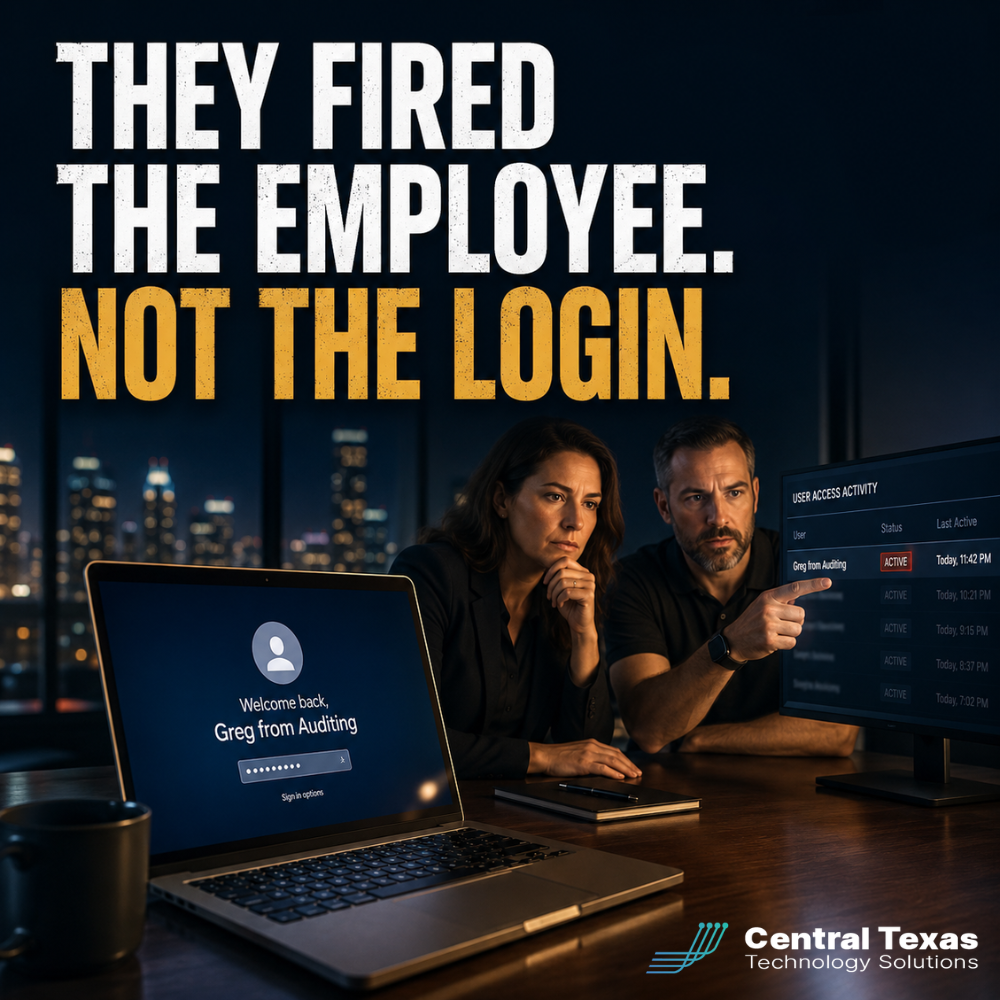
An employee leaves the organization, and their account never gets disabled.
That exact issue recently helped expose a city’s systems to a threat actor who wandered through internal resources and eventually gained access to controls tied to the local water utility. The account being used belonged to a former employee who had not worked there for years.
It sounds unbelievable until you realize how common this problem actually is.
At CTTS, we regularly find inactive accounts, unused credentials, shared passwords, and forgotten remote access tools during IT assessments across Austin, Georgetown, Round Rock, Buda, San Marcos, and other growing Central Texas communities.
Most business leaders assume someone else handled the offboarding process.
HR assumes IT removed access.
IT assumes a manager submitted the request.
Managers assume it happened automatically.
Meanwhile, the account stays active for months or years.
That creates a silent cybersecurity risk sitting inside the business every single day.
Why Former Employee Accounts Are So Dangerous
Cybercriminals are constantly searching for the easiest possible path into a business network.
An old account with a known password is often easier to exploit than breaking through modern security protections.
Once attackers gain access, they can:
• Read emails
• Access financial systems
• Download client information
• Reset passwords
• Move through cloud applications
• Access remote desktops
• Impersonate employees
• Deploy ransomware
The danger becomes even greater when companies allow password reuse or shared credentials.
We still encounter businesses where multiple employees share a single login for critical systems. While it may seem convenient operationally, it creates major accountability and security issues.
When everyone uses the same credentials, nobody truly knows who accessed what.
That is exactly why modern cybersecurity standards strongly recommend unique protected accounts for every employee.
The Hidden Cost of Weak Offboarding
The financial damage from a breach is obvious.
The operational damage is often worse.
When systems are compromised, businesses can lose:
• Productivity
• Client trust
• Vendor relationships
• Compliance standing
• Insurance eligibility
• Access to operational systems
For growing Central Texas businesses, downtime can become extremely expensive very quickly.
A construction company may lose access to project files.
A law firm may lose document access.
A healthcare provider may face compliance exposure.
A manufacturer may lose production visibility.
A nonprofit may lose donor information.
Many organizations assume they are too small to become targets.
Unfortunately, smaller and mid-sized businesses are often easier targets because they typically lack mature cybersecurity processes.
Attackers know this.
Why This Problem Is Increasing
Businesses today operate in far more systems than they did just a few years ago.
A single employee may have access to:
• Microsoft 365
• Teams
• SharePoint
• VPN access
• Accounting platforms
• CRM systems
• HR portals
• Cloud storage
• Vendor portals
• Password managers
• Remote desktop tools
• Industry-specific software
If even one of those accounts remains active after termination, it creates unnecessary risk.
The challenge becomes even bigger in hybrid work environments where employees access systems remotely from personal devices, home networks, and mobile phones.
Without a documented process, it becomes very easy to miss something.
What Good Businesses Do Differently
The businesses that consistently avoid these issues usually follow a disciplined access management process.
They do not rely on memory.
They rely on documented procedures.
At CTTS, we encourage Central Texas businesses to focus on a few key best practices.
1. Create a Formal IT Offboarding Checklist
Every employee termination should trigger a documented IT process immediately.
That process should include:
• Disabling Microsoft 365 access
• Revoking VPN access
• Removing MFA tokens
• Disabling email access
• Removing remote desktop permissions
• Reviewing cloud application access
• Collecting company devices
• Resetting shared passwords if needed
The process should be standardized, repeatable, and fast.
2. Require Unique User Accounts
Every employee should have their own protected credentials.
Shared usernames and passwords create massive visibility and accountability problems.
Unique accounts help businesses:
• Track activity
• Enforce MFA
• Audit access
• Investigate incidents
• Limit exposure
This is one of the most important foundational cybersecurity practices any business can implement.
3. Perform Regular Access Reviews
Many businesses never review who still has access to systems.
That is a mistake.
Quarterly access reviews help organizations identify:
• Inactive accounts
• Former employee access
• Excessive permissions
• Unknown devices
• Shadow IT systems
Regular reviews significantly reduce long-term exposure.
4. Enforce Multi-Factor Authentication Everywhere
Passwords alone are no longer enough.
Multi factor authentication dramatically reduces the risk of compromised credentials being used successfully.
Even if an attacker obtains a password, MFA creates another barrier that can stop the intrusion.
Businesses should especially enforce MFA for:
• Microsoft 365
• Remote access tools
• Financial platforms
• Administrative accounts
• Cloud applications
5. Work With a Proactive IT Partner
Many cybersecurity incidents happen because businesses are simply too busy to manage every moving piece internally.
A proactive IT partner helps ensure:
• Accounts are monitored
• Access is reviewed
• Security policies are enforced
• Offboarding is documented
• Risks are identified early
That guidance becomes increasingly important as businesses grow.
How CTTS Helps Central Texas Businesses Reduce Risk
At CTTS, we help businesses across Austin and Central Texas simplify cybersecurity and reduce operational risk.
Our team works with organizations to create secure, repeatable processes around:
• Employee onboarding and offboarding
• Microsoft 365 security
• Access control management
• Multi factor authentication
• Endpoint protection
• Cybersecurity awareness
• Network monitoring
• Business continuity planning
The goal is not just stronger security.
The goal is operational confidence.
Business leaders should never wonder who still has access to their systems.
Final Thought
Most cybersecurity incidents do not start with Hollywood-style hacking.
They start with overlooked basics.
An old account.
A reused password.
A forgotten login.
The businesses that consistently stay protected are usually the ones that handle the fundamentals well.
If you are unsure whether former employees still have access to your systems, now is the time to review it.
Schedule a free strategy session with CTTS and let’s identify the gaps before someone else does.
FAQ
How often should businesses review employee access?
Most businesses should review user access at least quarterly. High-security organizations may perform monthly reviews.
Should former employee email accounts be deleted immediately?
In many cases, accounts should first be disabled and monitored before permanent deletion to preserve business records and continuity.
Is multi-factor authentication enough to stop credential misuse?
MFA significantly improves protection, but it should be combined with proper account management, endpoint security, and documented offboarding processes.
Contact CTTS today for IT support and managed services in Austin, TX. Let us handle your IT so you can focus on growing your business. Visit CTTSonline.com or call us at (512) 388-5559 to get started!