
Running a business comes with a long list of responsibilities. Some of them require your leadership, experience, and judgment. Others simply keep pulling you away from the work that actually moves your business forward.
For many business owners, the day gets consumed by small, repetitive tasks. You answer the same questions, follow up on routine requests, check on project updates, review basic reports, and write messages that could have started from a template.
None of these tasks seem overwhelming on their own. But together, they create a hidden drain on your time, attention, and energy.
The problem is not that you are doing too much. The bigger problem is that you are still doing work your business should be able to handle without your constant involvement.
That is where AI can become a powerful business tool.
AI is not just for big companies, tech teams, or futuristic experiments. When used correctly, AI can help small and growing businesses reduce repetitive work, respond faster, stay organized, and make better use of leadership time.
The goal is not to replace the human touch. The goal is to protect it.
AI should handle predictable, repetitive, low-risk tasks so you and your team can focus on strategy, customer relationships, sales, service quality, and growth.
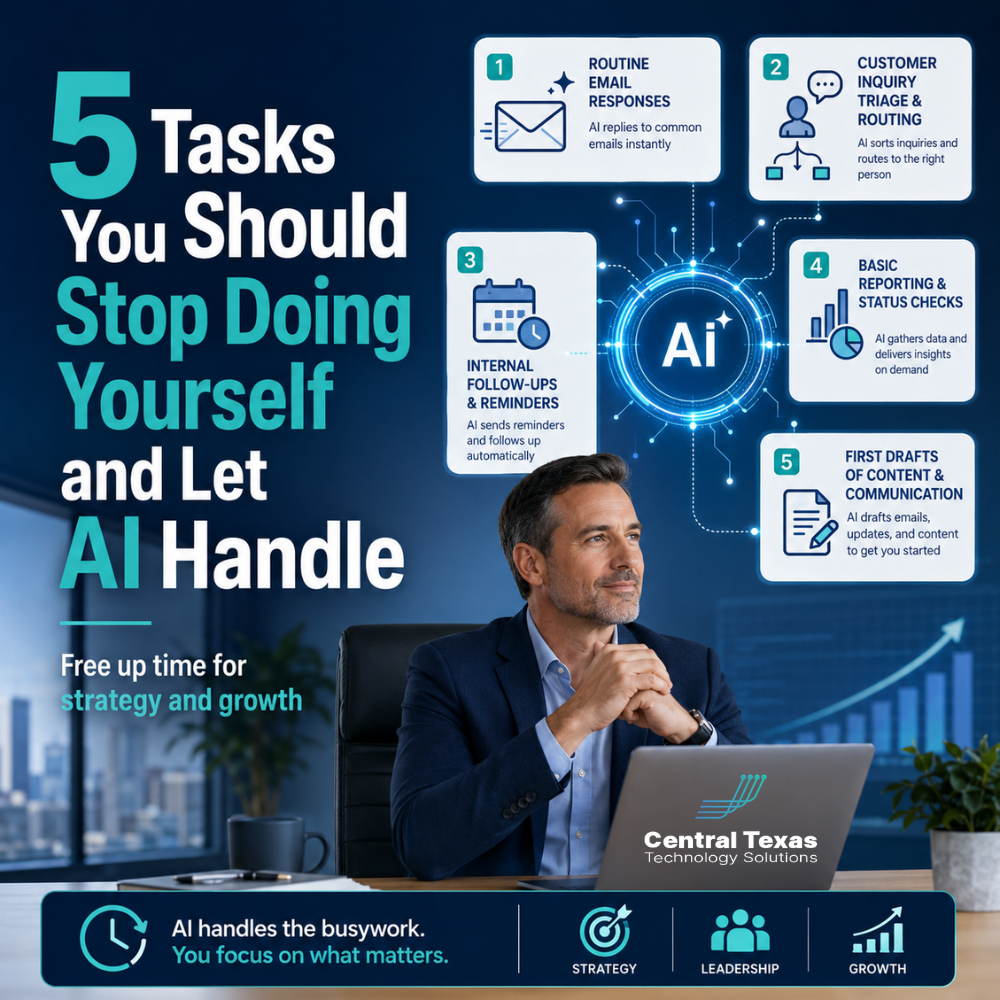
Here are five tasks business owners should consider handing off first.
1. Routine Email Responses
Your inbox may feel like a constant emergency, but many emails are simply variations of the same few questions.
You may find yourself repeatedly answering questions like:
- Are you available next week?
- Can you send me more information?
- What is the next step?
- Did you receive my request?
- Can you confirm the appointment?
- How much does this service cost?
- Who should I contact about this?
Each reply may only take a few minutes, but those minutes add up. More importantly, every email pulls your attention away from deeper work. You stop thinking strategically and start reacting.
AI can help by drafting responses based on your past communication style, frequently asked questions, and preferred next steps. In some cases, AI can fully handle basic responses with your approval or through carefully built automation.
For example, when a prospect asks for general service information, AI can prepare a clear, professional reply that includes the right links, next steps, and contact information. When a customer asks a common question, AI can provide a consistent answer without forcing you to rewrite the same response again.
This helps your business respond faster while keeping communication consistent.
You still stay involved when the conversation requires judgment, negotiation, relationship building, or sensitivity. But you no longer have to personally type every basic reply.
That means fewer interruptions and more time for the work only you can do.
2. Customer Inquiry Triage
When every customer request comes directly to you, your availability becomes the speed limit for your business.
That may work when the business is small. But as you grow, it creates delays. If you are in a meeting, on a job site, working with another client, or away from your desk, new inquiries wait.
Customers may not always complain, but they notice when response times are slow. Prospects may move on. Team members may wait for direction. Simple requests may sit too long because they were not routed to the right person quickly.
AI can help by reviewing incoming inquiries, identifying what the request is about, assigning priority, and directing it to the right team member or workflow.
For example, AI can help sort requests into categories such as:
- New sales inquiry
- Existing customer support request
- Billing question
- Appointment request
- Website form submission
- Urgent issue
- General information request
Instead of every message landing in one crowded inbox, AI can help organize the flow of communication.
This does not mean every inquiry is handled automatically. It means each request gets a better starting point.
Your team knows what needs attention first. Customers get faster responses. You only get pulled in when your involvement is truly needed.
That is how AI helps remove you as the bottleneck without removing you from the important moments.
3. Internal Follow-Ups and Reminders
Many business owners spend too much time keeping work moving.
You check whether someone followed up with a client. You remind a team member about a deadline. You ask whether a quote was sent. You look through messages to see whether a task was completed.
That kind of work is easy to overlook because it feels responsible. But if progress depends on your personal reminders, your business has a process problem.
AI can help track routine next steps and prompt the right people at the right time.
For example, AI-assisted systems can help remind your team to:
- Follow up with a prospect after a call
- Send a proposal after a meeting
- Check in on an unfinished task
- Confirm an appointment
- Review an open customer request
- Update a project status
- Respond to a stale email thread
This gives your business a stronger operating rhythm.
Instead of relying on memory, sticky notes, or your personal check-ins, AI can help make sure routine work continues moving. You stay informed, but you do not have to chase every detail.
The business becomes more consistent because the follow-up process is no longer dependent on one person remembering everything.
That creates a better experience for customers and a less stressful environment for your team.
4. Basic Reporting and Status Checks
Business owners need visibility, but gathering updates can become a major time drain.
You may log into multiple systems just to answer basic questions:
- How many leads came in this week?
- Which tasks are overdue?
- What projects are still open?
- Which customers have not been contacted?
- What invoices are outstanding?
- Which campaigns are performing best?
- What issues need attention today?
The problem is usually not a lack of data. The problem is that the data is scattered.
AI can help by collecting, summarizing, and highlighting important information so you do not have to search through multiple tools.
Instead of digging through dashboards, spreadsheets, email threads, project management tools, and CRM records, AI can help create clear summaries that show what matters most.
For example, a simple AI-supported report could tell you:
- New leads received this week
- Leads that still need follow-up
- Open customer issues
- Tasks that are overdue
- Projects at risk of delay
- Website or marketing activity trends
- Key items that need a decision
This helps you move from searching for information to acting on information.
AI can also flag patterns that might otherwise go unnoticed. If a customer issue keeps repeating, a proposal has not been sent, or a project has stalled, you can catch the problem earlier.
Better visibility leads to better decisions.
And when information is easier to understand, you spend less time hunting for updates and more time leading the business.
5. First Drafts of Content and Communication
A blank page slows people down.
Whether you are writing an email, proposal, announcement, blog post, social media update, client message, or internal memo, the hardest part is often getting started.
You know what you want to say, but turning those thoughts into a clear message takes time. That delay can cause communication to pile up.
AI can help by creating strong first drafts you can review, edit, and personalize.
This is one of the most practical ways business owners can use AI immediately.
AI can help draft:
- Client update emails
- Proposal introductions
- Blog outlines
- Social media posts
- Meeting summaries
- Internal announcements
- Follow-up messages
- Job descriptions
- Process documentation
- Customer FAQs
The key is to remember that AI should not replace your judgment. It should give you a starting point.
You bring the experience, tone, context, and final approval. AI helps organize the message faster.
This allows you to communicate more consistently without spending as much time starting from scratch.
For businesses that rely on marketing, customer education, sales follow-up, and clear internal communication, this can be a major productivity boost.
Why These Tasks Matter More Than You Think
It is easy to dismiss repetitive tasks as “just part of running the business.”
But these small tasks often create big limits.
When you are constantly answering routine emails, sorting requests, chasing updates, checking reports, and drafting basic communication, you have less time to think about growth.
You may find yourself putting off important work such as:
- Improving customer experience
- Developing new services
- Training your team
- Reviewing financial performance
- Building stronger processes
- Creating better marketing
- Following up with high-value prospects
- Planning for the next stage of growth
A business that depends on your constant involvement is not just busy. It is fragile.
If you have to personally touch every task, approve every movement, and answer every repeated question, your business cannot scale efficiently.
AI gives you a way to reduce that dependency.
It helps you build systems that support your team, improve response times, and protect your attention.
AI Works Best When It Has a Clear Process
AI is not magic. It works best when your business gives it clear structure.
That means you need to think through questions like:
- What tasks are repeated every week?
- What questions do customers ask most often?
- Which messages could be templated?
- Which requests need human judgment?
- What information should be summarized regularly?
- Where do leads, tasks, and follow-ups currently get stuck?
- What should AI handle, and what should stay human?
The best AI systems are built around real business workflows.
That is why the starting point should not be, “How can we use AI?”
The better question is, “Where is our time being wasted on repeatable work?”
Once you identify those areas, AI can be applied in a practical way that saves time and improves consistency.
Your Business Should Not Need You for Everything
Your time is one of the most valuable resources in your business.
When it is spent on repetitive tasks, your growth slows down. When it is protected for leadership, strategy, and customer relationships, your business becomes stronger.
AI is not about removing people from your business. It is about removing unnecessary friction from your business.
It helps your team respond faster, communicate better, stay organized, and focus on the work that creates real value.
If your day is still filled with tasks that could be handled by a smarter process, now is the time to rethink how your business operates.
You do not need to hand everything over to AI at once. Start with one task. Build a better workflow. Test it. Improve it. Then move to the next one.
Small changes can create major time savings.
And over time, your business becomes less dependent on constant reaction and more focused on intentional growth.
Ready to Build a More Efficient AI-Powered Business?
If you are still involved in more day-to-day tasks than you want to be, it may be time to identify what AI can safely and effectively take off your plate.
Schedule a free discovery call to find out how we can help you build a smarter, more efficient AI-powered business.
Frequently Asked Questions About Using AI for Business Tasks
What business tasks should AI handle first?
AI is usually most helpful when it is applied to repetitive, predictable tasks that follow a clear pattern. These may include routine email responses, customer inquiry sorting, internal follow-ups, basic reporting, and first drafts of communication.
The best place to start is with tasks that take time every week but do not always require your direct judgment. When AI handles those responsibilities, you can stay focused on decisions, customer relationships, and business growth.
Will AI replace the personal touch in my business?
AI should not replace the personal touch. It should protect it.
When AI handles repetitive work, you and your team have more time for the conversations and decisions that actually need a human response. The goal is not to remove people from the process. The goal is to make sure your team is not buried in routine tasks that slow everyone down.
How can I make sure AI is used safely and effectively?
AI works best when it is guided by clear processes, approved messaging, and defined boundaries. Start by identifying which tasks are safe to automate, which ones need review, and which ones should always stay human.
For example, AI may be able to draft an email, organize a customer request, or summarize a report, but sensitive customer issues, financial decisions, legal matters, and important relationship conversations should still involve human oversight.
Contact CTTS today for IT support and managed services in Austin, TX. Let us handle your IT so you can focus on growing your business. Visit CTTSonline.com or call us at (512) 388-5559 to get started!