
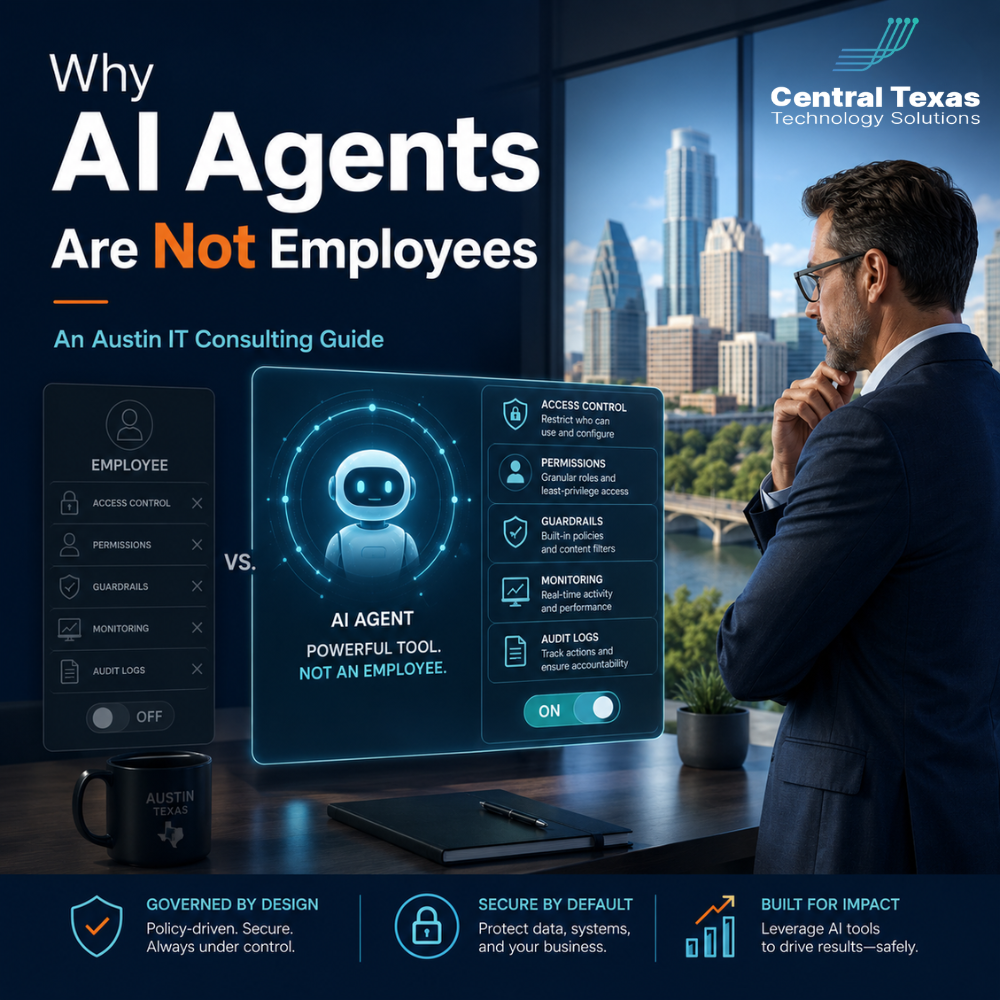
In 2026, a tempting idea is spreading through boardrooms: stop treating artificial intelligence as a tool and start treating it like an employee. It sounds forward thinking, and it makes AI feel approachable. From an Austin IT consulting perspective, it is also one of the riskiest mental shortcuts a business can take right now. The framing feels harmless, but it quietly invites you to extend trust, access, and assumptions to something that has not earned them the way a person does.
The instinct is understandable. AI agents now draft emails, pull reports, answer customers, and take actions across your systems. They look like coworkers. But the moment you treat one like an employee, you start governing it like one, and that is where the trouble begins.
What Is at Stake
An employee is accountable. If a person makes a costly mistake, there is a chain of responsibility, judgment that improves with experience, and an understanding of when to stop and ask. An AI agent has none of that. It can be confidently wrong, it does not know what it does not know, and it can be manipulated by a cleverly worded input.
The data backs up the concern. Recent research found that 91 percent of organizations now use AI agents, while only 10 percent have a clear strategy to manage them. Even more striking, a large share of companies have given their AI systems more access than the human doing the equivalent job.
That access gap is not theoretical. One 2026 study found that organizations enforcing least privilege access for their AI agents reported a 17 percent security incident rate, while those without it reported 76 percent. The single decision to stop treating an agent like a trusted employee and start scoping it like a tool produced the biggest measurable drop in risk of any control tested.
There is also a human cost. The same body of research found that treating AI like a colleague actually reduced individual accountability among staff, increased unnecessary escalations, and lowered the quality of review, all without making adoption any smoother. The employee metaphor does not just create security risk. It can quietly erode how your team takes ownership of their work.
Why Central Texas Businesses Face This Challenge
Central Texas is full of fast moving companies eager to put AI to work. A professional services firm in Round Rock or a clinic in Georgetown can stand up an AI agent in an afternoon, often without a security team weighing in on what it can touch.
That speed is exactly the problem. Smaller and mid sized businesses rarely have someone whose job is to ask which systems a new agent can reach, who owns it, and how it gets shut off if it misbehaves. The agent gets broad permissions because broad permissions are easy, and then it quietly becomes one of the most powerful identities in the company.
Attackers have noticed. Security professionals now rank autonomous AI among the top attack vectors for the year, precisely because these agents hold real access and most organizations are not equipped to govern them. A business in Buda running an over trusted agent is carrying enterprise level risk on a small business budget.
The companies that handle this well are not the ones moving slowest. They are the ones who adopt AI eagerly but govern it deliberately, treating each agent as a powerful system to be controlled rather than a colleague to be trusted.
How Austin IT Consulting Helps You Govern AI Agents
Good Austin IT consulting does not tell you to slow down on AI. It helps you go faster safely by putting the right structure around every agent before it becomes a problem. At CTTS, that starts with a simple inventory: which agents are running, what they can access, and who, if anyone, is responsible for them.
From there we apply the same discipline we use for any powerful identity. We scope each agent to the least access it actually needs, so a single compromised or confused agent cannot reach far. We make sure every agent has a named human owner and a clear way to shut it down. And we log what agents do, so their activity is visible rather than hidden inside a black box.
Just as important, we translate this into plain business terms. You should not need to understand machine identities or token permissions to know your AI is under control. Our job is to reduce your risk and help you keep more of your money, while still letting you capture everything AI has to offer. We treat your AI agents like what they are, powerful tools that deserve strong guardrails, not employees who have earned your trust.
How to Manage AI Agents the Right Way in 2026
You do not need to halt your AI plans to govern them well. You need a handful of clear practices applied consistently. Here is where to focus.
Treat Them as Privileged Tools, Not People
The single most important shift is in your mindset. An AI agent is not a junior employee who will use good judgment when the instructions are unclear. It is a fast, capable tool that does exactly what it is pointed at, including the wrong thing if it is misled.
When you think of an agent as a privileged tool, the right questions follow naturally. What can it touch? What is the worst it could do? How would we know if it did? Those questions rarely get asked when an agent is mentally filed under coworker.
Give Every Agent the Least Access It Needs
Least privilege is the highest impact control you can apply. An agent that summarizes invoices does not need the ability to send payments. An agent that answers customer questions does not need access to payroll. Scope each one tightly to its actual job.
This is the discipline that took organizations from a 76 percent incident rate down to 17 percent in recent research. It is not glamorous, but it is the difference between a contained mistake and a company wide event. Review those permissions regularly, because access tends to creep wider over time.
Name a Human Owner and an Off Switch
Every agent in production should have a person whose name is attached to it. That owner understands what the agent does, watches how it behaves, and is responsible for the call to pause or shut it down. An agent no one owns is an agent no one is watching.
Just as critical is the off switch. Decide in advance how you would stop an agent that starts acting strangely, before you actually need to. Many organizations have agents running with no documented way to turn them off, which is a risk no business would accept from any other powerful system.
Log and Review What Your Agents Actually Do
You cannot govern what you cannot see. Keep a record of the actions your agents take, and review it on a regular schedule. Logging turns a mysterious black box into something you can audit, learn from, and improve.
Regular review also gives your team a chance to flag where an agent is helping and where it is creating rework. That feedback keeps your AI useful and your people engaged, rather than quietly working around a tool no one fully trusts.
Take the Next Step
AI agents can be a genuine advantage for your business, but only if you govern them like the powerful tools they are rather than the employees they are not. With the right structure in place, you get the speed without handing over the keys.
If you want help putting smart guardrails around your AI, our Austin IT consulting team would be glad to walk through it with you.
Schedule a free strategy session with CTTS today to see where your AI agents stand today and how to govern them with confidence.
Frequently Asked Questions
What is the danger of treating an AI agent like an employee?
The biggest danger is misplaced trust. Employees are accountable, exercise judgment, and know when to escalate, while AI agents do not. When you treat an agent like staff, you tend to give it broad standing access and little oversight, which makes it one of the riskiest identities in your business. Recent research shows most organizations already give AI agents more access than the humans doing the same work, and that over trust is exactly what attackers look to exploit.
How should a small business in Central Texas manage its AI agents?
Start by listing every agent you run, what it can access, and who owns it. Then apply least privilege so each agent can only reach what its job requires, assign a human owner and a clear off switch to every agent, and log what they do so their activity is visible. Most small businesses do not have the time or in house expertise to do this alone, which is where a managed IT and security partner can help you move quickly without taking on hidden risk.
Does governing AI agents mean slowing down our AI adoption?
No. Good governance is what lets you adopt AI faster with confidence, not slower out of fear. The goal is to put guardrails in place so you can use powerful tools without exposing the business to outsized risk. In practice, companies that scope access and assign ownership tend to scale their AI further because they are not constantly cleaning up avoidable problems.
Contact CTTS today for IT support and managed services in Austin, TX. Let us handle your IT so you can focus on growing your business. Visit CTTSonline.com or call us at (512) 388-5559 to get started!