
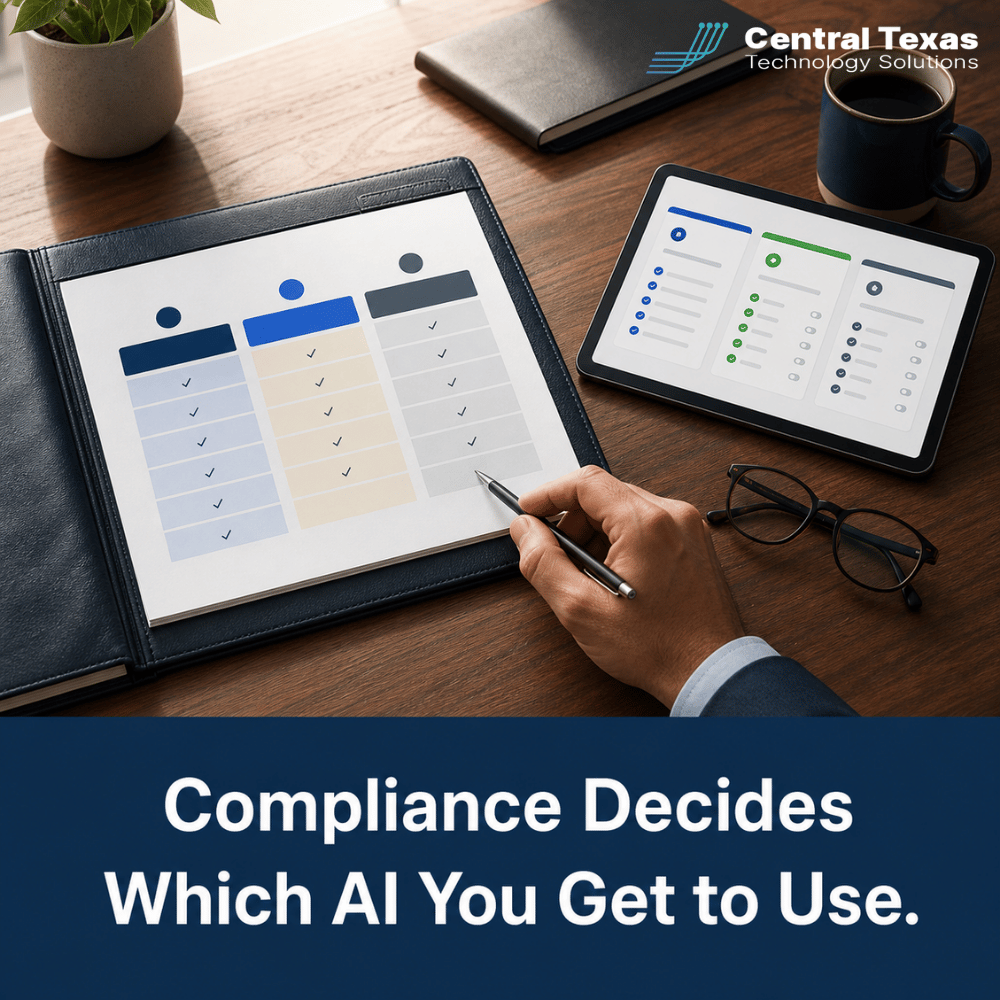
 Deciding which artificial intelligence platform to adopt is hard enough on its own. When the company also has compliance obligations under HIPAA, CMMC, the Texas Responsible Artificial Intelligence Governance Act, or contracts that touch sensitive government data, the typical Copilot versus Claude versus Gemini comparisons online stop being useful.
The enterprise AI compliance Temple Texas leaders need in 2026 starts with the regulatory posture and works backward into the platform decision. CTTS sits with Central Texas leaders to make that decision in plain language.
What Does Enterprise AI Compliance Temple Texas Leaders Need in 2026?
Enterprise AI compliance Temple Texas leaders need in 2026 is a written AI use policy, a vetted set of approved platforms, a documented data classification standard that tells employees which AI may touch which data, and a continuous review cadence as both the platforms and the regulations move. Most online comparisons of Copilot, Claude, and Gemini compare features. Compliance-driven businesses have to compare data handling, regulated cloud availability, contract terms, and the audit posture of each platform.
The stakes are concrete. Texas businesses operating under HIPAA, the Texas Data Privacy and Security Act, the Texas Responsible Artificial Intelligence Governance Act, or any Department of Defense contract are accountable for what their employees do with AI. An employee who pastes protected health information into the wrong chat interface is a reportable event. An employee who runs controlled unclassified information through a non-approved AI service can disqualify a contract.
CTTS works with Temple, Austin, and Georgetown leaders to make the decision in the right order. Regulatory posture first. Approved platform list second. Workforce policy and training third. The enterprise AI compliance Temple Texas firms can sustain is a policy program, not a single tool choice.
Why Central Texas Businesses Face This AI Platform Decision
Central Texas businesses face this AI platform decision because Copilot, Claude, and Gemini have each become genuinely useful, and because vendors increasingly assume every customer is operating under a single trust framework. Healthcare practices in Temple, defense and advanced manufacturing suppliers in Taylor, professional services firms in Round Rock, and nonprofits across the corridor all want the productivity gains the same week, and they all face slightly different regulatory pictures.
The pressure is real. Employees are already using AI. The question is no longer whether to allow it. The question is whether the business has named which platforms are approved for which kinds of data, and whether the technical controls match the policy. Without that decision documented, employees default to whatever interface is open in front of them, and the company inherits the risk of that choice.
Local context matters. Temple has grown into a regional healthcare hub anchored by Baylor Scott and White and a deep cluster of medical practices, which means HIPAA is not a footnote in any AI conversation here. The enterprise AI compliance Temple Texas firms invest in is the program that lets the workforce use AI productively without putting patient or contract data through the wrong pipe.
How CTTS Handles the AI Platform Decision for Compliance-driven Businesses
CTTS handles the AI platform decision for compliance-driven businesses by mapping the regulatory picture first, then evaluating each candidate platform against that picture, then building the policy and the technical controls around the approved choice. The decision is not Copilot or Claude or Gemini in isolation. The decision is which platform sits where in a documented program that an auditor will recognize.
The CTTS process starts with the data classification standard. Public, internal, confidential, regulated. Each class maps to the AI platforms permitted to process it. The regulated class is the strictest, and is typically routed to platforms with a current Business Associate Agreement for HIPAA, an Authorization to Operate or comparable posture for federal data, and contract terms that exclude training on customer prompts.
"The enterprise AI compliance Temple Texas leaders ask me about is not really a Copilot or Claude or Gemini question. It is a data classification and a policy question that ends in one of those three platforms. Once the data classification is right and the policy is signed, the platform choice gets simple, and we run the technical controls that make the policy real."
— Josh Wilmoth, President and CEO, CTTS
The CTTS engagement includes a quarterly review with leadership because the AI landscape moves faster than annual budgeting. New regulated cloud availability, new contract language from Microsoft, Anthropic, or Google, and new state guidance under TRAIGA all change the approved list across a calendar year.
Best Enterprise AI Compliance Support in Texas in 2026: Criteria That Matter
The best enterprise AI compliance support in Texas in 2026 meets a defined set of criteria. Use these to evaluate any provider, including CTTS.
- A written data classification standard the employees actually understand. Plain language, four classes.
- A short approved platform list mapped to each class. Not a fifteen-tool catalog.
- Contract review for AI vendor terms. Training opt-outs, data residency, and breach notification.
- Regulated cloud awareness. Familiarity with Azure Government, AWS GovCloud, and equivalent posture for healthcare.
- Identity and access controls tied to the AI platforms. Single sign-on, conditional access, and least privilege.
- Logging and audit for AI usage. The company can answer who used which platform and when.
- Workforce training in the specific platforms approved. Generic AI awareness is not enough.
How to Choose Between Copilot, Claude, and Gemini for a Compliance-driven Business
Use these five questions when evaluating any of the three platforms for a Temple Texas or Central Texas business under real compliance constraints.
- Which regulated frameworks does the platform currently support, in writing, for our company size and contract type?
- What is the vendor's position on training on customer prompts in the tier we would buy?
- Which regulated cloud environment is the platform deployable in for our most sensitive data class?
- How does the platform integrate with our existing identity provider and conditional access?
- What logging and audit do we have available for compliance reporting?
A Practical Enterprise AI Platform Selection Plan for Central Texas Businesses
The CTTS approach for Central Texas businesses making this choice breaks into three workstreams. Each stands alone, and together they produce a defensible posture inside ninety days.
Regulatory Mapping and Data Classification
The first workstream answers what data the company holds and what frameworks govern it. CTTS produces a one-page data classification standard and a regulatory map specific to the business. Healthcare clients see HIPAA addressed first. Defense clients see CMMC and contract clauses addressed first. Texas businesses see TDPSA and TRAIGA addressed in every map.
Platform Evaluation by Data Class
The second workstream evaluates the three major platforms against the regulatory map. The comparison Central Texas leaders ask CTTS about most often sits below, with the understanding that vendor posture changes and the CTTS team confirms current status in any active engagement before commitments are made.
| Dimension | Microsoft Copilot | Anthropic Claude | Google Gemini |
|---|---|---|---|
| Native M365 productivity integration | Strongest by design | Available via partner integrations | Available via partner integrations |
| Regulated cloud availability | Microsoft 365 Government and Azure Government posture | Available in AWS Bedrock with HIPAA-eligible posture; enterprise BAA channels | Vertex AI in Google Cloud with regulated posture options |
| Training on customer prompts | Enterprise tiers documented as not training on tenant data | Enterprise tiers documented as not training on customer prompts | Enterprise tiers documented as not training on customer prompts |
| HIPAA business associate agreement | Available via Microsoft enterprise agreements | Available via enterprise channels including AWS Bedrock | Available via Google Cloud enterprise agreements |
| Identity and SSO integration | Native Entra ID | Standards-based SSO via enterprise tier | Native Google Workspace; standards-based SSO elsewhere |
| Best initial fit (general guidance) | M365-centric businesses with internal productivity focus | Engineering, research, and document-heavy work | Workspace-centric businesses and Google Cloud workloads |
CTTS confirms current vendor terms and certifications at the moment of engagement because this landscape moves quarterly. The right choice for a Temple healthcare practice is rarely identical to the right choice for a Taylor defense contractor.
Policy, Controls, and Workforce Enablement
The third workstream operationalizes the decision. CTTS writes the AI use policy in plain language, configures identity and conditional access to enforce it, sets up logging and audit, and runs short workforce training on the specific approved platforms. Employees know what they can use, on which data, and how to ask when they are unsure.
Take The Next Step
If your Temple Texas business is moving on enterprise AI and you cannot answer with certainty which platforms are approved for which data, that uncertainty is the signal. CTTS offers a free strategy session for Temple, Austin, and Georgetown leaders who want a plain language read on Copilot, Claude, and Gemini in light of HIPAA, CMMC, TRAIGA, and any contract terms specific to the business.
Visit CTTSonline.com to schedule. The businesses that capture AI productivity without inheriting AI risk are the ones that documented the decision before the first prompt was written.
Frequently Asked Questions
Which AI platform is best for a HIPAA-regulated Texas business in 2026?
The best AI platform for a HIPAA-regulated Texas business in 2026 is the one with a signed business associate agreement, deployment in a HIPAA-eligible environment, and contract terms that exclude training on customer prompts at the tier you actually buy. Microsoft Copilot, Anthropic Claude, and Google Gemini all have enterprise paths that meet these tests under the right configuration. CTTS confirms current status before any commitment because vendor posture changes. The answer is rarely a single platform across the entire organization.
Can a defense contractor use Copilot or Claude or Gemini under CMMC?
A defense contractor handling controlled unclassified information can use Microsoft, Anthropic, or Google AI services under CMMC only inside a properly scoped, regulated cloud environment with documented controls and contract terms aligned to NIST SP 800-171. Generic consumer or commercial-tier AI services are not appropriate for CUI. CTTS scopes the AI workload inside the enclave the contractor already uses for CMMC, with audit logging tied to the same evidence pipeline. The platform choice flows from the cloud posture.
What does enterprise AI compliance Temple Texas businesses need to address first?
Enterprise AI compliance Temple Texas businesses need to address the data classification standard first. Without classification, every other decision is approximate. The standard names the kinds of data the company holds, ranks each kind by sensitivity, and maps each kind to the AI platforms approved to process it. CTTS produces this standard on a single page that employees can read in five minutes, with the policy, training, and technical controls following from it.
Should our company pick one AI platform or use multiple?
Most Central Texas businesses use more than one. Microsoft Copilot handles internal productivity inside Microsoft 365. Anthropic Claude or Google Gemini may handle research, analysis, or document workflows on different data classes. The decision is per data class, not per company. The risk is undocumented sprawl, where every employee uses something different. CTTS keeps the approved list short and the documentation current.
How does CTTS help us choose and govern enterprise AI?
CTTS helps Central Texas leaders choose and govern enterprise AI by mapping the regulatory picture, evaluating Copilot, Claude, and Gemini against that picture, writing the data classification standard and AI use policy, configuring identity and logging, and running workforce training on the approved platforms. Quarterly reviews keep the program current as the vendor and regulatory landscape moves. The deliverable is a program leadership can present to an auditor and an employee can follow on the first day.
Contact CTTS today for IT support and managed services in Austin, TX. Let us handle your IT so you can focus on growing your business. Visit CTTSonline.com or call us at (512) 388-5559 to get started!