
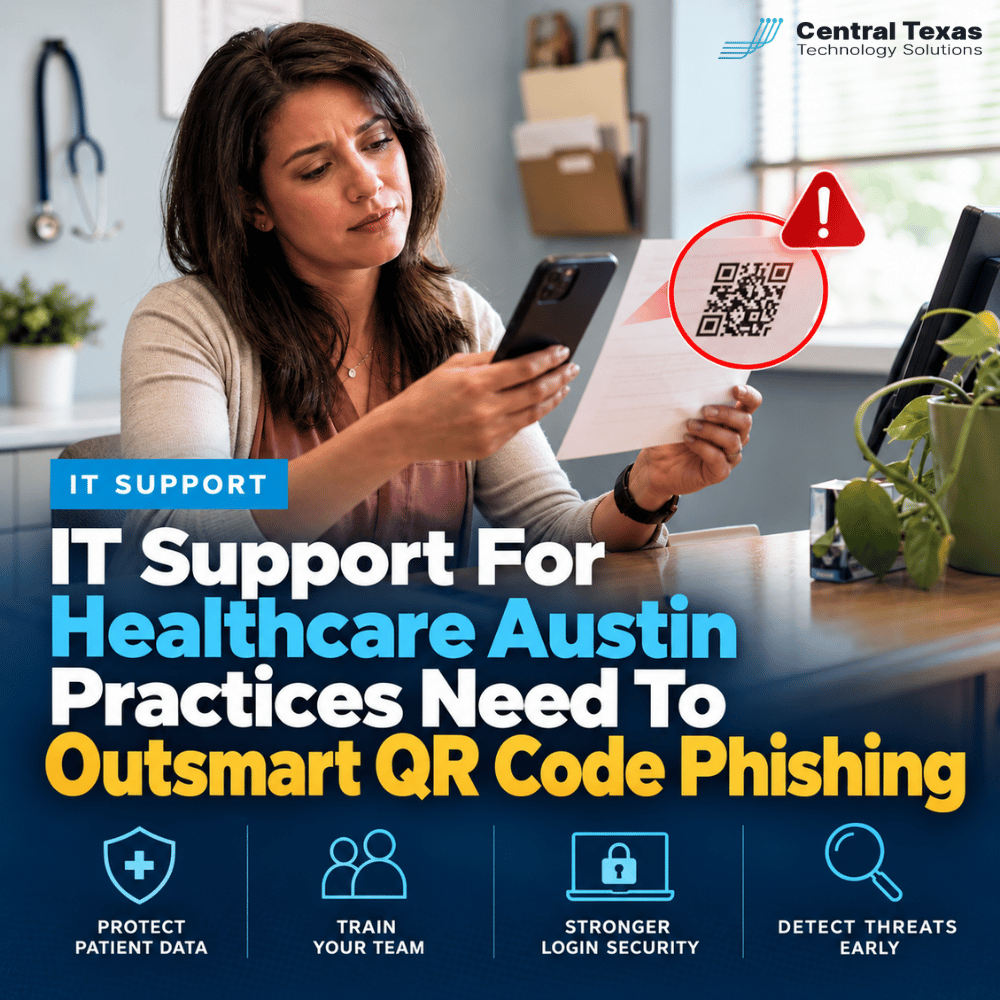
If your front desk staff or billing team scanned a QR code this week without a second thought, you are not alone, and that is exactly the problem. In 2026, quishing, which is phishing delivered through a QR code instead of a link, has become one of the fastest growing ways attackers get into a business email account or an electronic health record system.
For healthcare practices in Austin and across Central Texas, where patient data and appointment systems depend on a handful of trusted logins, reliable IT support for healthcare Austin providers can lean on is no longer optional. It is the difference between a normal Tuesday and a breach notification letter.
Quick Answer: QR code phishing, or quishing, hides a malicious link inside a scannable image instead of clickable text, so it slips past the email filters and staff instincts that normally catch phishing. The fix is layered: phishing resistant multi-factor authentication, a policy of never scanning a QR code to log in or verify payment, and the kind of IT support for healthcare Austin practices trust to monitor for the accounts these attacks target.
Key Takeaways
- Quishing attacks jumped 146 percent in the first quarter of 2026 alone, according to Microsoft's own email threat data, from 7.6 million to 18.7 million incidents.
- QR codes bypass traditional email link scanning because the malicious URL is hidden inside an image, not readable text.
- Healthcare practices are prime targets because a single compromised login can expose scheduling systems, patient portals, and billing platforms at once.
- Phishing resistant MFA and a simple no scan to log in policy stop the vast majority of these attempts before they succeed.
- Complete Care Coverage from CTTS bundles this kind of identity protection with monitoring, so a suspicious login gets caught fast rather than found weeks later.
What's at Stake
A single successful quishing attack can hand an outsider the same access your billing coordinator or office manager has, and in a healthcare practice that access usually touches everything.
Think about what one login unlocks: your patient scheduling platform, your electronic health record system, your billing and insurance portal, and very likely your email, which is where password resets for all the others get sent. Attackers know this. Once they have one set of credentials from a healthcare employee, they are not looking to cause a scene. They are looking to sit quietly, read old emails to learn how your practice communicates, and then send a wire transfer request or a fake vendor invoice that looks exactly like something your office would normally pay.
The financial loss is real, but for a healthcare practice the bigger risk is a HIPAA reportable breach involving protected health information, which brings notification costs, legal exposure, and a hit to patient trust that takes years to rebuild.
Why Central Texas Businesses Face This Challenge
Central Texas healthcare practices are growing fast, and growth usually outpaces internal IT capacity long before anyone notices the gap.
Austin, Round Rock, Georgetown, and the surrounding communities have seen real growth in outpatient clinics, dental groups, and specialty practices over the past few years. Most of these organizations run lean. There is rarely a full time security team watching for new attack patterns, and the office manager who also handles IT questions has a full plate already. Quishing thrives in that environment because it looks harmless. A QR code on a flyer, in a vendor email, or attached to what looks like a multifactor authentication prompt does not trigger the same instinct that a suspicious link does.
According to Microsoft's Q1 2026 threat report, quishing volume jumped from 7.6 million to 18.7 million attempts in a single quarter, and small and midsize organizations without dedicated security monitoring are disproportionately the ones who do not catch it until the damage is done.
How CTTS Helps Healthcare Practices Stop Quishing
CTTS closes the specific gaps that make QR code phishing effective, rather than just adding another awareness poster to the break room.
Under our Complete Care Coverage plan, healthcare clients get phishing resistant multifactor authentication that does not rely on a simple approve or deny push, conditional access rules that flag a login attempt from an unusual device or location before it succeeds, and ongoing monitoring so a compromised account gets locked down in minutes rather than discovered during a routine audit weeks later.
We also run practical, short awareness training that focuses on real scenarios your staff will actually encounter, like a QR code embedded in what looks like a vendor invoice or a fake Microsoft 365 login refresh, instead of generic slideshow modules nobody remembers. For practices serving Austin, Georgetown, Round Rock, and the rest of Central Texas, that combination means one scanned QR code does not turn into a HIPAA incident.
QR Code Phishing Best Practices Every Practice Should Follow
A handful of specific habits stop most quishing attempts cold, and none of them require replacing your entire technology stack.
What makes QR code phishing harder to spot than email phishing?
A malicious link inside a QR code is invisible until it is scanned, so none of the usual warning signs apply. There is no misspelled domain to notice, no suspicious hover preview, and no obvious red flag in the email itself, which is exactly why attackers have shifted toward this method as awareness of traditional phishing links has grown.
Can multi-factor authentication stop a quishing attack?
Standard push based MFA helps but is not enough on its own, because attackers now build QR codes that mimic a legitimate MFA approval screen to capture the code in real time. Phishing resistant MFA, such as passkeys or hardware security keys, closes this gap because there is no code or push notification for an attacker to intercept or trick a user into approving.
Never scan a QR code to log in or verify a payment
Any QR code that asks you to log into an account, verify multifactor authentication, or confirm a payment should be treated as suspicious by default, since legitimate systems rarely require this. Train staff to navigate to the website directly instead of scanning.
Use DMARC and email authentication to catch spoofed senders
Many quishing emails impersonate a known vendor or internal system, and proper DMARC, SPF, and DKIM configuration on your email domain makes those impersonation attempts far easier to catch and block automatically before they reach an inbox.
Give your team one simple reporting step
Staff need exactly one easy action when something looks off, whether that is a forward button or a report phishing icon, so a suspicious QR code gets flagged and reviewed in minutes instead of quietly acted on.
Take the Next Step
You do not have to guess whether your practice is exposed to this kind of attack. The most useful next step for most Austin area healthcare practices is a straightforward look at where your current defenses actually stand.
Our Executive IT Risk Assessment gives you a clear, no pressure picture of your current identity and email security, including whether your MFA setup would actually stop a quishing attempt, and where the gaps are. It is the same starting point we use with new Complete Care Coverage clients, and it takes far less of your time than a breach ever would.
Have Questions? We've Got Answers
What exactly is QR code phishing, or quishing?
Quishing is a phishing attack where the malicious link is hidden inside a QR code instead of clickable text or a button. When someone scans the code with their phone, it opens a fake login page or payment form designed to steal credentials or financial information, and because it is an image rather than text, many email security tools do not catch it the way they would a normal phishing link.
Why are healthcare practices specifically targeted by this kind of attack?
Healthcare practices manage patient scheduling, billing, and electronic health record access through a small number of shared logins, so a single compromised account can expose a large amount of sensitive data at once. Attackers also know a breach involving protected health information carries HIPAA reporting obligations and legal exposure, which makes healthcare targets more valuable to pursue.
What should my staff do if they already scanned a suspicious QR code?
Have them change the password for any account they may have entered information into immediately, and notify your IT provider so the account can be monitored for unusual activity. Acting within the first hour significantly reduces the chance that an attacker can do meaningful damage before access is cut off.
CTTS has served Central Texas businesses and nonprofits since 2002, with a 96 percent client satisfaction score across 159 surveys and calls answered in 3 rings by a local team. Built for organizations with 10 to 250 employees.
Contact CTTS today for IT support and managed services in Austin, TX. Let us handle your IT so you can focus on growing your business. Visit CTTSonline.com or call us at (512) 388-5559 to get started!