
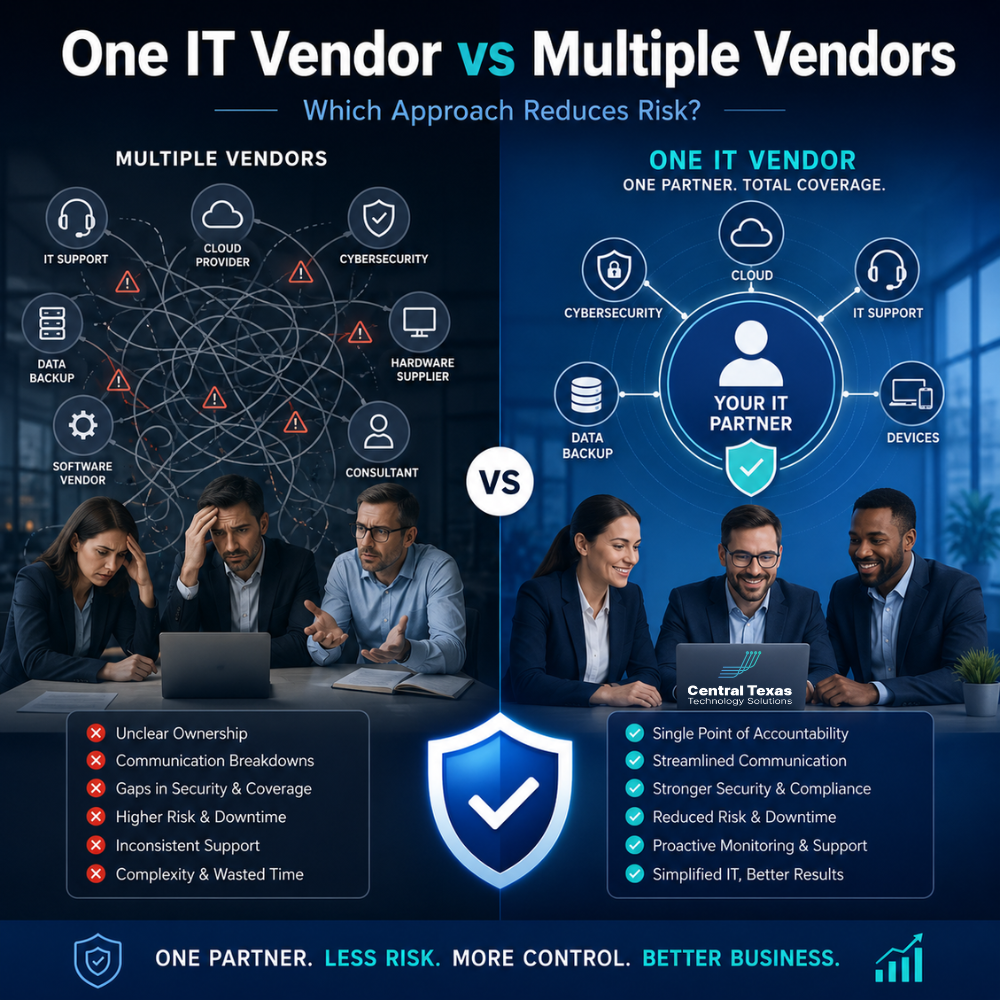
When your business depends on technology every day, the question is not whether you need reliable IT support. The real question is whether your current support structure is helping reduce risk or creating more of it.
Many growing businesses in Austin and Central Texas work with several technology vendors at once. One company handles cybersecurity. Another supports phones. Another manages cloud systems. Another responds when computers stop working. Another vendor may handle backups, software, or internet issues.
On paper, this can feel flexible.
In practice, it often creates confusion.
When something goes wrong, your team may not know who to call first. Vendors may point fingers at one another. Problems take longer to resolve. Security gaps become harder to find. Business leaders are left trying to manage technical relationships they do not have time to oversee.
For businesses in healthcare, legal, professional services, construction, manufacturing, and nonprofits, that confusion can affect productivity, compliance, security, and customer trust.
A single strategic IT partner like CTTS can help reduce that risk by bringing your technology under one coordinated plan.
Why Multiple IT Vendors Can Increase Business Risk
Working with multiple IT vendors is not always wrong. Some businesses need specialized software providers or industry-specific platforms. The risk comes when no one is responsible for the full technology picture.
That can create problems such as:
- Unclear accountability when systems fail
- Gaps between cybersecurity, backup, and support tools
- Inconsistent documentation
- Duplicate services and wasted spending
- Slower response times
- Finger-pointing between vendors
- Poor visibility into long-term IT risk
For example, a law firm in Austin may rely on one provider for case management software, another for Microsoft 365, another for cybersecurity, and another for help desk support. If email access fails before a filing deadline, who owns the problem?
A healthcare clinic may have one vendor managing devices, another handling compliance-related systems, and another managing backups. If patient data becomes unavailable, the issue is not just technical. It can become an operational and compliance concern.
A construction company with teams in the office, field, and jobsite trailers may need phones, cloud file access, mobile device support, cybersecurity, and vendor coordination to work together. When those systems are managed separately, downtime can quickly interrupt projects.
The more disconnected your vendors are, the harder it becomes to protect your business.
One IT Vendor Creates Clear Accountability
One of the biggest advantages of working with one managed IT services provider is accountability.
Instead of asking, “Who should we call?” your team has one clear point of contact.
That matters when problems affect:
- Internet access
- Cloud files
- Cybersecurity alerts
- Phone systems
- Backups
- Devices
- Remote access
- Vendor coordination
CTTS helps businesses avoid the “not our problem” trap by serving as a strategic IT partner, not just another vendor. When your technology is managed under one coordinated plan, your business has a guide who understands how each system affects the others.
That can make a major difference for companies in Austin, Buda, Kyle, New Braunfels, and across Central Texas.
Multiple Vendors Often Create Security Gaps
Cybersecurity is one area where disconnected vendors can create serious risk.
A cybersecurity tool may detect suspicious activity, but does your help desk provider know what to do next? Your backup vendor may store copies of your data, but does your security provider know whether those backups are protected from ransomware? Your Microsoft 365 setup may have basic protections enabled, but who is reviewing user access, permissions, and login activity?
Risk often hides in the space between vendors.
That is especially dangerous for organizations that handle sensitive information, including:
- Healthcare practices managing patient data
- Legal firms protecting client files
- Professional services firms handling financial or confidential records
- Construction companies managing bids, contracts, and project documents
- Manufacturing companies protecting operations and vendor data
- Nonprofits responsible for donor and community information
A proactive IT partner looks at the full environment. CTTS helps businesses identify where tools, users, devices, networks, and vendors connect, so security is not treated as a separate task. It becomes part of the entire technology strategy.
One Managed IT Services Provider Helps Prevent Downtime
Technology downtime is rarely caused by one isolated issue. It often happens because several small problems build up over time.
An outdated server. A poorly configured backup. A weak password policy. A delayed software update. An internet issue nobody has been tracking. A device that keeps failing but never gets replaced.
When multiple vendors are involved, these issues can fall through the cracks.
One vendor may only see the phone system. Another may only see endpoint security. Another may only see cloud storage. No one may be watching how the entire environment supports the business.
CTTS takes a proactive approach by helping prevent problems before they disrupt operations. That means looking at your technology as a connected system, not a collection of separate tools.
For business leaders, the goal is not just faster repair. The goal is fewer surprises.
One IT Partner Aligns Technology With Business Goals
Many businesses outgrow their technology setup without realizing it.
A nonprofit may add new programs and staff, but still rely on outdated shared drives. A manufacturing company may expand operations, but lack the network stability needed for growth. A professional services firm may adopt new software, but struggle with duplicate tools and poor user adoption.
When no single IT partner is helping guide the bigger picture, technology decisions often become reactive.
You buy tools when something breaks. You upgrade systems when they become urgent. You make decisions based on immediate pressure instead of long-term strategy.
CTTS helps businesses create a more intentional plan. That includes reviewing where the business is today, where it is going, and what technology needs to support that growth.
A strong IT strategy should help answer questions like:
- Are we protected from current cybersecurity threats?
- Are our systems ready for growth?
- Are we paying for tools we do not use?
- Are employees able to work efficiently from anywhere?
- Are our backups reliable and tested?
- Are we prepared for audits, compliance reviews, or insurance requirements?
- Are our vendors being managed effectively?
That is the difference between basic IT support and strategic IT leadership.
When Multiple Vendors Still Make Sense
The goal is not to eliminate every outside vendor.
Many businesses need specialized platforms for accounting, healthcare records, legal case management, manufacturing systems, project management, donor management, or industry-specific operations.
The key is making sure those vendors are coordinated.
A strong managed IT services provider can act as the central point of communication between your business and those specialized providers. Instead of expecting your internal team to manage technical conversations, CTTS can help coordinate vendor support, troubleshoot problems, and make sure your systems work together.
That gives your team one trusted guide while still allowing your business to use the tools it needs.
The Real Question Is Who Owns the Outcome
The debate is not simply one IT vendor vs multiple vendors.
The better question is this:
Who is responsible for making sure your technology works, stays secure, supports your people, and helps your business move forward?
If the answer is unclear, your business may already be carrying unnecessary risk.
When every vendor owns only a small piece of the puzzle, no one may be protecting the full picture. That can lead to downtime, security exposure, wasted spending, frustrated employees, and delayed growth.
CTTS helps Central Texas businesses bring order to their technology environment by providing proactive managed IT services, cybersecurity, help desk support, cloud services, backup and recovery, vendor coordination, and strategic guidance.
For businesses in Austin, Buda, Kyle, New Braunfels, and surrounding communities, the right IT partner can reduce risk and give leaders more confidence in the systems they rely on every day.
How CTTS Helps Reduce Vendor Complexity
CTTS helps businesses simplify IT by creating a clear, managed approach to technology.
That includes:
- Reviewing your current systems and vendor relationships
- Identifying security gaps and operational risks
- Creating a proactive IT support plan
- Managing help desk needs
- Supporting Microsoft 365 and cloud environments
- Strengthening cybersecurity protections
- Reviewing backup and disaster recovery readiness
- Coordinating with third-party vendors
- Aligning technology with business goals
Instead of waiting for problems to interrupt your team, CTTS helps prevent issues, improve visibility, and create a more reliable foundation for growth.
Your business should not have to manage technology chaos alone.
Ready to Reduce IT Risk and Vendor Confusion?
If your business is relying on multiple technology vendors and no one is clearly responsible for the full picture, it may be time to simplify your approach.
CTTS helps businesses in Austin and across Central Texas move from reactive IT support to proactive technology leadership.
Schedule a consultation with CTTS today to find out whether your current vendor structure is helping reduce risk or quietly creating more of it.
FAQs About One IT Vendor vs Multiple Vendors
Is it better to use one IT vendor or several specialized vendors?
For most growing businesses, one primary managed IT services provider reduces risk because it creates clear accountability and better coordination. Specialized vendors may still be needed for certain industry platforms, but your primary IT partner should help manage those relationships.
Can multiple IT vendors create cybersecurity problems?
Yes. When vendors manage separate parts of your environment without coordination, security gaps can be missed. A proactive IT partner can help connect cybersecurity, backups, user access, devices, and cloud systems into one stronger protection strategy.
How does CTTS help businesses manage other technology vendors?
CTTS can serve as the central IT partner for your business. That means helping communicate with software providers, internet companies, phone vendors, cloud platforms, and other technical providers so your internal team is not stuck in the middle.
Contact CTTS today for IT support and managed services in Austin, TX. Let us handle your IT so you can focus on growing your business. Visit CTTSonline.com or call us at (512) 388-5559 to get started!
Make your next IT decision with confidence. Start with these insights:
Managed IT Services vs Break Fix IT Support: Which Is Right for Your Business?
Local IT Support in Austin vs National IT Providers
In House IT vs Outsourced IT Support: Pros and Cons for Growing Companies
Microsoft 365 Support Through a Partner vs Doing It Yourself
Cloud First IT Consulting vs Traditional IT Infrastructure
Fully Managed IT vs Co Managed IT: Which Model Fits Your Business Best?
IT Generalists vs IT Specialists: What Does Your Business Really Need?
Should You Standardize Your Technology Stack or Stay Flexible?