
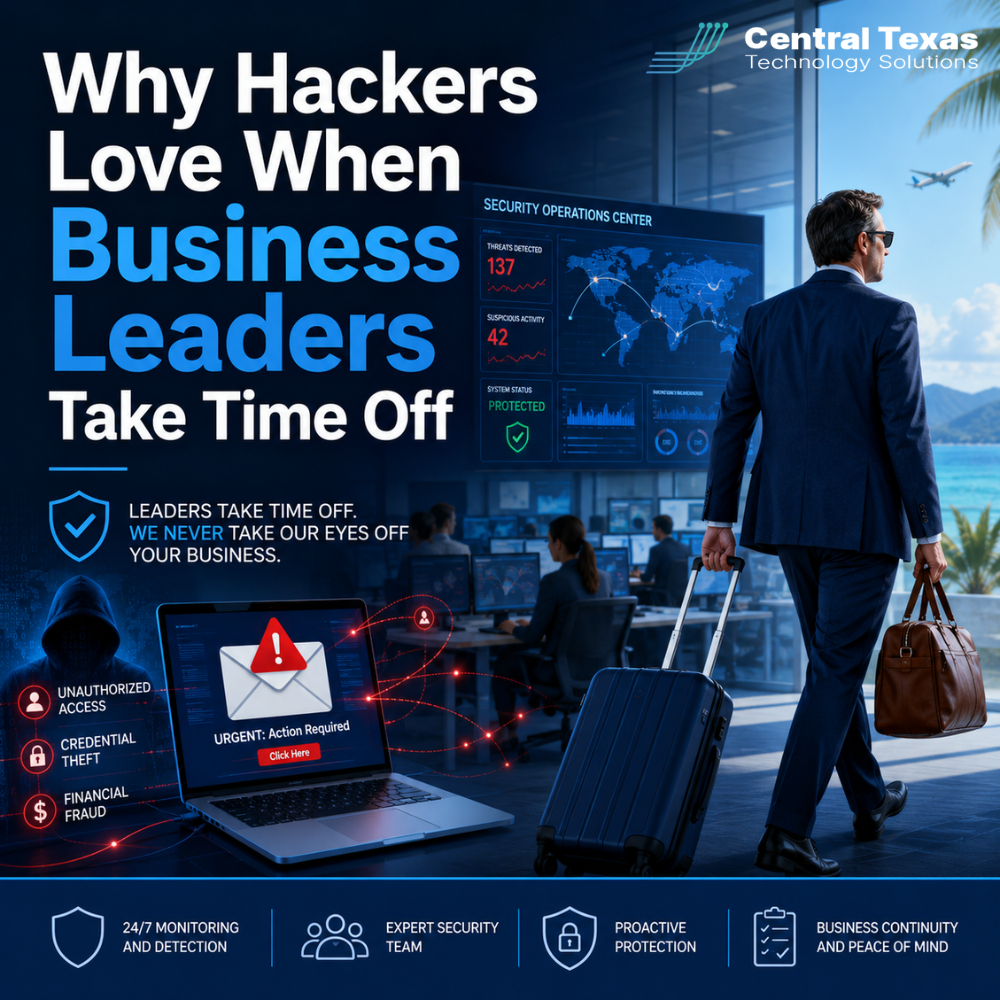
Business leaders need time away from the office. Whether you are traveling, taking vacation, attending an industry conference, or simply stepping back for a few days, your company should be able to operate without everything depending on you.
But there is a risk many organizations do not think about until something goes wrong.
When key leaders are less available, oversight slows down. Decisions take longer. Employees may hesitate to escalate concerns. Cybercriminals know this, and they often look for moments when businesses are distracted, short-staffed, or operating outside their normal rhythm. The attached draft explains this core risk well: when leaders step back, attention can drop and response times can slow, creating opportunities for attackers.
This does not mean you should avoid taking time off. It means your business needs a cybersecurity strategy that works whether you are at your desk, on a plane, at a family event, or unavailable for the afternoon.
For business leaders in healthcare, legal, professional services, construction, manufacturing, and nonprofits, the goal is simple: your technology should protect the business even when you are not personally watching every detail.
Why Cybercriminals Look for Gaps in Leadership Availability
Hackers are not always trying to break through the front door with obvious attacks. Many are patient. They test systems, study behavior, and wait for weak moments.
Those weak moments often happen when:
- The owner or executive team is traveling
- A key manager is out of office
- A holiday or long weekend disrupts normal routines
- Staff members are unsure who should approve unusual requests
- IT issues are handled reactively instead of proactively
- Security alerts depend on someone noticing them manually
For businesses in Austin, Round Rock, Georgetown, and Pflugerville, this matters because growth often creates more moving parts. More employees, more cloud tools, more remote access, more vendors, and more customer data all increase the need for reliable security oversight.
If your cybersecurity plan depends on one person being available at all times, your business is already exposed.
Slower Cybersecurity Response Times Can Lead to Bigger Damage
Speed matters in cybersecurity.
A suspicious login caught within minutes can often be stopped before real damage occurs. The same suspicious login left alone for hours can lead to stolen data, compromised email accounts, ransomware, or unauthorized access to sensitive systems.
When leaders are unavailable, delays happen naturally. Someone may see something unusual but decide not to interrupt. An employee may receive a convincing phishing email and hesitate before asking for help. A system alert may sit unnoticed because no one knows who owns the next step.
That delay can turn a small incident into a much larger problem.
This is especially important for:
- Healthcare organizations protecting patient information
- Legal firms managing confidential client files
- Professional services firms handling financial, strategic, or operational data
- Construction companies coordinating projects, vendors, and payments
- Manufacturers relying on uptime and production systems
- Nonprofits protecting donor information and internal operations
A strong cybersecurity strategy should not depend on your personal availability. It should include continuous monitoring, clear escalation paths, and fast response from a team that knows what to do.
Reduced Oversight Can Make Unauthorized Access Easier to Miss
Cybercriminals do not always make loud moves. Often, they try to blend in.
They may use stolen credentials to log in after hours. They may access email accounts quietly. They may monitor conversations before sending a fake invoice or payment request. They may test what they can reach before launching a larger attack.
When leadership attention is lower, these warning signs can be easier to miss.
The problem is not that your team is careless. The problem is that manual oversight is not enough. People get busy. Vacations happen. Meetings run long. Employees focus on serving clients, patients, customers, vendors, and internal teams.
Security needs to be built into the business, not left to chance.
A proactive managed IT services partner like CTTS helps Central Texas businesses maintain visibility through monitoring, alerting, system reviews, endpoint protection, user access controls, and ongoing security improvements. That means abnormal activity is more likely to be spotted and addressed before it becomes a bigger problem.
Employee Uncertainty Creates Cybersecurity Risk
Most cybersecurity incidents are not caused by movie-style hacking. Many happen because a real person makes a reasonable decision under pressure.
For example:
- An employee receives an urgent email that appears to come from the CEO
- A staff member gets a request to change payment information
- Someone is asked to share a file through an unfamiliar link
- A vendor asks for access to a system
- A password reset request appears legitimate
- A remote employee has trouble logging in and needs help quickly
When the usual decision-maker is unavailable, employees may improvise. They may approve something they normally would not approve. They may click a link because it looks urgent. They may avoid asking questions because they do not want to slow the business down.
That is exactly what cybercriminals count on.
The solution is not to make your team afraid of every email. The solution is to give them a clear process.
Employees should know:
- How to report suspicious emails
- Who to contact when something feels wrong
- What requests require verification
- How payment changes should be confirmed
- What to do if they think they clicked something unsafe
- When to stop and ask for help
Cybersecurity awareness training, clear internal procedures, and responsive IT support help employees make better decisions when leadership is not immediately available.
“No News” Does Not Mean Your Business Is Secure
Many business leaders assume that if they have not heard about a problem, everything must be fine.
That assumption is dangerous.
Cybersecurity threats are often quiet by design. Attackers may sit inside an account before acting. Malware may run in the background. A compromised password may be used weeks after it is stolen. A vulnerability may exist long before anyone notices.
Silence does not always mean security. Sometimes it means no one is actively watching.
That is why proactive IT management matters.
A stronger approach includes:
- Regular security monitoring
- Patch management and software updates
- Endpoint detection and response
- Multi-factor authentication
- Cloud account protection
- Backup and disaster recovery planning
- User access reviews
- Vendor risk awareness
- Security reporting for leadership
This gives business leaders confidence because systems are being watched, maintained, and improved consistently.
Your Cybersecurity Should Not Depend on One Person
If your business becomes less secure when you take time off, the issue is not your vacation. The issue is your process.
A healthy technology environment should keep working when you step away. Your team should know how to respond. Your systems should be monitored. Your backups should be tested. Your access controls should be current. Your IT partner should already understand your business and know what matters most.
That is the difference between reactive IT support and proactive managed IT services.
Reactive IT waits for something to break.
Proactive IT looks for risk before it becomes downtime, data loss, compliance trouble, or operational disruption.
For businesses across Austin and Central Texas, this is especially important during periods of growth, leadership transitions, audits, staffing changes, remote work expansion, and system upgrades.
How CTTS Helps Businesses Stay Protected When Leaders Step Away
CTTS helps businesses build technology environments that are not dependent on one person watching everything.
Instead of waiting for problems, CTTS works proactively to help prevent them. That includes aligning your technology with your business goals, improving cybersecurity visibility, supporting employees, reducing downtime, and helping leadership make informed decisions.
For healthcare, legal, professional services, construction, manufacturing, and nonprofit organizations, that kind of support can make a major difference.
CTTS helps businesses:
- Reduce cybersecurity blind spots
- Improve response times
- Strengthen employee security awareness
- Monitor systems more consistently
- Protect Microsoft 365 and cloud environments
- Improve backup and recovery readiness
- Manage users, devices, and access
- Prepare for audits, growth, and operational changes
- Create a technology plan that supports long-term business continuity
The goal is not just to fix IT issues. The goal is to help your business operate with confidence, even when key leaders are unavailable.
Before You Take Time Off, Ask These Cybersecurity Questions
Before your next vacation, conference, or extended absence, ask yourself:
- Who receives and reviews security alerts?
- What happens if an employee clicks a phishing email?
- Who can approve access changes while I am away?
- Are payment change requests verified through a separate process?
- Are backups current and tested?
- Do employees know how to report suspicious activity?
- Is someone monitoring our systems after hours?
- Do we have a documented incident response process?
- Are former employee accounts fully disabled?
- Does our IT partner know what to do without waiting on me?
If the answers are unclear, your business may be more vulnerable than you think.
A Better Way to Step Away From the Business
You should be able to take time off without wondering whether your business is exposed.
Your team should not have to guess what to do. Your systems should not go unwatched. Your security should not depend on whether you check your phone during dinner, vacation, or a family event.
With the right managed IT services partner, your business can move from reactive problem-solving to proactive protection.
CTTS helps Central Texas businesses build technology systems that support efficiency, security, productivity, and business continuity. When your people, processes, and security tools are working together, you can step away with more confidence.
Schedule a 10-minute discovery call with CTTS today and find out how your cybersecurity coverage holds up when you are away.
Frequently Asked Questions About Cybersecurity Protection When Leaders Are Away
Why are businesses more vulnerable when leaders take time off?
Businesses can become more vulnerable when leaders are unavailable because decisions may be delayed, employees may be unsure how to escalate concerns, and unusual activity may go unnoticed longer. A proactive cybersecurity plan helps reduce that risk by creating clear processes and continuous monitoring.
What cybersecurity steps should a business take before leadership travels?
Before key leaders travel, businesses should confirm who handles security alerts, review access permissions, remind employees how to report suspicious emails, verify backup readiness, and make sure IT support has authority to respond quickly to urgent issues.
How can managed IT services help protect a business during vacations or holidays?
Managed IT services help protect businesses through monitoring, security tools, employee support, patch management, backup oversight, and fast response procedures. CTTS helps businesses stay protected even when owners, executives, or internal managers are not immediately available.