
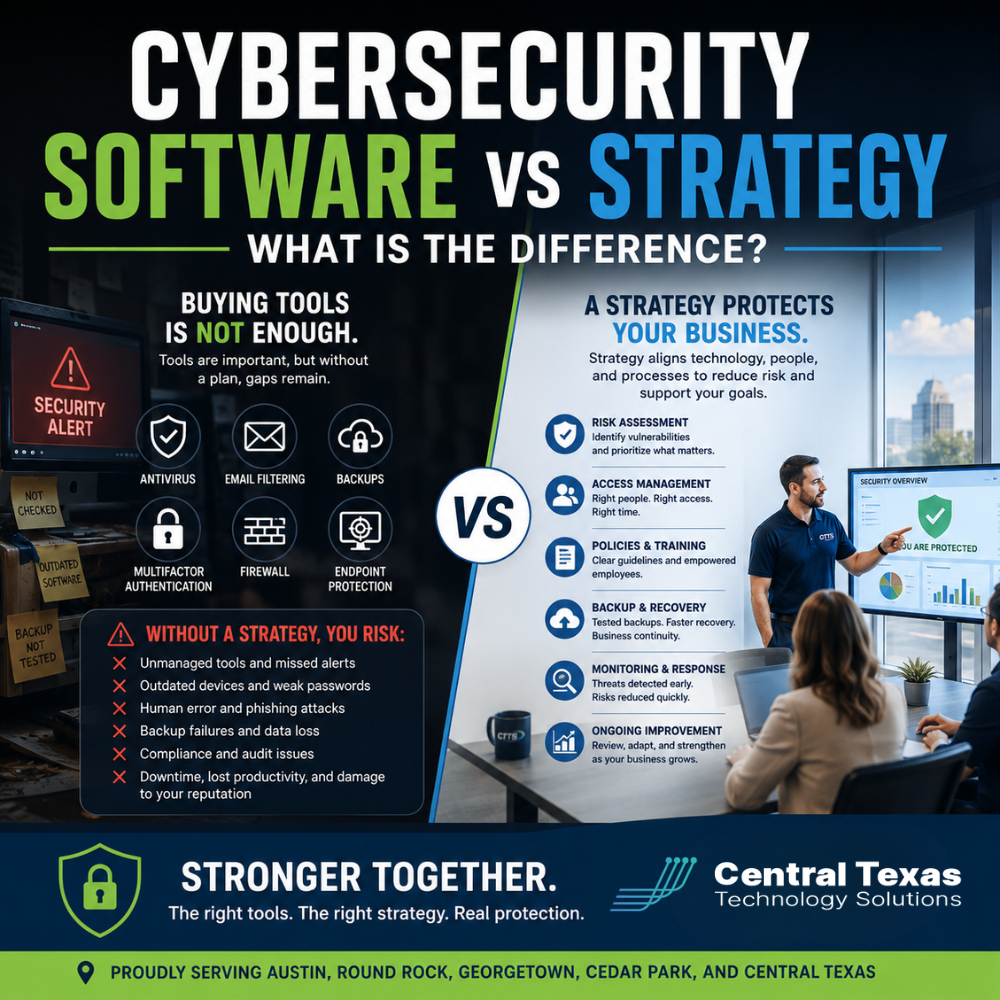
Many business leaders believe they are protected because they bought cybersecurity software.
They have antivirus.
They have spam filtering.
They have cloud backups.
They may even have endpoint detection tools, password managers, or multifactor authentication.
Those tools matter. But tools alone do not make a business secure.
A business can spend thousands of dollars on cybersecurity software and still have weak passwords, old devices, forgotten user accounts, risky file sharing, poor backup testing, and no plan for what happens when something goes wrong.
That is the difference between cybersecurity software and cybersecurity strategy.
Cybersecurity software gives your business tools. A cybersecurity strategy gives your business direction, accountability, and protection that matches the way your team actually works.
For growing businesses in Austin, Round Rock, Georgetown, Cedar Park, and across Central Texas, this difference matters. Whether you lead a healthcare practice, law firm, construction company, professional services firm, manufacturing business, or nonprofit, security cannot be treated like a one-time purchase.
It needs to be managed as part of your business.
Cybersecurity Software Is a Tool, Not a Complete Security Plan
Cybersecurity software is any technology used to help protect your business from digital threats.
Common examples include:
- Antivirus and endpoint protection
- Email filtering
- Firewalls
- Multifactor authentication
- Password managers
- Backup software
- Security monitoring tools
- Vulnerability scanners
- Mobile device management
- Cloud security tools
These are important pieces of protection. The problem starts when businesses assume that buying the tool means the risk has been handled.
It has not.
A firewall does not help much if it is misconfigured.
Backup software does not protect you if nobody checks whether restores actually work.
Email security does not stop every employee from clicking a convincing phishing message.
Multifactor authentication is weaker if former employees still have access to systems.
Endpoint protection cannot fully protect outdated devices that should have been replaced years ago.
Software can detect, block, alert, and report. But it does not decide what your business needs, who is responsible, how risks are prioritized, or how your team should respond during a real incident.
That requires strategy.
What Is a Cybersecurity Strategy?
A cybersecurity strategy is a structured plan for protecting your business based on your risks, goals, systems, people, compliance needs, and daily operations.
It answers practical questions like:
- What data matters most to the business?
- Who has access to sensitive systems?
- Which employees need extra security training?
- What happens if email is compromised?
- How often are backups tested?
- Which devices are outdated or unsupported?
- Are vendors and connected apps creating hidden risk?
- What compliance requirements apply to the business?
- How quickly can operations recover after an outage or attack?
A strong cybersecurity strategy connects technology decisions to business outcomes. It helps protect productivity, reduce downtime, support compliance, and keep customers, patients, clients, donors, and employees confident in your organization.
For example, a healthcare clinic in Austin may need stronger access controls because patient data is involved. A law firm in Georgetown may need strict document protection and email security because client confidentiality is critical. A construction company in Round Rock may need secure remote access for field teams. A manufacturer in Cedar Park may need stronger protections around operational systems and vendor access. A nonprofit may need affordable, practical safeguards that protect donor information without overwhelming staff.
The right strategy starts with how your business actually operates.
Why Buying Cybersecurity Tools Does Not Equal Being Secure
The biggest misconception in cybersecurity is that security is something you buy.
It is not.
Cybersecurity is something you build, manage, measure, and improve over time.
Buying tools without a strategy creates a false sense of security. Business leaders may think they are protected, while important gaps remain unaddressed.
Here are a few common examples.
Tools Are Often Installed but Not Fully Managed
Many businesses have cybersecurity software in place, but nobody is actively watching it, tuning it, updating it, or responding to alerts.
That creates a dangerous gap.
If a security tool sends an alert and no one reviews it, the business may miss early warning signs of an attack. If software is installed but not configured correctly, it may provide far less protection than expected.
A cybersecurity strategy defines who is responsible, what alerts matter, how issues are escalated, and how quickly action should be taken.
Businesses Often Protect the Wrong Things First
Without a strategy, businesses often buy whatever tool sounds urgent at the moment.
One month it is antivirus.
The next month it is backup.
Then it is email security.
Then it is compliance software.
Each purchase may be reasonable, but the overall approach can become fragmented.
A better strategy starts with risk. What could hurt the business most? What systems are essential? Where is sensitive data stored? What would stop operations if it failed?
For healthcare, legal, professional services, construction, manufacturing, and nonprofit organizations, the answer may be different. That is why a one-size-fits-all cybersecurity stack rarely works well.
Employees Still Need Clear Guidance
Even the best cybersecurity software cannot remove human risk.
Employees still handle passwords, open email, approve payments, share files, use mobile devices, and access cloud systems. If they are not trained, supported, and guided, they can accidentally create openings for attackers.
A cybersecurity strategy includes employee education, clear policies, and practical workflows that help people make better decisions without slowing the business down.
The goal is not to blame employees. The goal is to give them the right guardrails.
Compliance Requires More Than Software
For many businesses, cybersecurity is connected to compliance.
Healthcare organizations may deal with HIPAA expectations. Legal firms must protect confidential client information. Manufacturing companies may face vendor or contract requirements. Professional services firms often manage sensitive financial or business data. Construction companies may handle project documents, payment details, and remote team access. Nonprofits may be responsible for donor records and grant-related information.
Software can help support compliance, but it does not create a complete compliance posture by itself.
You still need documentation, policies, access reviews, audit preparation, evidence, and a clear process for managing risk.
Cybersecurity Strategy Starts With Business Risk
A strong cybersecurity strategy does not begin with a product demo.
It begins with understanding the business.
What would happen if your email went down for a day?
What would happen if your accounting system was locked by ransomware?
What would happen if a former employee still had access to company files?
What would happen if a client, patient, customer, or donor asked how their data is protected?
These are not just technical questions. They are leadership questions.
The right cybersecurity strategy helps business owners and executives make informed decisions about risk, budget, priorities, and accountability.
That is where CTTS helps Central Texas businesses move from scattered tools to a structured plan.
What a Cybersecurity Strategy Should Include
A practical cybersecurity strategy should be clear enough for leadership to understand and detailed enough for technical teams to act on.
It should include several core areas.
Risk Assessment
Before adding more tools, your business needs to understand where risk already exists.
This includes reviewing users, devices, networks, cloud systems, email security, backups, remote access, software, vendors, and existing security controls.
The goal is to identify what needs attention first.
Access Management
Not every employee should have access to every system.
A strategy should define who can access sensitive information, how access is approved, how it is removed when employees leave, and when access should be reviewed.
This is especially important for healthcare, legal, professional services, construction, manufacturing, and nonprofit teams that rely on cloud platforms, shared documents, and remote work.
Security Policies
Policies should be practical, not buried in a document nobody reads.
Your business should have clear expectations for passwords, multifactor authentication, device use, remote work, file sharing, email safety, vendor access, and incident reporting.
Good policies help employees understand what to do before a mistake becomes a crisis.
Backup and Recovery Planning
Backups are not enough unless they are tested.
A cybersecurity strategy should define what gets backed up, how often backups happen, where backups are stored, who checks them, and how quickly the business can restore operations.
This is where business continuity becomes real.
Monitoring and Response
Security alerts need a response plan.
A strategy should define how threats are monitored, who investigates alerts, when leadership is notified, and what steps happen during a suspected breach.
The faster a business responds, the better chance it has to limit damage.
Ongoing Improvement
Cybersecurity is not a one-time project.
New employees join. Software changes. Devices age. Vendors connect to systems. Attack methods evolve. Compliance expectations shift.
A strong strategy includes regular reviews so the business keeps improving instead of falling behind.
How CTTS Helps Businesses Move From Tools to Strategy
CTTS helps businesses across Austin, Round Rock, Georgetown, Cedar Park, and Central Texas take a proactive approach to cybersecurity.
Instead of waiting for something to break or reacting after an attack, CTTS helps businesses identify risk, strengthen weak points, and align technology decisions with business goals.
That means helping leaders understand:
- Which risks deserve attention first
- Which cybersecurity tools are working
- Which tools are missing or underused
- Where access should be tightened
- Whether backups are reliable
- How employees should be trained
- What policies need to be documented
- How security supports growth, compliance, and continuity
CTTS acts as a strategic partner, not just an IT provider. The goal is not to sell more software. The goal is to help your business operate with confidence.
The Real Difference: Software Protects Pieces, Strategy Protects the Business
Cybersecurity software protects specific parts of your environment.
Cybersecurity strategy protects the business as a whole.
Software may help block a threat. Strategy helps your business understand which threats matter most, how to reduce exposure, how to respond quickly, and how to keep operations moving.
For a growing business, that difference is critical.
A company can have great tools and still be vulnerable if there is no plan. But when the right tools are guided by the right strategy, cybersecurity becomes stronger, clearer, and more effective.
Signs Your Business Has Cybersecurity Tools but No Real Strategy
You may have a software-first approach if:
- You are not sure who reviews security alerts
- You have not tested backups recently
- Former employees may still have access
- Employees use personal devices without clear rules
- Password and MFA policies are inconsistent
- You do not have a written incident response plan
- Security decisions happen only after a scare
- Leadership does not receive regular security updates
- You keep adding tools, but risk still feels unclear
If any of these sound familiar, your business does not need more confusion. It needs a clearer plan.
Cybersecurity Strategy Helps Your Business Grow With Confidence
Growth creates complexity.
More employees, more devices, more cloud apps, more vendors, more locations, and more remote access all create more risk. Without a strategy, cybersecurity becomes reactive and stressful.
With the right strategy, your business can make better decisions before problems happen.
That helps protect:
- Efficiency
- Security
- Productivity
- Compliance
- Client trust
- Business continuity
For business leaders in healthcare, legal, professional services, construction, manufacturing, and nonprofits, cybersecurity is no longer just an IT issue. It is part of responsible leadership.
Build a Cybersecurity Plan That Protects Your Business
Buying cybersecurity software is a step in the right direction. But it is not the finish line.
If your business is relying on tools without a clear strategy, CTTS can help you identify gaps, prioritize risks, and build a practical cybersecurity plan that supports the way your business actually works.
Schedule a consultation with CTTS today to strengthen your cybersecurity strategy and move forward with confidence.
FAQ: Cybersecurity Software vs Cybersecurity Strategy
What is the difference between cybersecurity software and cybersecurity strategy?
Cybersecurity software includes the tools used to protect systems, such as antivirus, firewalls, backup software, and email filtering. A cybersecurity strategy is the broader plan that defines how those tools are used, managed, reviewed, and aligned with business risk.
Can a business be secure with just cybersecurity software?
No. Software is important, but it is not enough by itself. A business also needs policies, access management, employee training, monitoring, backup testing, incident response planning, and ongoing review.
How often should a business review its cybersecurity strategy?
Most businesses should review their cybersecurity strategy at least once a year. Growing businesses, regulated industries, and companies with remote teams, vendor access, or major system changes may need more frequent reviews.
Contact CTTS today for IT support and managed services in Austin, TX. Let us handle your IT so you can focus on growing your business. Visit CTTSonline.com or call us at (512) 388-5559 to get started!
Make your next IT decision with confidence. Start with these insights:
Managed IT Services vs Break Fix IT Support: Which Is Right for Your Business?
Local IT Support in Austin vs National IT Providers
In House IT vs Outsourced IT Support: Pros and Cons for Growing Companies
Microsoft 365 Support Through a Partner vs Doing It Yourself
Cloud First IT Consulting vs Traditional IT Infrastructure
Fully Managed IT vs Co Managed IT: Which Model Fits Your Business Best?
IT Generalists vs IT Specialists: What Does Your Business Really Need?
Should You Standardize Your Technology Stack or Stay Flexible?
One IT Vendor vs Multiple Vendors: Which Approach Reduces Risk?
Is It Better to Upgrade Your Current Systems or Start Fresh?