
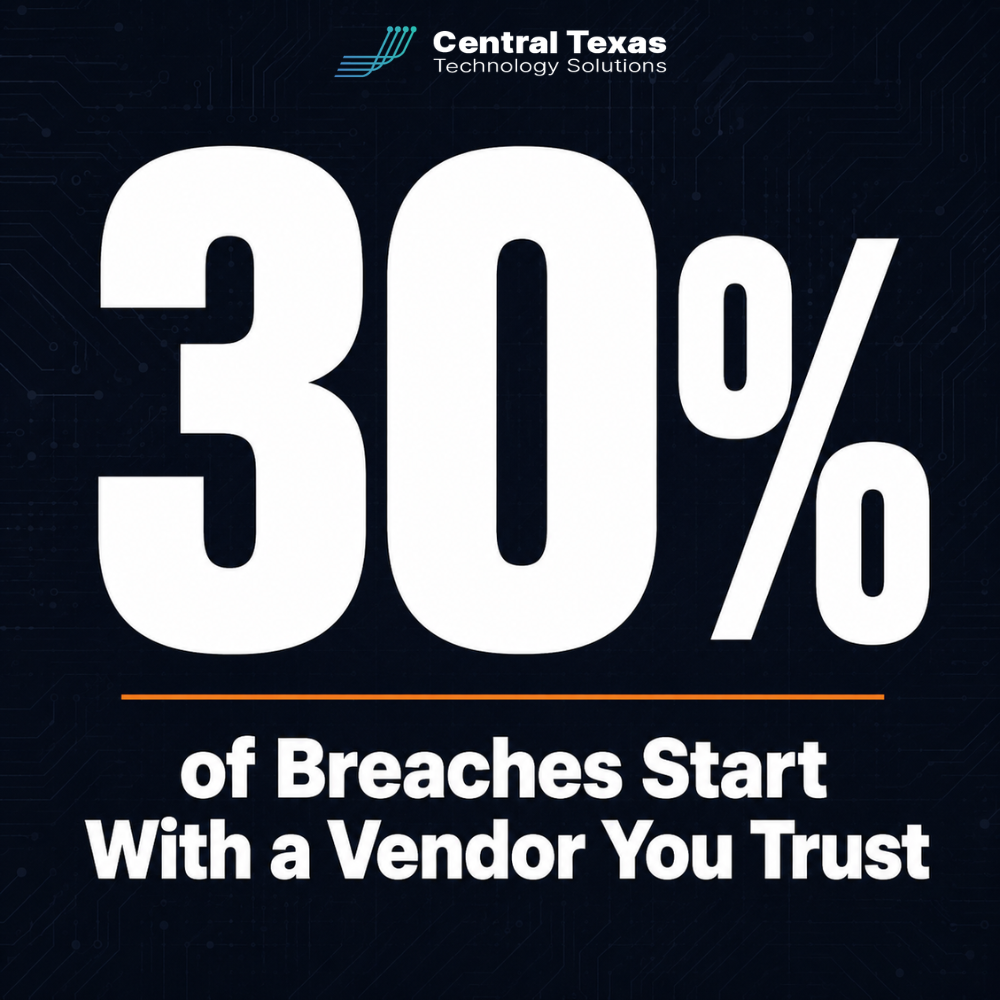
 In 2026, Central Texas businesses face a cybersecurity risk that most security checklists miss entirely: the vendors they rely on every day. Third-party vendor breaches now account for 30% of all data incidents, according to the Verizon Data Breach Investigations Report, double the rate from just two years ago.
If your business pays for a payroll platform, a benefits administrator, a CRM, or a cloud storage service, you are sharing your most sensitive data with companies whose security posture you have probably never reviewed. The right cybersecurity services will help you see and close that gap before it becomes a crisis.
What Is at Stake
The average cost of a data breach for a small to mid-sized business now exceeds $200,000. That figure does not capture the full damage. It excludes the weeks of operational disruption, the client relationships that erode when a notification letter arrives, and the reputational damage that follows in a market as relationship-driven as Central Texas.
Under Texas law, businesses are required to notify affected individuals without unreasonable delay when a breach involves personal information. That obligation applies to your business even if you were not the one that was breached. If your payroll vendor was compromised and employee Social Security numbers were exposed, the notification burden is yours. The relationship damage is yours. The liability exposure is yours.
Small and mid-sized businesses represent 48% of all breaches involving high-risk data such as Social Security numbers, financial credentials, or authentication tokens. The size of your company does not insulate you from these incidents. It simply means you are less likely to have the legal team, the communications team, or the IT bench needed to manage the aftermath.
Why Central Texas Businesses Face This Challenge
Businesses across Austin, Georgetown, San Marcos, and the broader Central Texas region tend to operate lean. A company with 50 employees is unlikely to have a dedicated IT director, let alone a formal vendor risk management program. Vendor relationships are built on trust, referrals, and a contract that someone's attorney reviewed a few years ago. Nobody audits the vendor's security practices at renewal. Nobody maps what data the vendor can access, export, or retain after the relationship ends.
Professional services firms, healthcare practices, and nonprofits are especially exposed. These organizations handle the most sensitive categories of data, medical records, legal documents, financial information, donor records, and they depend heavily on third-party platforms to manage it. A law firm or accounting practice might use cloud-based practice management software, a client portal, an email marketing tool, and a document storage service.
Each one of those vendors holds a different slice of sensitive information. If any one of them is compromised, the firm's clients receive the notification, and the firm bears the reputational cost.
The attack surface for your business is not your office walls. It is the entire ecosystem of tools your business trusts every day.
How CTTS Cybersecurity Services Address Vendor Risk
CTTS takes a structured approach to what we call vendor risk hygiene. It starts with a vendor data access audit: we identify every third-party platform or service that holds your employee data, your client data, or your financial systems access. Most business owners are surprised by how many vendors appear on that list, and how much access each one has been granted over the years.
From there, we assess the security posture of your highest-risk vendors. Do they carry cyber liability insurance? Do their terms of service define how your data is handled, stored, and deleted when the relationship ends? Do they maintain SOC 2 compliance or equivalent security certifications? These are questions your Managed IT Services partner should be asking on your behalf, and they are questions CTTS makes standard practice for every client.
We also help you build incident response coordination into your vendor agreements. That means defining in writing how a vendor notifies you of a breach, within what timeframe, and what their obligations are to support your remediation. Most vendor contracts are silent on these points unless someone puts them there.
Best Practices for Protecting Your Business From Vendor Data Risk in 2026
Know What Data Each Vendor Can Access
Start with a simple exercise: list every third-party platform your business currently uses, and for each one, document what category of data it holds. Can your HR software export employee Social Security numbers? Can your CRM access client payment information? Does your marketing platform store customer email addresses along with behavioral data and purchase history?
Most business owners have never completed this exercise. When they do, they almost always find at least one vendor holding sensitive data that nobody thought to assess or restrict. That vendor is your highest-priority risk. Treat the gap like the security exposure it is, and prioritize closing it before a breach forces your hand.
Data visibility is not a one-time project. As your business adds new tools, as vendors update their feature sets, and as employee turnover changes who has credentials to what, your vendor data map needs to stay current. A good managed IT security partner makes this an ongoing practice rather than a one-time audit.
Review Your Vendor Contracts Before a Breach Forces You To
Your vendor contracts define your rights and obligations when an incident occurs. If the contract does not require the vendor to notify you within 72 hours of discovering a breach, they may not. If it does not define data retention and deletion obligations, the vendor may retain your data indefinitely after you cancel the service.
Take your three highest-risk vendor agreements and review them this quarter. Look specifically for breach notification language, data handling requirements, data deletion terms, and liability provisions. Where that language is absent or weak, request a contract amendment. Most vendors will accommodate reasonable data security terms, particularly when framed as a compliance or insurance requirement on your end.
This is not a legal exercise for its own sake. It is a practical risk management step that takes less than a day to complete and defines what happens on your worst day. Businesses that have done this work in advance navigate vendor breach notifications far more cleanly than those that have not.
Apply Multi-Layer Authentication Across Third-Party Connections
Every vendor portal your employees access is a potential entry point for attackers. Requiring multi-factor authentication across all vendor logins is one of the most straightforward controls available and one of the most frequently overlooked. It will not prevent a vendor from being breached on their infrastructure, but it will prevent an attacker from using your stolen credentials to access that vendor's portal after a breach.
Review your MFA posture for vendor logins specifically, not just your internal systems. Many businesses have strong MFA policies for Microsoft 365 and core applications, while dozens of SaaS tools employees log into every day have no MFA requirement at all.
Build Incident Response Into Your Vendor Agreements
Your business should have a documented process for what happens when a vendor notifies you of a breach. Who gets informed internally? Who handles client communication? Who contacts your attorney? Who notifies your cyber insurance carrier? The businesses that manage vendor breach notifications well are the ones that planned for them before they happened.
A one-page vendor breach response checklist, reviewed annually with your IT partner, can be the difference between a manageable incident and a public relations crisis. It does not need to be complex. It needs to exist, be accessible, and be practiced at least once before you need it.
Take the Next Step
Your vendors are part of your security posture whether you manage them that way or not. CTTS works with Central Texas businesses to close the visibility gaps, ask the right questions of your vendor stack, and build a protection framework that accounts for the risks most businesses cannot see from inside their own walls.
Schedule a free strategy session with CTTS at to start with a vendor risk conversation today.
Frequently Asked Questions
What is a third-party data breach?
A third-party data breach occurs when a vendor or service provider your business relies on is compromised, and attackers gain access to data your business shared with that vendor. Even though your own systems were not directly breached, your business data is exposed and you may still carry legal notification obligations to affected employees or clients under Texas law.
These incidents are increasingly common because attackers find it more efficient to target vendors that hold data from hundreds of businesses at once, rather than attacking each company individually. The 2025 Verizon DBIR confirmed that third-party involvement in breaches doubled in a single year, and that trend has continued into 2026.
How do I know which vendors pose the highest risk to my business?
Risk is generally proportional to the sensitivity of the data the vendor holds and the security maturity of the vendor itself. Begin by identifying which vendors hold personal employee data, client information, financial credentials, or health records.
Within that group, the highest-risk vendors are those without documented security certifications such as SOC 2 or ISO 27001, those with vague or absent breach notification terms in their contracts, and those that do not require multi-factor authentication for user access.
An IT partner like CTTS can conduct a structured vendor risk assessment that prioritizes your gaps and gives you a clear action order.
Is my business legally required to notify customers after a data breach in Texas?
Yes. Under the Texas Identity Theft Enforcement and Protection Act, businesses that experience a breach affecting Texas residents must notify affected individuals without unreasonable delay. If the breach involves more than 250 Texas residents, the business must also notify the Texas Attorney General.
Critically, this obligation applies even when the breach originated with a third-party vendor your business hired — the notification duty is yours if the compromised data belongs to your clients or employees, not the vendor's. Most businesses are surprised to learn this, which is exactly why reviewing vendor contracts and understanding your data exposure before an incident occurs is essential in 2026.
Contact CTTS today for IT support and managed services in Austin, TX. Let us handle your IT so you can focus on growing your business. Visit CTTSonline.com or call us at (512) 388-5559 to get started!