
 Every business runs on connected apps. The scheduling tool linked to your calendar, the e-signature platform tied to your documents, the AI assistant someone trialed last year and forgot about. In 2026, attackers have figured out that these quiet connections are the easiest way into your data, and as an Austin cybersecurity company, CTTS is watching it happen to businesses across Central Texas.
What Is at Stake
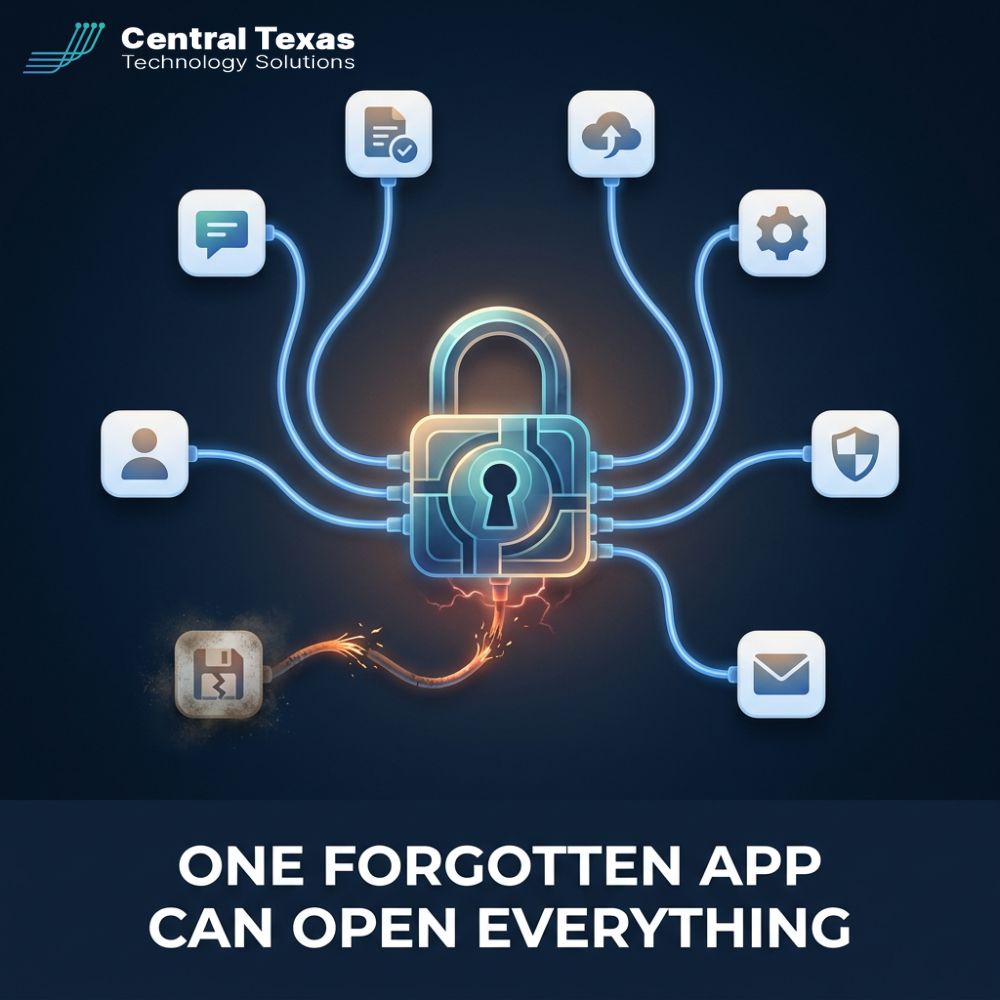
This spring, the developer platform Vercel disclosed a breach that should worry every business owner, not just tech companies. Attackers never touched Vercel's front door. Instead, they compromised a small vendor called Context.ai, an AI analytics tool that some Vercel employees had connected to their accounts. That connection, granted through a standard authorization process called OAuth, still held valid access months after the trial ended. The attackers picked up that forgotten key and walked in.
The pattern is not isolated. The Salesloft Drift campaign in 2025 reached more than 700 organizations through a single compromised integration, and Mandiant reported in April 2026 that over 1,000 SaaS environments were affected in one supply chain campaign. According to the Verizon Data Breach Investigations Report, third party involvement in breaches doubled in a single year, from 15 percent to 30 percent of all incidents.
The financial stakes are just as sobering. When a breach originates with a third party, remediation costs now average nearly 4.8 million dollars, roughly 40 percent more than a breach contained within your own systems. And under Texas law, the notification duty falls on you, not your vendor. If a breach involves at least 250 Texas residents, you must report it to the Texas Attorney General within 30 days of discovery. Your vendor's mistake becomes your legal obligation, your cost, and your reputation on the line.
Why Central Texas Businesses Face This Challenge
The typical business we serve runs between 25 and 250 employees and relies on a stack of cloud services to stay lean. A law firm in Round Rock might have its practice management platform, e-signature service, document storage, and a transcription tool all connected to Microsoft 365. A medical practice in New Braunfels might link scheduling, billing, patient communication, and an AI notetaker to the same environment.
Each of those connections was approved with a single click on a screen that said something like "This app would like to access your account." Nobody reads those screens twice. Nobody goes back later to check what is still connected. The employee who approved the app may have left the company two years ago, and the access remains.
This is what security professionals call OAuth app sprawl, and it grows silently. Unlike a password, an OAuth token does not expire when someone changes their credentials. It is not covered by your multifactor authentication. It sits there, valid and trusted, until someone deliberately revokes it. Growing companies along the I-35 corridor adopt new tools constantly, which means the sprawl compounds faster here than almost anywhere.
How an Austin Cybersecurity Company Helps You Take Back Control of Connected Apps
CTTS approaches this problem the way we approach everything: reduce your risk and help you keep more of your money. The first step is visibility. We audit your Microsoft 365 tenant and identify every third party application that has been granted access, what permissions each one holds, who approved it, and when it was last actually used. Most owners are stunned by the list. Dozens of connections are typical, and a meaningful share of them belong to tools the business stopped using long ago.
The second step is cleanup. We revoke access for abandoned and unnecessary apps, and we tighten overly broad permissions on the ones you keep. An invoicing tool may need to read your contacts, but it almost never needs the ability to read every mailbox in the company. Right sizing those permissions shrinks the blast radius if any single vendor is ever compromised.
The third step is governance going forward. We configure your environment so new app connections require administrator approval before they take effect, and we fold connected app reviews into your regular security cadence. That way the inventory you worked to clean up stays clean, and every new tool gets a quick risk check before it touches your data.
Best Practices for Managing SaaS and OAuth Risk in 2026
You do not need to be technical to lead well on this issue. These are the conversations every CEO and CFO should be having.
Demand a Living Inventory of Connected Apps
You cannot protect what you cannot see. Ask your IT provider or internal team for a current list of every application connected to your business systems, including what data each app can reach and when it was last used. If the answer takes more than a few days to produce, that delay is itself a finding.
Treat this inventory like your client list or your financials: a living document, reviewed on a schedule. Quarterly is a reasonable rhythm for most businesses. The review does not need to be long. It needs to be consistent, because sprawl returns quietly the moment attention moves elsewhere.
Revoke First, Ask Questions Later
When you find a connection nobody recognizes or a tool nobody has opened in six months, revoke its access. If it turns out someone still needed it, reconnecting takes two minutes. The reverse mistake, leaving a forgotten connection alive because removing it feels risky, is exactly how the Vercel attackers got their opening.
Pay special attention to departed employees. Offboarding checklists usually cover passwords and devices, but app authorizations granted by that person often survive their exit. Make revoking their personal app grants a standard offboarding step.
Require Approval Before New Apps Connect
Modern platforms like Microsoft 365 allow you to require administrator consent before any new application can access company data. Turning this on is one of the highest value, lowest cost security moves available to a small business. It converts every future "Connect Your Account" click from an instant grant into a quick review.
The review itself can be lightweight. Who makes this app, what data does it want, and does the requested access match what the tool actually does? Five minutes of friction at the front door beats months of incident response after a compromise.
Vet the Vendors Behind the Apps
Before your team adopts a new tool, ask the vendor two questions: how will you notify us if you are breached, and what happens to our data if we cancel? A vendor that cannot answer crisply is telling you something. For tools that will touch sensitive client or patient information, ask for their security documentation, such as a SOC 2 report.
This does not need to slow your business down. A simple one page vendor checklist, applied consistently, filters out the riskiest choices and gives you a paper trail your insurer and your clients will appreciate.
Take the Next Step
If you cannot name every app connected to your company data right now, you are carrying risk you have not priced. As an Austin cybersecurity company serving the entire Central Texas corridor, CTTS helps businesses find those hidden connections, close the dangerous ones, and put guardrails on everything new.
Schedule a free strategy session with CTTS today and let's get you a clear answer.
Frequently Asked Questions
What is OAuth app sprawl and why is it dangerous for my business?
OAuth app sprawl is the buildup of third party applications that have been granted standing access to your business systems through "Connect Your Account" style authorizations. Each connection is a set of valid credentials that lives outside your password policies and multifactor authentication. When one of those vendors is compromised, attackers inherit its access to your data without ever logging in as you. Because most businesses never review these grants, attackers increasingly target them as the path of least resistance.
How do I find out which apps have access to my Microsoft 365 data?
Microsoft 365 administrators can view enterprise applications and their permissions in the Microsoft Entra admin center, which lists every app that users have authorized. The challenge is interpretation: knowing which permissions are excessive, which apps are abandoned, and which vendors are risky takes security experience. A qualified Austin cybersecurity company can run this audit quickly, explain the findings in business terms, and handle the cleanup safely. CTTS performs connected app audits as part of our broader security assessments for Central Texas businesses.
What should I do if a vendor or app we use gets breached?
Move quickly on three fronts. First, revoke the vendor's access to your systems immediately, since their tokens may be in attacker hands even if your own accounts look untouched. Second, determine what data the vendor could reach, because Texas law requires you to notify affected individuals without unreasonable delay and to report breaches involving 250 or more Texas residents to the Texas Attorney General within 30 days. Third, document everything for your cyber insurance carrier. An IT partner who already maintains your app inventory can compress this entire response from weeks into hours.
Contact CTTS today for IT support and managed services in Austin, TX. Let us handle your IT so you can focus on growing your business. Visit CTTSonline.com or call us at (512) 388-5559 to get started!