
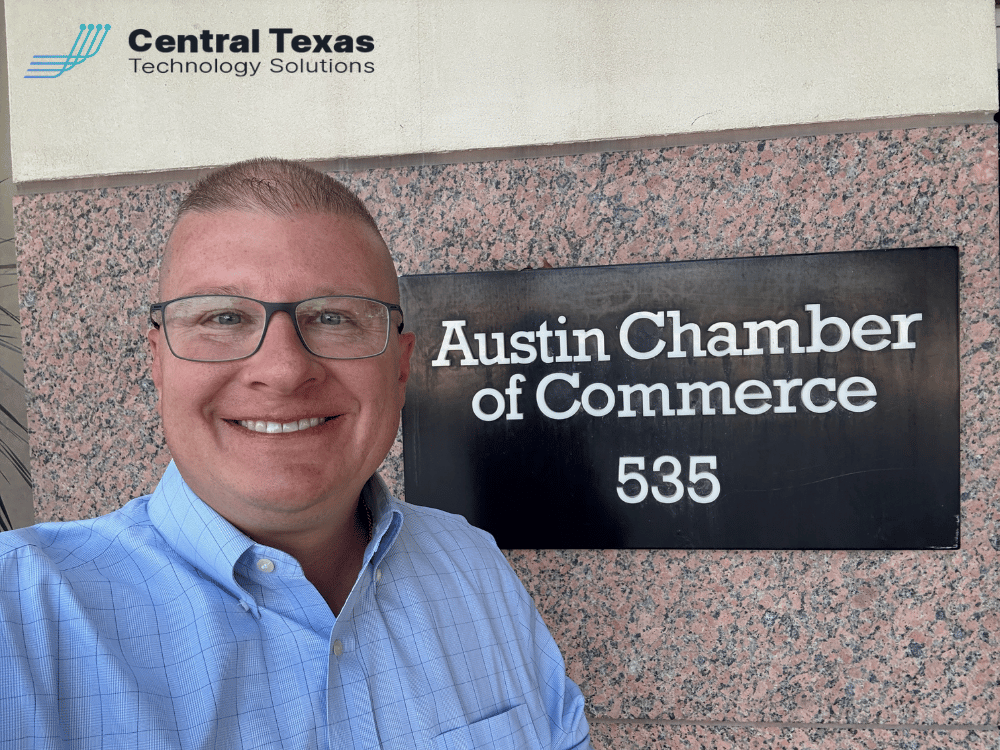
On Wednesday, August 12, I had the privilege of joining a panel hosted by the Austin Chamber's Business Owners Council on a topic I care about deeply: Innovation, AI, and Technology, and what owners actually need to know.
I want to start with a genuine thank you to the Austin Chamber, and specifically to Britney Hartle, Vice President of Corporate Engagement, for organizing a session that gave real answers instead of hype. If you run a business in Central Texas and you have been trying to sort out what AI actually means for you in 2026, this recap is for you.
What We Talked About
The session was built around four themes: understanding what AI actually is beyond consumer chatbots, where it delivers practical value, how to govern it responsibly, and what to do first. Writ Baese, Co-Chair of the Business Owners Council and President of Hill Country Payroll, moderated the panel, and I was joined by three people whose perspectives made the conversation far richer than anything I could have offered alone.
Malini Mistry, CEO of 963IT and a board member of the ISACA Austin Chapter, opened the conversation by framing what business owners should understand about AI beyond tools like ChatGPT, then carried the discussion into agentic AI and the governance policies every business should have in place before employees start using AI tools on their own. Raja Sampathi, founder of MeanderingSapien, brought a perspective I had not thought enough about myself: how a company builds the kind of visibility and credibility that gets it recommended by AI powered search tools, and why waiting on that is riskier than most owners assume. Tommy Wald, CEO of RIATA Technologies, rounded out the panel with his own read on where technology investment is paying off for growing companies. Between the four of us, the room got a genuinely well rounded picture instead of one person's opinion dressed up as a trend report.
My part of the conversation focused on three questions: where AI is delivering real value for small and mid-sized businesses today, the security and privacy risks of putting company, customer, or employee data into AI tools, and the three concrete actions an owner should take in the next 30 days to start using AI responsibly.
Why This Conversation Matters for Central Texas Business Owners
Here is the honest truth I shared on the panel. Most owners in that room, and most of the clients I talk with every week, are not behind on AI because they lack ambition. They are behind because nobody has given them a straight, practical answer to what to actually do. The tools are moving fast, the marketing around them is louder than the substance, and most business owners are simply trying to run a company, not become an AI expert on the side.
That gap is exactly why events like the Business Owners Council matter. Central Texas has a dense, competitive small business community, and the owners who figure out how to use AI as a genuine advantage, rather than either ignoring it or bolting it on without a plan, are the ones who will be ahead in a year. Technology solutions Austin owners can trust need to start with clarity, not hype.
Key Takeaways for Any Business Owner
AI adoption succeeds or fails based on a handful of decisions made early, not on which tool you pick. Here is what I want every owner reading this to walk away with, whether you were in the room on the 12th or not.
Where Is AI Actually Delivering Value for Small and Mid-Sized Businesses Right Now?
The clearest wins I am seeing across our own client base are in the back office, not the flashy places. Drafting and summarizing documents, cleaning up scheduling and routine customer communication, and helping short staffed teams keep up with the administrative load that used to require another hire. The businesses getting real value are not chasing the newest AI headline. They are picking one specific, boring, repeatable task and automating it well.
What Are the Real Security and Privacy Risks of Using AI Tools?
The biggest risk is not a dramatic hack. It is an employee pasting a customer list, a contract, or financial data into a free AI tool because it is faster, with no idea where that information goes afterward or whether it gets used to train someone else's model. Most businesses have no policy at all governing this, which means the decision is being made ad hoc, dozens of times a day, by people who are not trying to cause harm and have no idea they are creating exposure.
What Is Agentic AI and Why Should Owners Care?
Malini's answer to this on the panel stuck with me. Agentic AI refers to AI systems that do not just answer a question but can actually take multi-step actions on your behalf, booking, updating records, triggering workflows, largely without a human clicking approve at every step. That is a meaningful shift from the chatbot most owners picture when they hear "AI," and it means governance questions that felt theoretical a year ago are now urgent.
What Three Actions Should an Owner Take in the Next 30 Days?
This is the question I got the most follow up on after the panel, so here is the honest version. First, write a short, plain language policy telling employees what information can and cannot go into public AI tools, even if it is one page. Second, pick a single, specific, low risk process to pilot AI on, rather than trying to transform the whole business at once. Third, ask whoever manages your technology, internal or outsourced, to tell you exactly what AI tools are already running inside your business today, because in most companies nobody has actually counted.
How Should Owners Prepare Their Team, Not Just Their Tools?
This was Malini's closing point, and it is one I believe firmly. Employees are not worried about AI in the abstract. They are worried about their own job, their own role, and whether leadership will be honest with them about what is changing. Owners who talk openly with their teams about what AI will and will not touch build far more trust, and far less quiet resistance, than owners who roll out new tools without any conversation at all.
Take the Next Step
I am grateful to the Austin Chamber for creating a space where business owners can get straight answers instead of sales pitches, and I am grateful to Malini, Raja, Tommy, and Writ for making the conversation better than I could have on my own. If this recap raised more questions than it answered, that is normal, and it is exactly the kind of conversation CTTS has with Central Texas owners every week.
Schedule a free Executive IT Risk Assessment today. It's a good starting point if you want a clear, no obligation look at where your business actually stands with AI and technology today.
Frequently Asked Questions
What was the Austin Chamber Business Owners Council panel about?
The August 12, 2026 panel, titled "Innovation, AI & Technology: What Owners Actually Need to Know," covered what AI actually is beyond consumer chatbots, where it delivers practical value for small and mid-sized businesses, how to govern it responsibly, and what owners should do first.
Who else was on the panel with Josh Wilmoth?
The panel was moderated by Writ Baese, Co-Chair of the Business Owners Council and President of Hill Country Payroll, with panelists Malini Mistry of 963IT, Raja Sampathi of MeanderingSapien, Tommy Wald of RIATA Technologies, and Josh Wilmoth of CTTS.
What is the single most important first step for a business owner exploring AI?
Write a short, plain language policy on what information employees can and cannot put into public AI tools before adoption spreads further. It is the fastest way to close the biggest and most common gap owners have right now.
Contact CTTS today for IT support and managed services in Austin, TX. Let us handle your IT so you can focus on growing your business. Visit CTTSonline.com or call us at (512) 388-5559 to get started!