
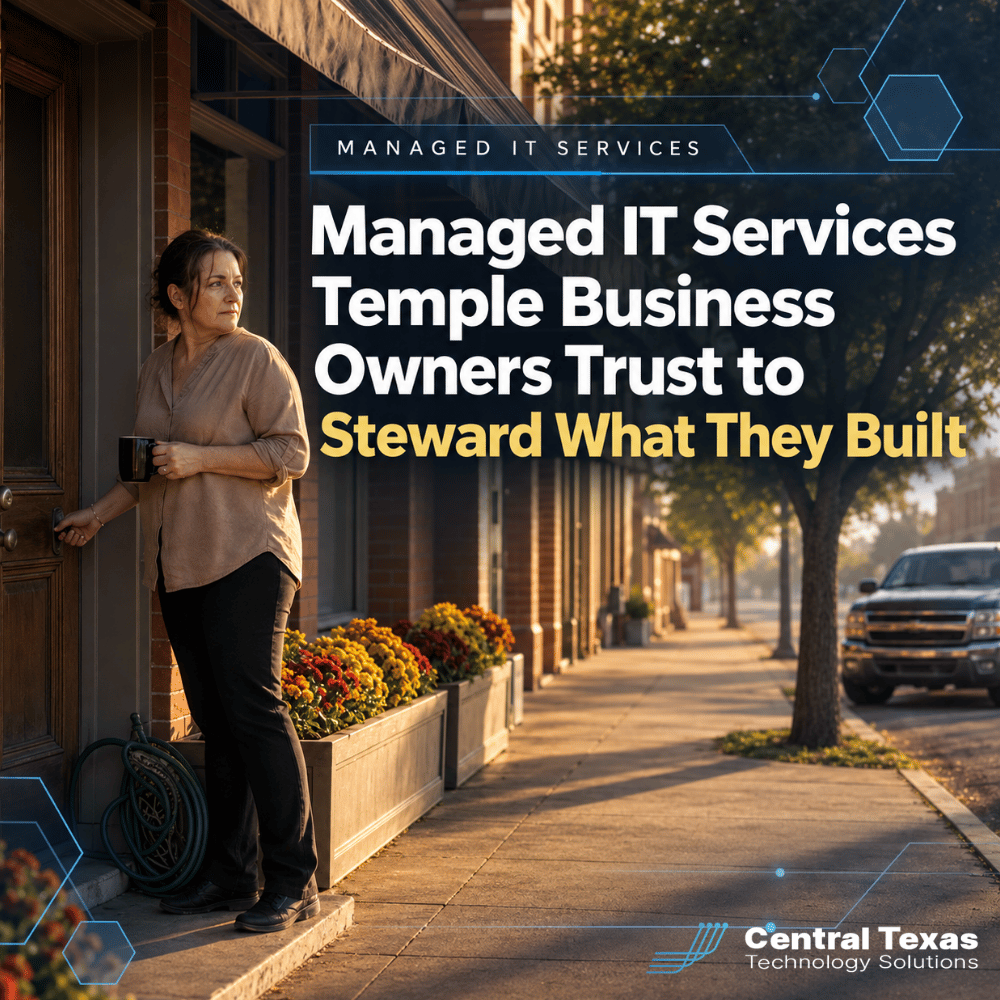
If you own a business in Temple, you did not build it by accident. In 2026, the systems holding that business together deserve the same care you gave your first customer, your first hire, and your first location. The right managed IT services Temple owners rely on treat your technology as something to be stewarded, not simply something to be fixed after it breaks.
Quick Answer: Technology stewardship means treating the systems your business runs on as something you are responsible for rather than something you simply bought. In practice that means protecting them before they fail, funding them honestly, and making sure the people who depend on them can do their work.
Key Takeaways
- Stewardship is a leadership question before it is a technical one, and it belongs to the owner, not the vendor.
- Most technology losses at Central Texas businesses come from deferred decisions, not sudden disasters.
- A well stewarded IT environment is documented, funded, monitored, and reviewed on a schedule you control.
- Companies with 10 to 250 employees rarely need more technology. They need someone accountable for the technology they already have.
- The question to ask a potential IT partner is not what they sell. It is what they are willing to be responsible for.
What Is at Stake When Nobody Is Stewarding Your Technology
Everything you built runs on systems most of your team never thinks about, right up until the morning those systems stop.
I have sat across the table from a lot of owners in Bell County and along the corridor, and the conversation almost never starts with technology. It starts with a payroll file nobody can open, a scheduling system that went down during the busiest week of the quarter, or a longtime employee who left and still has access to the shared drive. By the time technology becomes the topic, it has already cost something.
That is what is at stake. Not servers and not software licenses, but the trust your customers place in you, the paychecks your team is counting on, and the reputation you spent years earning in a community where word travels fast. A business is one IT failure away from a serious problem, and the failure is rarely dramatic. It is usually a small thing that went unwatched for a long time.
Stewardship is the opposite of that. It is the discipline of paying attention to what you have been entrusted with before anyone forces you to.
Why Temple and Central Texas Businesses Face This Challenge
Growth hides technology problems, because a busy business always has something more urgent than the thing that has not broken yet.
Temple has become a genuinely attractive place to build a company. Low operating costs, a workforce that is expanding, and a business community that actually shows up for each other have drawn new employers into the area and given established ones room to grow. Anyone who has driven past the new construction on the west side of town in the last two years has seen it.
That growth is good news, and it creates a specific blind spot. When a company goes from twelve people to forty, the technology usually grows the same way the office does, one addition at a time. A laptop here, a cloud application there, a new location that needed internet fast so somebody plugged in whatever worked. Nobody sat down and designed it. It accumulated.
Owners in Temple, Georgetown, and Round Rock tell me the same thing: they are not neglecting their technology on purpose. They are running a business. The person handling IT is often the operations manager who is good with computers, or a break fix vendor who shows up when called and disappears when the invoice is paid. Neither arrangement includes anyone whose actual job is to look ahead.
That is the gap. Not a lack of care, but a lack of ownership.
How CTTS Helps Temple Owners Steward Their Technology
Our job is not to be the hero of your business. It is to make sure the technology never gets in the way of the work you are actually here to do.
CTTS has served Central Texas since 2002, and the reason we are still here is not that we sell the newest tools. It is that we have treated other people's businesses the way we would want ours treated. When you call us, the phone is answered in three rings by someone local who knows your name and your environment.
For companies that want the whole thing handled, Complete Care Coverage is our fully managed offering. It brings the helpdesk, monitoring, patching, backup, security, and strategic guidance under one flat monthly agreement, so the work of watching your systems happens whether or not anyone remembers to ask for it. For businesses that already have internal IT staff, our Co-Managed IT option extends our remote monitoring, documentation platform, and PSA tools to your team so they are not carrying the whole load alone.
Either way, the point is the same. Somebody is accountable. Somebody is looking at your environment on a Tuesday morning when nothing is on fire, noticing that a backup has not completed in nine days, and fixing it before it becomes the worst week of your year.
Four Stewardship Habits That Protect What You Have Built
What Does Good Technology Stewardship Actually Look Like?
Good technology stewardship looks like knowing what you have, knowing what protects it, and knowing who is responsible when something changes. That is it. There is no exotic tooling required.
In practice it means a current inventory of every device and cloud application your business touches, a written record of who has access to what, verified backups you have actually tested by restoring something, and a named person or partner who owns each of those things. Most businesses we meet can produce none of the four on the day we ask. Within ninety days of starting a managed relationship, they can produce all four.
How Often Should a Business Owner Review Their IT?
A meaningful review belongs on the calendar quarterly, with one deeper annual planning session tied to your budget cycle. Anything less frequent and you are reacting rather than stewarding.
The quarterly conversation does not need to be technical. It should answer four questions in plain language. What changed in the business this quarter. What is aging out and when will it need replacing. What is our current risk exposure and is it moving in the right direction. What should we spend next quarter and why. If your current IT arrangement cannot give you those answers without a translator, that is worth knowing.
Fund Technology the Way You Fund the Building
Nobody is surprised when a roof needs replacing after twenty years. We plan for it, we set money aside, and we schedule the work before the ceiling stains show up. Technology is treated completely differently at most companies, as an emergency expense that appears without warning.
Workstations have a lifespan. So do firewalls, switches, and wireless access points. When you know the replacement year for every one of them, the budget stops being a surprise and starts being a plan. Predictable spending is not a small thing when you are trying to protect margin.
Leave the Business Stronger Than You Found It
The best test of stewardship is what happens when you are not there. If your business could not run for two weeks without you personally unlocking something, approving something, or remembering a password, then the systems are dependent on you rather than serving you.
Documented environments, standardized equipment, clear offboarding, and tested recovery procedures are how a company becomes something that outlasts any one person. That is worth doing whether you plan to sell someday, hand it to your kids, or simply take a vacation without your laptop.
Take the Next Step
You do not have to overhaul anything to find out where you stand. The Executive IT Risk Assessment is a straightforward look at your current environment, your exposure, and the gaps between what you think is protected and what actually is. You get a plain language summary you can act on, whether you act on it with us or not.
If you run a business in Temple, Georgetown, Austin, or anywhere along the Central Texas corridor with 10 to 250 employees, this is the kind of conversation that costs you an hour and can save you a very bad quarter.
Schedule a free strategy session with CTTS.
Have Questions? We've Got Answers
What is the difference between managed IT services and just calling someone when something breaks?
Break fix means you pay for problems after they happen, so your vendor only makes money when something goes wrong. A managed agreement is a flat monthly fee for keeping things from going wrong in the first place, which puts your interests and your provider's interests on the same side. For most Temple businesses, the managed model ends up costing less over a year because the expensive emergencies stop happening.
How much do managed IT services in Temple typically cost?
Managed services are usually priced per user and per device, and a typical user with their equipment runs around $250 per month all in. The exact number depends on how many locations you have, what compliance requirements you carry, and how much of your environment lives in the cloud. Any provider who quotes you a price before understanding those things is guessing.
Do I need to replace my current IT person to work with a managed provider?
No, and in a lot of cases you should not. Co-Managed IT exists specifically for businesses that have internal staff worth keeping, extending our monitoring, documentation, and tooling to your team so they can focus on the work only they can do. The right structure depends on what your person is good at and where they are stretched too thin.
Contact CTTS today for IT support and managed services in Austin, TX. Let us handle your IT so you can focus on growing your business. Visit CTTSonline.com or call us at (512) 388-5559 to get started!