
Cybersecurity problems rarely appear out of nowhere. Most start as small weaknesses that go unnoticed until a hacker, ransomware group, or careless user finds them first.
That's why many businesses ask for a security scan. A scan can be useful, but it's only one piece of a much bigger process.
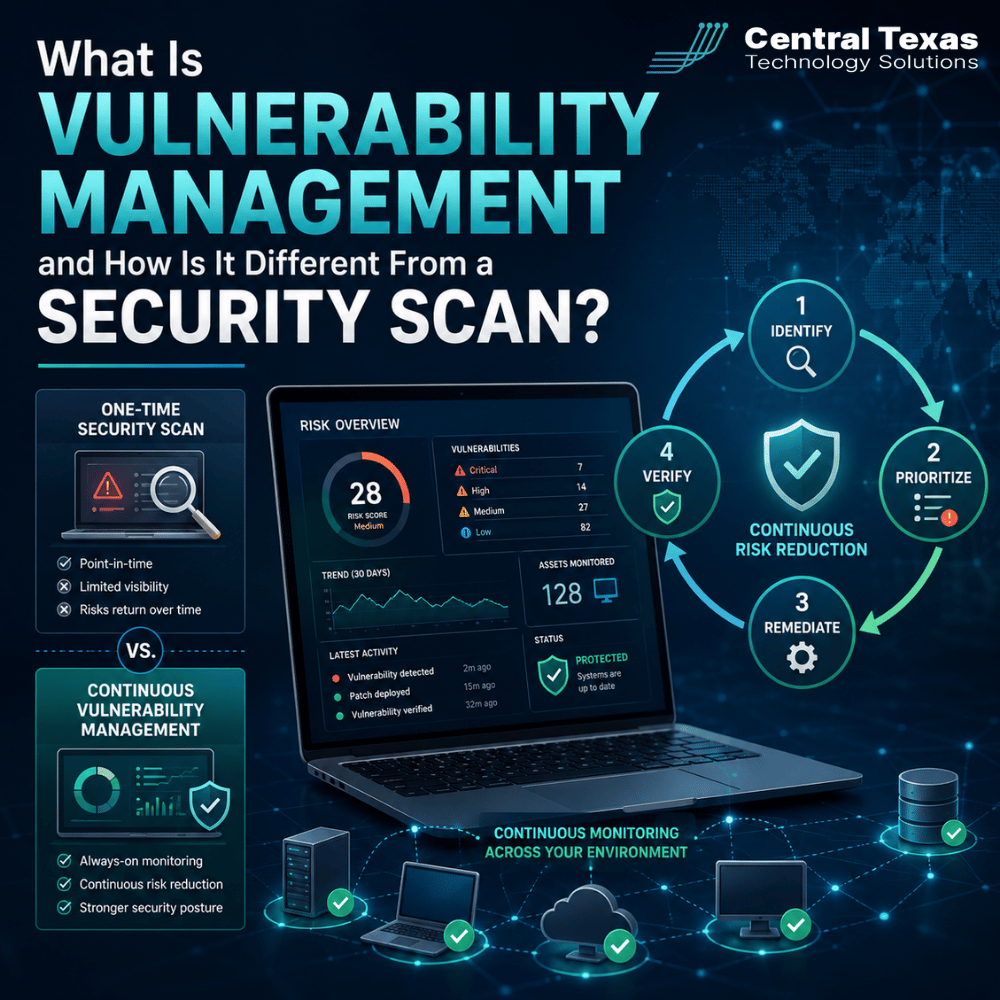
Vulnerability management is the ongoing practice of finding, prioritizing, fixing, and verifying security weaknesses across your technology environment. A security scan may tell you what is exposed today. Vulnerability management helps reduce risk over time.
For growing businesses in Austin, Round Rock, Georgetown, and Cedar Park, that difference matters. Whether you operate in healthcare, legal, professional services, construction, manufacturing, or the nonprofit sector, your systems hold data, workflows, and access points that need more than occasional attention.
Vulnerability Management Is an Ongoing Security Process
Vulnerability management is not a one-time report. It is a repeatable process designed to help your business stay ahead of risk.
A strong vulnerability management program includes four key steps:
- Identifying weaknesses across devices, software, cloud systems, and network assets
- Prioritizing the most serious risks based on business impact
- Remediating issues through patches, configuration changes, or compensating controls
- Verifying that the issue was actually fixed
This process gives business leaders a clearer view of where risk exists and what should happen next.
For example, a law firm may discover that an outdated remote access tool creates unnecessary exposure. A construction company may find that field laptops have missing patches. A healthcare practice may uncover software that could affect compliance or patient data security.
The goal is not to create fear. The goal is to create a practical plan.
How a Security Scan Is Different From Vulnerability Management
A security scan is a tool or activity. Vulnerability management is the strategy that turns scan results into measurable risk reduction.
A scan can identify known vulnerabilities, missing patches, open ports, outdated software, weak configurations, and other issues. That information is valuable, but it does not automatically make the business safer.
The real question is what happens after the scan.
Without a management process, scan results often become a long list of technical findings that no one owns. Some items may be urgent. Others may be low risk. Some may be false positives. Some may affect mission-critical systems that cannot be patched without planning.
Vulnerability management adds the structure businesses need:
- Who reviews the findings?
- Which issues matter most?
- What can be fixed quickly?
- What requires vendor coordination?
- What needs testing before changes are made?
- How do we confirm the fix worked?
A scan shows visibility. Vulnerability management creates accountability.
Why Continuous Identification Matters
Your technology environment changes constantly. Employees join and leave. New software is installed. Devices move between offices and remote locations. Cloud services get added. Vendors update platforms. Attackers discover new weaknesses.
A scan from three months ago cannot fully represent your risk today.
Continuous vulnerability identification helps businesses catch problems sooner. This is especially important for organizations with remote or hybrid teams, multiple locations, or compliance requirements.
For professional services firms, nonprofits, and manufacturers, even one unmanaged device can create a path into sensitive systems. For healthcare and legal organizations, unpatched systems can create both security and compliance concerns.
Continuous visibility helps answer practical questions:
- What assets do we actually have?
- Which systems are missing critical updates?
- Are remote devices being maintained?
- Are vendor applications introducing new risk?
- Are old systems still connected to the network?
You cannot protect what you cannot see.
Prioritization Keeps Your Team Focused on the Right Risks
One reason security scans overwhelm businesses is that they can produce hundreds or thousands of findings. Not every finding carries the same level of risk.
Prioritization helps separate urgent problems from lower-priority maintenance items.
A serious vulnerability on an internet-facing system may need immediate attention. A lower-risk issue on an isolated internal device may be scheduled during routine maintenance. A vulnerability affecting a critical application may need vendor testing before changes are applied.
Good vulnerability management considers:
- Severity of the vulnerability
- Whether the system is exposed to the internet
- Whether attackers are actively exploiting it
- Sensitivity of the data involved
- Importance of the affected system to business operations
- Whether a patch or workaround is available
This matters because business leaders do not need a bigger pile of alerts. They need a clear path forward.
CTTS helps businesses align security work with business impact, so the most important risks get addressed first.
Remediation Turns Security Findings Into Action
Finding vulnerabilities is only helpful if someone fixes them.
Remediation may include installing patches, removing unsupported software, changing system configurations, tightening access controls, updating firmware, replacing outdated equipment, or coordinating with software vendors.
This is where many businesses struggle. Internal teams are often busy with daily support needs. Smaller organizations may not have dedicated security staff. Even when a finding is clear, the fix may require planning to avoid downtime.
For example, a manufacturing company may need to patch systems that support production. A healthcare office may need to schedule updates outside patient hours. A nonprofit may need help replacing outdated devices without disrupting staff productivity.
A proactive IT partner looks at both sides of the problem: reducing risk while protecting business continuity.
That is one of the reasons CTTS focuses on prevention, not just response. The goal is to address weaknesses before they become incidents.
Verification Confirms the Problem Was Actually Fixed
A vulnerability should not be considered resolved just because a ticket was closed.
Verification confirms whether the fix worked. This may involve rescanning the system, reviewing patch status, checking configurations, or validating that the vulnerable service is no longer exposed.
This step is easy to skip, but it is critical.
Without verification, businesses may assume they are protected when the same weakness still exists. A patch might fail. A device might not check in. A configuration change might not apply correctly. A vendor system might still require additional action.
Verification gives leadership more confidence that security work is producing real results.
It also supports compliance and audit readiness. Businesses in healthcare, legal, professional services, construction, manufacturing, and nonprofit environments often need to show that security issues are being managed, not ignored.
Vulnerability Management Reduces Risk Over Time
The biggest difference between a scan and vulnerability management is progress.
A scan gives you a snapshot. Vulnerability management helps your business improve month after month.
Over time, a mature process can help reduce:
- Unpatched systems
- Unsupported software
- Unknown devices
- High-risk exposures
- Repeat security findings
- Emergency fixes
- Audit surprises
- Downtime caused by preventable issues
This does not mean every risk disappears. No provider can promise that. But businesses can reduce exposure, make smarter decisions, and respond faster when new vulnerabilities are discovered.
That is the point of proactive IT support. Instead of waiting for problems to become emergencies, CTTS helps Central Texas businesses identify risk early, prioritize the right work, and keep technology aligned with business goals.
Security Scans Are Useful, but They Are Not Enough
A security scan can be a valuable starting point. It can help reveal weaknesses that deserve attention.
But a scan by itself does not decide what matters most. It does not patch systems. It does not coordinate with vendors. It does not verify fixes. It does not create a long-term improvement plan.
Vulnerability management does.
For business leaders in Austin, Round Rock, Georgetown, Cedar Park, and across Central Texas, the question should not be, “Have we run a scan?”
The better question is, “Do we have a process that reduces our risk over time?”
If the answer is unclear, it may be time to take a closer look.
Build a Stronger Security Process With CTTS
Your business does not need another confusing security report that sits untouched. You need a practical process that helps you find risk, focus on what matters, fix issues, and confirm progress.
CTTS helps Central Texas businesses move from reactive security to proactive vulnerability management.
Schedule a free strategy call today to find out where your business may be exposed and how to reduce risk with a clear, practical plan.
FAQs About Vulnerability Management
What is vulnerability management in cybersecurity?
Vulnerability management is the ongoing process of identifying, prioritizing, fixing, and verifying security weaknesses across your technology environment. It helps businesses reduce risk over time instead of relying on one-time scans or reactive fixes after something goes wrong.
Is a vulnerability scan the same as a penetration test?
No. A vulnerability scan identifies known weaknesses. A penetration test goes further by attempting to validate how an attacker might exploit certain weaknesses. Both can be useful, but vulnerability management is the ongoing process that helps address issues before and after testing.
How often should a business review vulnerabilities?
Most businesses should review vulnerabilities continuously or on a regular schedule, depending on their size, risk, compliance needs, and technology environment. Businesses with remote teams, regulated data, or critical systems should not rely on occasional scans alone.
Contact CTTS today for IT support and managed services in Austin, TX. Let us handle your IT so you can focus on growing your business. Visit CTTSonline.com or call us at (512) 388-5559 to get started!
Explore these expert insights before making your next IT decision:
What Role AI Is Playing in Cybersecurity for Texas Businesses
How Network Visibility Tools Help Prevent Costly IT Surprises
Why Microsoft 365 Security Defaults Are Not Enough for Most Businesses
How Conditional Access Helps Protect Your Business From Unauthorized Logins
What Is Zero Trust Security and Does Your Business Really Need It?
How Business Email Compromise Happens and How to Prevent It
Why Endpoint Security Matters When Your Team Works From Anywhere
What Is Microsoft Intune and Does Your Business Need It?
What Is SASE and Why Are More Texas Businesses Using It?
What Is DMARC and How Does It Protect Your Business Email Domain?