
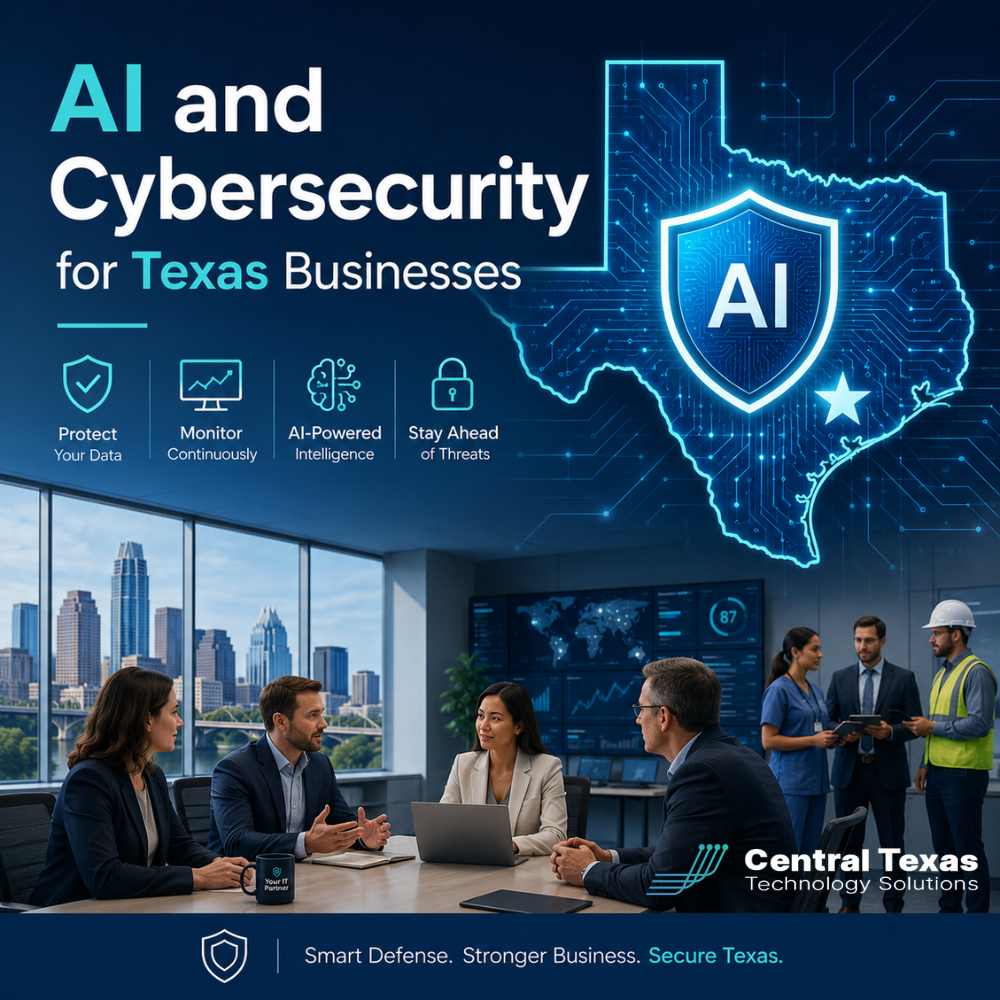
Artificial intelligence is changing cybersecurity faster than many business leaders realize.
For Texas businesses, especially in growing markets like Austin, New Braunfels, and San Marcos, AI is no longer just a futuristic technology. It is already shaping how cybercriminals attack, how security teams respond, and how businesses prepare for risk.
The challenge is simple: AI can help protect your business, but it can also help attackers move faster.
That means business leaders in healthcare, legal, professional services, construction, manufacturing, and nonprofits need a clearer understanding of how AI fits into cybersecurity today. Not hype. Not fear. Just practical insight that helps you make better decisions.
Why AI Cybersecurity Matters for Texas Businesses
Cybersecurity used to feel like a technical issue handled quietly in the background. That is no longer true.
Today, a single cyberattack can interrupt operations, expose client data, delay projects, damage trust, and create costly compliance problems. For businesses across Central Texas, that risk is growing because attackers now have better tools.
Recent cybersecurity reports show that AI is increasing the speed, scale, and sophistication of cyber threats. The World Economic Forum notes that attackers are using AI to make threats faster and more advanced, while defensive teams are also using AI to improve detection, prevention, response, and recovery.
That creates a new reality for Texas businesses:
AI is not replacing cybersecurity strategy.
AI is raising the standard for it.
How Cybercriminals Are Using AI Against Businesses
AI gives attackers the ability to do more in less time. That matters because many small and midsize businesses still rely on outdated systems, weak passwords, limited monitoring, or reactive IT support.
Here are some of the ways attackers are using AI.
More Convincing Phishing Emails
Phishing emails used to be easier to spot. Many had poor grammar, strange wording, or obvious red flags.
AI has changed that.
Now, cybercriminals can create polished emails that sound professional, personal, and believable. They can imitate vendors, executives, coworkers, banks, insurance carriers, and software providers.
For a law firm, that might look like a fake client document request.
For a healthcare office, it might look like a message about billing or patient records.
For a construction company, it might look like a subcontractor invoice.
For a nonprofit, it might look like a donor communication.
The danger is that employees may trust the message before they think to verify it.
Faster Password Attacks
AI can help attackers test stolen credentials, identify patterns, and automate login attempts more efficiently.
If your team reuses passwords, lacks multifactor authentication, or has former employee accounts that were never disabled, AI can make those weaknesses easier to exploit.
Deepfake and Impersonation Scams
AI-generated voice and video tools are making impersonation attacks more believable. Cybercriminals may use deepfake audio or video to imitate executives, vendors, or trusted contacts.
This can lead to wire fraud, unauthorized payments, data exposure, or account takeover.
A business in Austin may not think it is large enough to be targeted, but attackers often look for easy opportunities, not just big names.
Smarter Malware and Attack Automation
Security researchers are warning that AI can help attackers improve malware, find software weaknesses, and scale attacks more efficiently. Reuters reported that advanced AI systems are creating new concerns because of their potential ability to identify vulnerabilities in outdated software.
This matters for Texas businesses that have delayed upgrades, skipped patches, or relied on old systems because “they still work.”
Old technology may keep the business running today, but it can quietly increase risk tomorrow.
How AI Helps Improve Cybersecurity
The good news is that AI is also helping defenders.
When used correctly, AI can help security teams detect suspicious activity faster, identify patterns humans might miss, and respond before a small issue becomes a business disruption.
For CTTS, the key is not using AI as a shortcut. The goal is to use technology as part of a broader cybersecurity strategy that protects the business, supports productivity, and aligns with long-term goals.
AI for Threat Detection and Monitoring
AI can help monitor systems for unusual behavior.
For example, it may help detect:
- A login attempt from an unexpected location
- Unusual file access
- Suspicious email activity
- A device behaving differently than normal
- A sudden spike in failed login attempts
- Activity that may suggest malware or ransomware
This is important because many attacks do not begin with a dramatic event. They begin quietly.
A compromised account.
An employee clicking a link.
A vendor portal being abused.
A device communicating with a suspicious location.
AI can help security tools recognize those warning signs more quickly.
AI for Faster Incident Response
When a cybersecurity incident happens, time matters.
The longer an attacker remains inside your systems, the more damage they can cause. AI can help organize alerts, prioritize risks, and give IT teams better visibility into what needs attention first.
This helps businesses reduce downtime, limit exposure, and recover more quickly.
For industries like healthcare, legal, manufacturing, construction, professional services, and nonprofits, faster response can mean the difference between a manageable event and a major operational disruption.
AI for Better Email Security
Email remains one of the most common ways attackers reach businesses.
AI-powered email security can help identify suspicious messages, malicious links, unusual sender behavior, and possible impersonation attempts.
This is especially important for businesses that depend heavily on email communication with clients, vendors, patients, donors, or project partners.
However, AI email protection should not stand alone. It should work alongside employee training, multifactor authentication, strong policies, and ongoing monitoring.
AI for Security Awareness Training
One of the most practical ways AI can support cybersecurity is by making employee training more realistic.
Instead of generic warnings, businesses can use simulated phishing tests and targeted training that reflect the kinds of threats employees are likely to see.
That matters because cybersecurity is not just a technology issue. It is a people issue.
Your team needs to know what to do when something feels off.
They need to slow down before approving payment changes, sharing passwords, opening attachments, or responding to unusual requests.
The Risk of Relying Too Much on AI
AI is powerful, but it is not perfect.
One of the biggest mistakes a business can make is assuming AI will solve cybersecurity by itself.
AI tools still need:
- Proper configuration
- Human oversight
- Clear security policies
- Strong identity management
- Regular updates and patching
- Reliable backups
- Incident response planning
- Ongoing employee training
AI can help spot problems, but it cannot replace a cybersecurity strategy.
A tool may generate an alert, but someone still needs to know what it means, whether it matters, and what to do next.
That is where a proactive IT partner becomes critical.
Why Proactive IT Support Matters More in the AI Era
Many businesses still treat IT as something to fix after it breaks.
That approach is risky.
In the AI era, attackers move too quickly for reactive support to be enough. Waiting until something fails can lead to downtime, lost revenue, compliance exposure, and damaged trust.
A proactive cybersecurity approach focuses on prevention.
That includes:
- Monitoring systems before problems become emergencies
- Keeping software and devices updated
- Securing user accounts
- Reducing unnecessary access
- Training employees
- Reviewing backups
- Planning for recovery
- Aligning technology decisions with business goals
This is the difference between having someone who responds to tickets and having a strategic partner who helps protect your business.
What Texas Business Leaders Should Do Now
AI is changing cybersecurity, but business leaders do not need to become AI experts.
They need a clear plan.
Start by asking these questions:
- Do we know which AI tools employees are using?
- Are our email and identity systems properly protected?
- Do we have multifactor authentication in place?
- Are former employee accounts removed quickly?
- Are our backups tested and recoverable?
- Do we have a documented incident response plan?
- Are our employees trained to recognize AI-driven scams?
- Do we have proactive monitoring in place?
- Are our systems patched and supported?
- Do we know where our biggest risks are?
If the answer to any of these questions is unclear, your business may have gaps that need attention.
How CTTS Helps Texas Businesses Use AI and Cybersecurity Wisely
CTTS helps businesses across Austin and Central Texas take a practical, proactive approach to cybersecurity.
Instead of waiting for problems to happen, CTTS helps identify risks early, strengthen defenses, and align technology with business goals.
For healthcare organizations, that may mean protecting patient data and supporting compliance.
For law firms, it may mean securing confidential client information.
For professional services firms, it may mean keeping teams productive and client communication protected.
For construction companies, it may mean securing project files, mobile devices, and vendor communication.
For manufacturers, it may mean reducing downtime and protecting operational systems.
For nonprofits, it may mean protecting donor data while making the most of limited resources.
AI can be part of the solution, but it must be managed carefully. CTTS helps businesses use modern tools with the right strategy behind them.
AI Cybersecurity Is Not Optional Anymore
AI is now part of the cybersecurity landscape.
Attackers are using it.
Security tools are using it.
Employees are using it.
The question is not whether AI will affect your business. The question is whether your business is prepared to manage the risk.
Texas businesses that take cybersecurity seriously now will be better prepared for what comes next. They will reduce disruption, protect trust, improve productivity, and make smarter technology decisions.
If you are not sure where your business stands, CTTS can help you find the gaps and create a practical plan.
Schedule a consultation with CTTS today to learn how proactive cybersecurity support can help protect your business in the age of AI.
Frequently Asked Questions About AI and Cybersecurity
How is AI changing cybersecurity for Texas businesses?
AI is changing cybersecurity by helping attackers create more convincing scams while also helping security teams detect and respond to threats faster. For Texas businesses, this means cybersecurity must become more proactive, better monitored, and more closely aligned with business risk.
Can AI replace a cybersecurity team or IT provider?
No. AI can support cybersecurity, but it cannot replace human judgment, strategy, policy, or response planning. Businesses still need experienced IT professionals who can interpret alerts, manage tools, reduce risk, and guide long-term decisions.
What should my business do first to prepare for AI-driven cyber threats?
Start with the fundamentals. Use multifactor authentication, secure employee accounts, patch systems, train your team, monitor your network, test backups, and create an incident response plan. A proactive IT partner like CTTS can help assess your current risk and prioritize next steps.
Contact CTTS today for IT support and managed services in Austin, TX. Let us handle your IT so you can focus on growing your business. Visit CTTSonline.com or call us at (512) 388-5559 to get started!
Explore these expert insights before making your next IT decision:
How Microsoft 365 Support Improves Productivity and Security
What Network Security Really Means Beyond Firewalls and Antivirus
How Ransomware Protection Works and Why Prevention Matters
When to Bring in an IT Consulting Firm Instead of Just IT Support
How Endpoint Detection and Response Protects Your Business From Modern Threats
What Multi-Factor Authentication Really Does and Why It Matters More Than Ever
How Secure Cloud Migrations Work Without Disrupting Your Business