
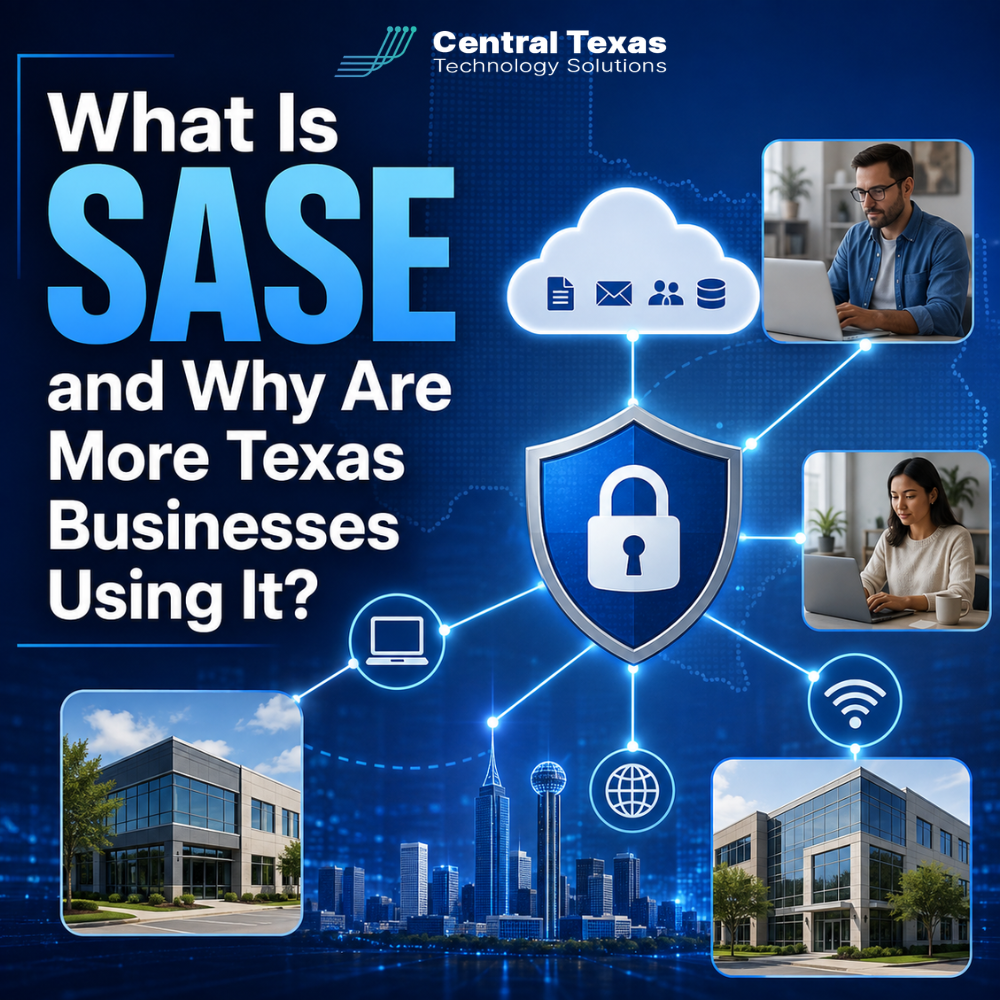
The way businesses use technology has changed. Employees work from home, travel between locations, connect from job sites, and rely on cloud applications that may never touch the company’s traditional office network.
That creates a problem for older approaches to network security.
When people, applications, devices, and data are spread across different locations, protecting everything with a firewall sitting inside the main office is no longer enough. Secure Access Service Edge, commonly called SASE, is designed for this new environment.
For businesses across Austin, Georgetown, Belton, Temple, and the rest of Central Texas, SASE can provide a more consistent way to connect people to the resources they need while protecting the business wherever work happens.
What Is SASE in Simple Terms?
SASE stands for Secure Access Service Edge.
At its simplest, SASE combines networking and cybersecurity into a cloud-based service. Instead of relying on separate products to connect offices, secure internet traffic, protect remote workers, and control access to applications, SASE brings many of those capabilities together.
A traditional network was often built around one central location. Employees came to the office, connected to the company network, and accessed servers and applications from there.
Today, the network might include:
- Employees working from home
- Teams using Microsoft 365 and other cloud applications
- People traveling with company laptops
- Multiple offices connected across Texas
- Employees working from customer or construction sites
- Vendors who need limited access to certain systems
- Business applications hosted in several different cloud environments
SASE helps create a common security framework around all of these connections.
CISA describes SASE as a cloud architecture that combines networking and security capabilities, including technologies such as SD-WAN, secure web gateways, cloud access security brokers, firewalls, and zero trust network access. CISA has also encouraged organizations to consider modern approaches such as SASE and Zero Trust as alternatives to relying solely on traditional remote access methods.
The individual technologies can sound complicated. The business idea is much simpler: provide secure access based on who someone is, what device they are using, and what they are trying to access, rather than assuming someone is safe simply because they are connected to the company network.
Why SASE Makes Sense for Remote and Hybrid Work
Remote work changed where the network ends.
An employee working from home may be accessing Microsoft 365, a line-of-business application, cloud storage, customer information, and internal company resources throughout the day. Another employee may be doing the same work from an Austin office, while someone else connects from a hotel or customer location.
Trying to route every connection through a traditional office firewall can create unnecessary complexity. Allowing employees to connect directly to cloud services without consistent security controls can create a different problem.
SASE is designed to bring security closer to the user, regardless of where that user happens to be.
That can help businesses apply consistent rules for:
- Internet access
- Cloud applications
- Private business systems
- Remote access
- User authentication
- Device security
- Data protection
For a legal firm handling confidential client information, a healthcare organization protecting sensitive records, or a nonprofit with employees working from several locations, consistent access controls can be especially important.
The goal is not simply to make remote work possible. It is to make remote work safer without creating unnecessary barriers that hurt productivity.
How SASE Helps Businesses That Depend on Cloud Applications
Many businesses have moved important parts of their operations away from traditional servers and into the cloud.
Microsoft 365 is an obvious example, but businesses may also rely on cloud-based accounting platforms, customer relationship management systems, project management tools, industry applications, file storage, and dozens of smaller services.
That changes how network security needs to work.
If most of your employees' daily applications are already outside your physical office, forcing all traffic through equipment at the office may no longer be the most practical approach.
SASE can provide security controls through cloud-based infrastructure instead.
This approach can help a professional services firm protect employees using cloud applications from multiple locations. A manufacturer may need secure connections between offices, production environments, vendors, and cloud platforms. Construction companies may have employees connecting from headquarters, temporary offices, and active job sites.
The network needs to follow the business instead of requiring the business to stay inside the network.
Why Multiple Offices Make SASE More Attractive
Managing one office network can be challenging enough. Add a second, third, or fourth location and things become more complicated.
Each office may have:
- Its own internet connection
- Local networking equipment
- Different security configurations
- Different applications
- Employees who move between locations
- Connections back to centralized systems
Over time, businesses can end up with a collection of networking and security products that were added whenever a new need appeared.
One system handles the firewall. Another manages remote connections. Another filters web traffic. Another connects branch offices. Another controls cloud application access.
The result can be difficult to manage and even harder to monitor.
SASE is attractive because it can consolidate many of these functions into a more unified architecture.
For a growing Central Texas business with locations in Austin, Georgetown, Belton, and Temple, that can make expansion easier. Instead of recreating an entirely separate security environment every time the company opens another location, the organization can extend established policies to the new users and office.
How SASE Can Improve Network Security
One of the biggest benefits of SASE is consistency.
Security gaps often appear when different people, locations, and systems are protected in different ways.
For example, an employee working inside the office might have traffic protected by the corporate firewall. That same employee could leave the building, connect from home, and suddenly have a very different level of protection.
SASE is designed to reduce that inconsistency.
Depending on the solution, a SASE strategy may include capabilities such as:
- Zero Trust Network Access: Verifies users and devices before allowing access to specific resources.
- Secure Web Gateway: Helps inspect and control internet traffic.
- Firewall as a Service: Provides firewall capabilities through cloud infrastructure.
- Cloud Access Security Broker: Helps organizations control and monitor cloud application usage.
- SD-WAN: Helps businesses intelligently connect locations and route network traffic.
These capabilities can work together instead of operating as separate security islands.
That can give an IT team or Managed IT Services Provider better visibility into how users, locations, devices, and applications are connecting.
SASE is not a magic cybersecurity product that eliminates risk. It is an architecture that can help businesses build security around the way they actually operate today.
Does Your Texas Business Need SASE?
Not every business needs the same SASE deployment.
A small company with one location, a handful of employees, and very limited cloud usage may have different requirements from a 150-person organization with several offices and a hybrid workforce.
SASE becomes especially worth considering when your business has:
- Remote or hybrid employees
- Multiple offices
- Heavy reliance on cloud applications
- Employees who frequently travel
- Growing cybersecurity requirements
- Concerns about traditional VPN access
- Difficulty managing multiple networking and security products
- Plans to expand into additional locations
The right question is not, "Should we buy SASE?"
A better question is, "Does our current network and security strategy still match the way our business operates?"
That is where strategic IT planning matters.
At CTTS, we look at the entire environment before recommending a technology. That includes how employees work, where applications are located, what data needs protection, how locations connect, where security gaps may exist, and what the business expects to look like several years from now.
For healthcare, legal, professional services, construction, manufacturing, and nonprofit organizations, the right network strategy should support both today's operations and tomorrow's growth.
Technology should not become more complicated every time your company hires someone, opens an office, or adds another cloud application.
A proactive approach creates a network and security foundation designed to grow with you.
Build a Network Around the Way Your Business Works
Your employees should not have to be sitting inside one office for your security strategy to work.
If your business has changed but your network was designed for the way people worked ten years ago, it may be time to rethink the architecture behind it.
CTTS helps Central Texas businesses build proactive technology strategies that connect networking, cybersecurity, cloud services, and business goals.
Schedule a free strategy call with CTTS to find out whether SASE belongs in your future IT strategy.
Frequently Asked Questions About SASE
Is SASE the same thing as a VPN?
No. A VPN typically creates a connection between a user and a network. SASE is a broader approach that can combine secure remote access with networking, cloud security, web filtering, firewall capabilities, and other security controls. Zero Trust Network Access within a SASE platform can also give users access only to the specific resources they are authorized to use instead of placing them broadly on the corporate network.
Can a small or midsized business use SASE?
Yes. SASE is not limited to large enterprises. Cloud-delivered SASE platforms can make some advanced networking and security capabilities practical for smaller organizations, particularly businesses with remote employees, multiple locations, significant cloud usage, or growing cybersecurity requirements.
Does moving to SASE mean replacing all of our existing network equipment?
Not necessarily. SASE is often implemented as part of a broader network modernization strategy rather than an immediate replacement of everything a business already owns. The right approach depends on your current firewalls, internet connections, remote access systems, office locations, cloud applications, and security requirements.
Contact CTTS today for IT support and managed services in Austin, TX. Let us handle your IT so you can focus on growing your business. Visit CTTSonline.com or call us at (512) 388-5559 to get started!
Explore these expert insights before making your next IT decision:
What Multi Factor Authentication Really Does and Why It Matters More Than Ever
How Secure Cloud Migrations Work Without Disrupting Your Business
What Role AI Is Playing in Cybersecurity for Texas Businesses
How Network Visibility Tools Help Prevent Costly IT Surprises
Why Microsoft 365 Security Defaults Are Not Enough for Most Businesses
How Conditional Access Helps Protect Your Business From Unauthorized Logins
What Is Zero Trust Security and Does Your Business Really Need It?
How Business Email Compromise Happens and How to Prevent It
Why Endpoint Security Matters When Your Team Works From Anywhere
What Is Microsoft Intune and Does Your Business Need It?