
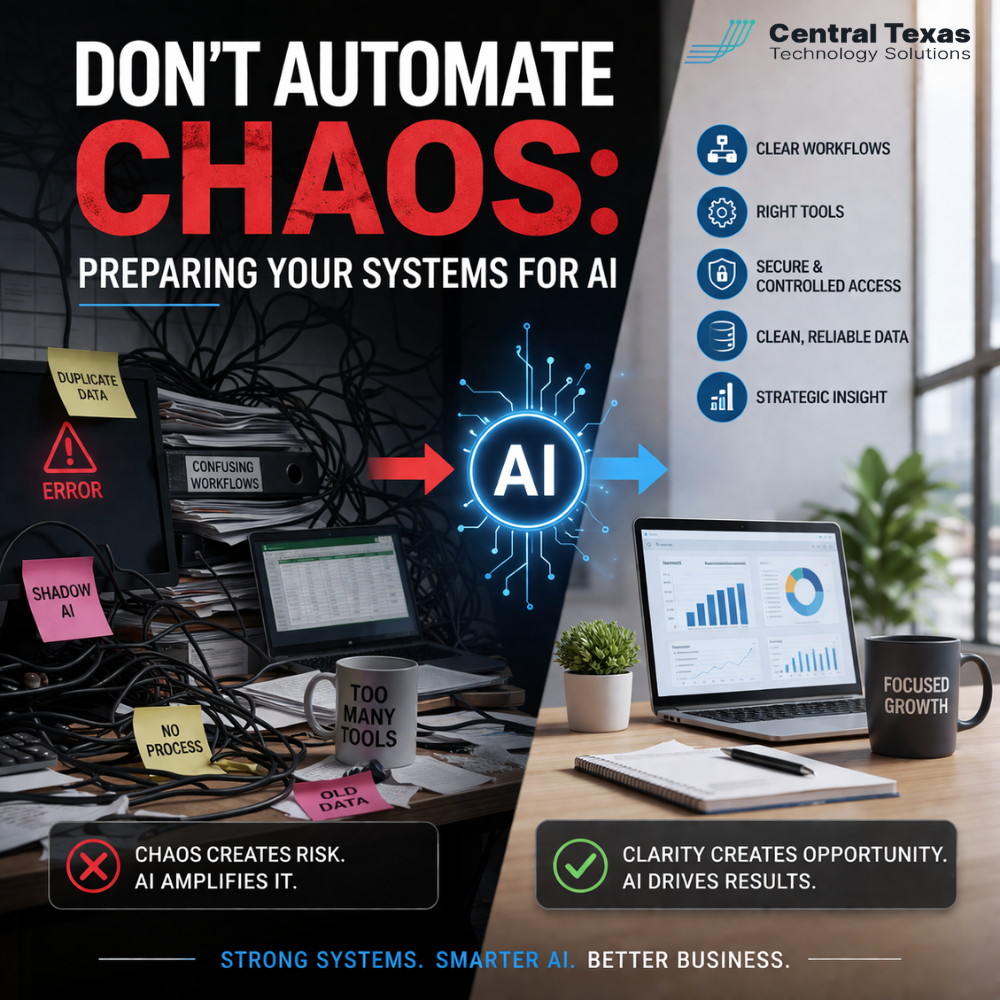
Business leaders across Austin and Central Texas are feeling the pressure to adopt AI. Whether you run a healthcare practice, a law firm, a professional services company, a construction business, a manufacturing operation, or a nonprofit, the message is everywhere: move fast or fall behind.
But there is a problem most companies do not see until it is too late.
AI does not fix broken systems. It multiplies them.
If your workflows are unclear, your tools are overlapping, or your data is inconsistent, AI will not solve those issues. It will accelerate them.
Why AI Fails Without the Right Foundation
AI works best when your business is already organized. It thrives on structure, clarity, and consistency.
When those things are missing, AI does exactly what it is designed to do. It processes what you give it faster than ever before. That sounds helpful until you realize it is processing flawed inputs.
That is when things start to break down.
Instead of improving efficiency, you may start to see:
- Conflicting reports from different systems
- Employees using different AI tools with no shared process
- Sensitive data being shared without clear controls
- More subscriptions and tools with less clarity on what is actually working
For a growing business in Austin, Round Rock, Georgetown, or Cedar Park, that kind of confusion slows decision-making and increases risk at the exact moment you are trying to scale.
What AI Can Actually Do for Your Business
When used the right way, AI can create real momentum.
It can:
- Reduce repetitive work so your team can focus on higher-value tasks
- Help draft communication faster without sacrificing quality
- Identify patterns in your data that are hard to spot manually
- Streamline workflows that currently rely on too many handoffs
For industries like healthcare and legal, this can mean faster documentation and improved compliance processes. For construction and manufacturing, it can mean better coordination and fewer delays. For nonprofits and professional services, it can free up time to focus on clients and mission-critical work.
But none of that happens without a solid foundation.
AI is not the strategy. It is a tool that supports the strategy.
What Happens When You Automate Chaos
The biggest risk is not a major system failure. It is something much harder to detect.
Performance quietly gets worse.
You may not notice it right away, but over time:
- Workflows become more complicated
- Teams lose confidence in the data
- Productivity gains disappear
- Security risks increase
These are not dramatic breakdowns. They are slow leaks that cost your business time, money, and trust.
And because AI is moving everything faster, those small issues compound quickly.
Signs Your Business Is Not Ready for AI
AI readiness has nothing to do with your budget or company size. It comes down to how well your systems are aligned.
If any of these sound familiar, it is worth slowing down before rolling out AI tools:
- Your team relies on spreadsheets outside your main systems to get work done
- Multiple tools perform similar functions with no clear reason why
- You have not reviewed user permissions or access controls recently
- You are unsure which features of your current tools are actually being used
- Workarounds have become the normal way of operating
These are common challenges for businesses in fast-growing areas like Austin, Buda, San Marcos, and Temple, especially as teams expand and technology stacks evolve.
If your systems are not aligned, AI will magnify the gaps.
What Getting Ready for AI Actually Looks Like
Preparing for AI does not require a massive overhaul. It requires clarity.
The goal is simple. Make sure your systems support your business instead of slowing it down.
That starts with:
- Mapping your core workflows so you understand how work actually gets done
- Aligning your tools with your current operations, not how things worked years ago
- Eliminating redundant systems that create confusion
- Cleaning up user access so the right people have the right permissions
- Organizing your data so it is accurate and consistent
- Reviewing unused features in your existing platforms
For healthcare, legal, and nonprofit organizations, this also includes ensuring compliance and data protection are built into every step. For construction, manufacturing, and professional services, it means creating workflows that scale without adding complexity.
This is where most businesses gain their biggest advantage.
A Smarter Approach to AI Adoption
The companies that succeed with AI do not rush into it. They approach it with intention.
They ask the right questions first:
- What problem are we trying to solve?
- Where can AI create measurable value?
- Where could it introduce unnecessary complexity?
- Are our systems secure and structured enough to support it?
This is why a technology performance review is often the best starting point.
It gives you a clear picture of:
- What is working
- What is not
- What needs to be fixed before AI is introduced
At CTTS, this is how we guide businesses across Austin and Central Texas. We help you evaluate your environment, align your systems, and make sure AI enhances your operations instead of disrupting them.
No hype. No rushed decisions. Just a clear path forward.
What Success Looks Like with AI
When AI is built on a strong foundation, the results are not temporary. They are sustainable.
You will see:
- Real productivity gains because your data is reliable
- Less repetitive work without added confusion
- Clear insights you can trust
- Reduced risk with proper governance in place
- The ability to scale without breaking your systems
This is what businesses in Georgetown, Round Rock, and across Central Texas are working toward.
Not just adopting AI, but using it with purpose.
Build the Foundation First
AI has the potential to transform how your business operates. But it works best when it is improving something that is already working, not trying to fix what is broken.
The smartest move is not to move faster.
It is to build stronger.
CTTS helps businesses in healthcare, legal, professional services, construction, manufacturing, and nonprofits take a clear look at their systems, identify gaps, and prepare for AI the right way.
If you are considering AI, start with your foundation.
Schedule a consultation with CTTS today to assess your AI readiness and build a system that supports real growth.
Frequently Asked Questions about AI Readiness
How do I know if my business is ready for AI?
If your systems are organized, your data is consistent, and your workflows are clearly defined, you are in a strong position. If not, it is best to address those areas first.
Can AI improve efficiency in small businesses?
Yes, but only when it is applied to well-structured processes. Without that structure, efficiency gains are limited and often temporary.
What is the first step in adopting AI?
Start with a technology performance review. This helps you understand your current environment and identify where AI can create real value without adding complexity.
Contact CTTS today for IT support and managed services in Austin, TX. Let us handle your IT so you can focus on growing your business. Visit CTTSonline.com or call us at (512) 388-5559 to get started!
Explore our related articles for practical insights into Artificial Intelligence:
Your AI Is Only as Safe as Your Permissions
Your Team Is Already Using AI. Is Your Microsoft 365 Governance Keeping Up?
AI Wrote This Phishing Email. Would Your Team Click It?
Is Copilot Reading the WRONG Things in Your Business?
AI Is Not Neutral: How to Recognize and Beat AI Bias in Your Business