
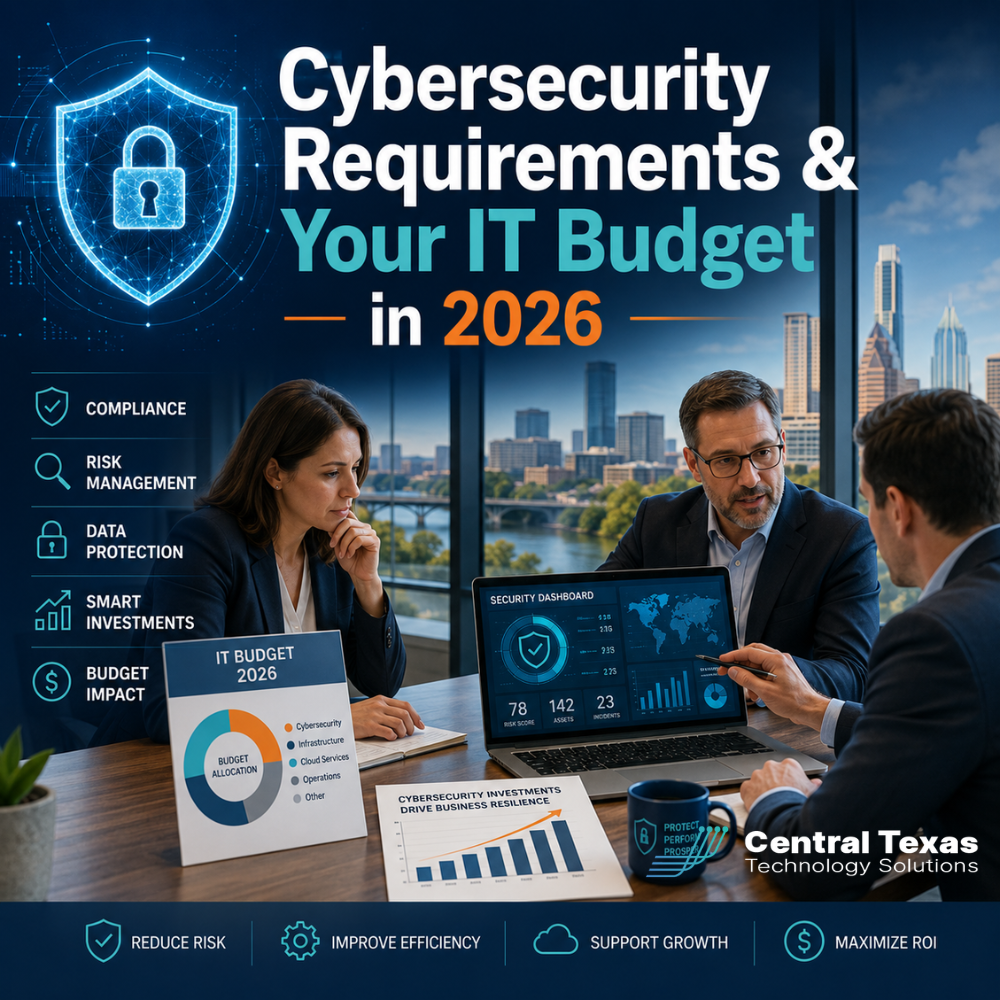
Cybersecurity used to be a line item many businesses reviewed once a year. In 2026, that approach is no longer enough.
For business leaders in Austin, Round Rock, Georgetown, Cedar Park, and across Central Texas, cybersecurity requirements are now directly shaping the IT budget. Cyber insurance carriers, industry regulations, software vendors, clients, and internal risk management policies are all raising the bar.
That does not mean every business needs to spend without limits. It does mean your IT budget needs to be built around prevention, documentation, and business continuity instead of waiting for problems to happen.
Healthcare, legal, professional services, construction, manufacturing, and nonprofit organizations all face the same basic challenge: your technology must protect your business, support your team, and prove that your organization is taking cybersecurity seriously.
Why Cybersecurity Requirements Are Changing IT Budgets in 2026
The biggest shift in 2026 is that cybersecurity is no longer just an IT issue. It is now tied to insurance eligibility, compliance, contracts, client trust, and operational resilience.
Cyber insurance carriers increasingly expect businesses to show they have strong security controls in place, such as multi-factor authentication, endpoint detection and response, reliable backups, security awareness training, and incident response planning. Many carriers are moving beyond simple questionnaires and asking for stronger evidence that protections are actually implemented.
Microsoft has also increased MFA enforcement for admin access across Microsoft 365, Azure, Entra, and Intune environments, which means businesses using Microsoft cloud tools need to make identity security part of their normal IT planning.
For businesses subject to the FTC Safeguards Rule, multi-factor authentication and written security programs are also key requirements for protecting customer information.
The result is clear: cybersecurity requirements are turning IT budgets from reactive repair budgets into proactive risk management budgets.
What Cybersecurity Requirements Usually Add to Your IT Budget
Many business leaders ask, “Why is our IT budget going up if nothing is broken?”
That question is understandable, but it points to an outdated way of thinking about IT.
In 2026, the real goal is not just to fix broken computers. The goal is to prevent downtime, reduce cyber risk, meet insurance requirements, protect data, and keep employees productive.
Common cybersecurity-related budget items include:
- Multi-factor authentication for email, cloud apps, remote access, and administrator accounts
- Endpoint detection and response tools that go beyond traditional antivirus
- Email security to reduce phishing, malware, and business email compromise
- Backup and disaster recovery systems that are tested regularly
- Patch management for workstations, servers, and applications
- Security awareness training for employees
- Dark web monitoring and password protection
- Firewall management and network monitoring
- Incident response planning
- Compliance documentation and reporting
- Vendor risk reviews
- Microsoft 365 security configuration and monitoring
For a medical practice, this may mean protecting patient records and supporting HIPAA-related security expectations. For a law firm, it may mean securing confidential client files. For a construction company, it may mean protecting project data, bids, and remote jobsite access. For a manufacturer, it may mean reducing downtime across production systems. For a nonprofit, it may mean protecting donor information while keeping technology costs predictable.
Cyber Insurance Is One of the Biggest Budget Drivers
Cyber insurance is one of the clearest examples of how cybersecurity requirements impact your IT budget in 2026.
Many businesses are discovering that cyber insurance is not just about paying a premium. Carriers want to know whether your organization has the right protections in place before they issue or renew coverage.
Common cyber insurance expectations now include MFA, endpoint protection, tested backups, employee training, and a documented incident response plan. Some carriers also look for proof that systems are patched and monitored.
This matters because missing controls can lead to:
- Higher premiums
- Lower coverage limits
- Exclusions for certain types of claims
- Delays during renewal
- Denied coverage after an incident
A cheaper IT plan may look attractive until it leaves your business unable to qualify for cyber insurance or unable to prove that basic protections were in place.
That is why CTTS helps businesses think beyond monthly IT costs. The better question is not, “What is the lowest IT price?” The better question is, “What level of protection does our business need to stay insurable, secure, and operational?”
Compliance Requirements Can Create Hidden IT Costs
Cybersecurity requirements can also come from compliance obligations.
Not every business is regulated the same way, but many organizations still face expectations based on the type of data they store, the clients they serve, or the contracts they sign.
For example:
- Healthcare organizations may need stronger controls around patient data.
- Legal firms need to protect confidential case information and client communications.
- Professional services firms may need secure file sharing, access controls, and audit-ready documentation.
- Construction firms may need secure access for mobile teams, vendors, and project managers.
- Manufacturing companies may need stronger protection for operational systems, vendor access, and business continuity.
- Nonprofits may need to protect donor records, payment data, and grant-related information.
These requirements often affect your IT budget because they require more than basic support. They require planning, security policies, technical controls, and documentation.
The Real Cost of Waiting Until Something Goes Wrong
Many businesses underbudget for cybersecurity because they only think about immediate costs.
But the cost of a cyber incident can be much higher than the cost of prevention.
A ransomware attack, email compromise, or failed backup can lead to:
- Lost revenue
- Employee downtime
- Emergency recovery costs
- Reputational damage
- Legal exposure
- Insurance complications
- Client trust issues
- Missed deadlines
- Compliance concerns
For a growing Austin business, even a short outage can disrupt sales, operations, billing, client communication, and leadership focus.
Reactive IT is expensive because it waits for damage before action is taken. Proactive IT is more strategic because it helps prevent problems before they disrupt the business.
How to Build a Smarter Cybersecurity Budget in 2026
A smart cybersecurity budget should be based on business risk, not guesswork.
Start by identifying the systems your business cannot afford to lose. This may include email, accounting software, line-of-business applications, client files, phones, cloud platforms, servers, and remote access tools.
Then ask practical questions:
- Who has access to sensitive data?
- Are all accounts protected with MFA?
- Are backups tested regularly?
- Can we recover quickly after an outage?
- Are employees trained to recognize phishing attempts?
- Are devices monitored for suspicious activity?
- Are security patches being applied consistently?
- Can we prove our security controls to an insurance carrier or auditor?
- Do we have an incident response plan?
The answers help separate “nice to have” technology from critical business protection.
CTTS helps businesses build IT budgets that align with their real needs. That means identifying risks, prioritizing improvements, and creating a practical roadmap instead of overwhelming your team with disconnected tools.
Why the Cheapest IT Provider May Cost More in the Long Run
One of the most common misconceptions about IT services is that all providers offer basically the same thing.
They do not.
Some providers focus mainly on help desk tickets and repairs. Others take a more proactive approach by monitoring systems, improving security, documenting the environment, and aligning technology with business goals.
In 2026, that difference matters.
A low-cost provider may not include the security tools, documentation, planning, and oversight your business needs to meet cybersecurity requirements. That can create hidden costs when you apply for cyber insurance, respond to an audit, onboard a new client, or recover from an incident.
CTTS is built around proactive IT support. Instead of waiting for problems to interrupt your business, CTTS helps prevent issues, strengthen security, and support long-term growth.
What Business Leaders Should Expect From an IT Budget Review
A cybersecurity-focused IT budget review should not feel like a scare tactic. It should give you clarity.
A strong review should help you understand:
- Where your current environment is secure
- Where your biggest risks exist
- Which improvements are urgent
- Which improvements can be phased over time
- How cybersecurity supports insurance, compliance, and uptime
- How your IT spending connects to your business goals
This is especially important for organizations that are growing, adding locations, supporting remote or hybrid employees, preparing for audits, or upgrading old systems.
The goal is not to spend more for the sake of spending more. The goal is to invest wisely so your business can operate with confidence.
Cybersecurity Requirements Are Not Just an Expense
Cybersecurity requirements can feel like another cost added to an already full budget. But handled the right way, they can also strengthen your business.
A better cybersecurity strategy helps your team:
- Work more securely
- Reduce downtime
- Improve client trust
- Support compliance needs
- Qualify for better insurance options
- Protect revenue
- Prepare for growth
- Respond faster when issues arise
For business leaders in Austin and throughout Central Texas, the right IT budget is not just about technology. It is about protecting momentum.
CTTS Helps Central Texas Businesses Plan Smarter IT Budgets
You do not have to figure out 2026 cybersecurity requirements alone.
CTTS helps businesses in healthcare, legal, professional services, construction, manufacturing, and nonprofits understand their risks, prioritize the right improvements, and create an IT strategy that supports long-term success.
Whether your business is in Austin, Round Rock, Georgetown, Cedar Park, or another Central Texas community, CTTS can help you move from reactive IT spending to proactive technology planning.
If you are unsure whether your IT budget is ready for 2026 cybersecurity requirements, now is the right time to review it.
Schedule a consultation with CTTS today to request an IT assessment and build a smarter cybersecurity budget for your business.
Frequently Asked Questions About Cybersecurity Requirements and IT Budgets
How much should a business budget for cybersecurity in 2026?
The right cybersecurity budget depends on your size, industry, systems, risk level, and compliance needs. A business with remote employees, sensitive data, cyber insurance requirements, or multiple locations will likely need a more structured security plan than a smaller organization with limited systems. The best starting point is an IT assessment that identifies your highest risks and prioritizes improvements.
Why do cyber insurance requirements increase IT costs?
Cyber insurance carriers often require protections such as MFA, endpoint detection and response, tested backups, employee training, patch management, and incident response planning. These controls require tools, management, documentation, and ongoing monitoring. While they may increase IT costs, they can also reduce risk, improve insurability, and help protect your business from larger financial losses.
Can cybersecurity improvements be phased into the budget?
Yes. Many cybersecurity improvements can be phased in based on risk and urgency. CTTS helps businesses prioritize the most important protections first, such as MFA, backups, endpoint security, and email protection, then build a practical roadmap for additional improvements over time.
Contact CTTS today for IT support and managed services in Austin, TX. Let us handle your IT so you can focus on growing your business. Visit CTTSonline.com or call us at (512) 388-5559 to get started!
If you're evaluating IT providers, these resources will guide you:
How Much Does IT Support Cost in Austin in 2026? A Real World Breakdown
Managed IT Services in Austin: What Are You Actually Paying For?
Is Outsourced IT Cheaper Than Hiring an In House IT Team?
Hidden Costs Businesses Miss When Choosing a Managed Services Provider
Why the Cheapest IT Support in Texas Often Costs You the Most
Why Do Managed IT Service Prices Vary So Much Between Providers in Austin?
What Is Included in a Typical Per User IT Support Pricing Model?
How Do IT Support Contracts Work and What Should You Expect to Sign?