
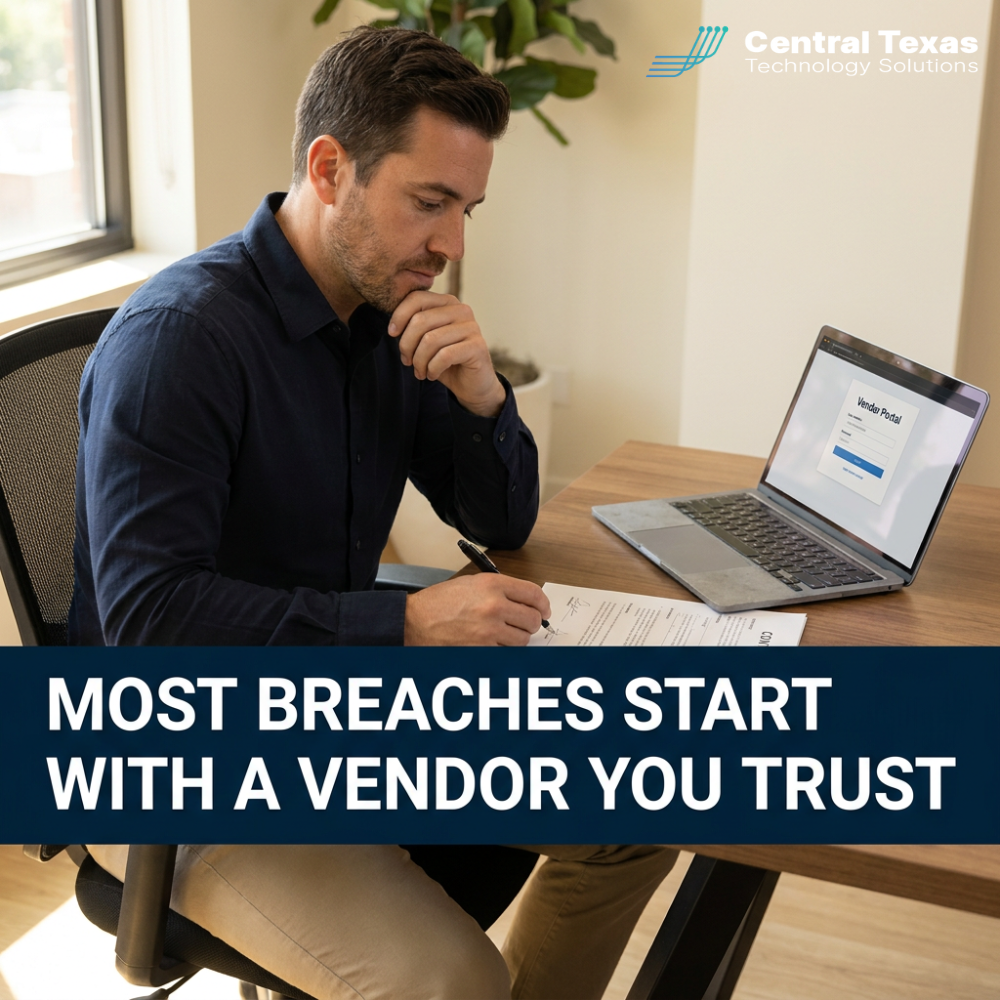
 In 2026, most cyber incidents that hurt Central Texas businesses do not start with your own systems. They start with a vendor you already trust and a contract you signed without asking the right questions. The best cybersecurity companies in this region treat vendor vetting as a daily discipline, not a once-a-year audit, because the cost of getting it wrong has changed in real, measurable ways.
What Is at Stake
According to the 2026 Verizon Data Breach Investigations Report, third parties are now involved in nearly half of all data breaches across small and mid-sized businesses. When a vendor is the entry point, the average remediation cost climbs to roughly four point eight million dollars.
For a Central Texas business with twenty to two hundred employees, those are not numbers you can absorb and move on from. They show up as missed payroll cycles, cyber insurance renewals that get denied, client contracts that are quietly not renewed, and senior leaders spending months on cleanup work instead of building the business.
The Federal Trade Commission made the same point in plain language on June 5, 2026. The agency finalized a ten-year consent decree against Illuminate Education over a breach that exposed personally identifiable information for more than ten point one million students. The notable part is what tripped the FTC. It was not a missing patch. It was not a phishing click. It was the absence of contractual controls over how a downstream vendor was allowed to access and handle that data. Illuminate signed the relationships. The vendor was the breach point. The FTC held Illuminate responsible. That precedent should land on every owner's desk from Austin to Round Rock to Temple.
Why Central Texas Businesses Face This Challenge
Most small and mid-sized companies here have grown faster than their vendor list. Over the last three to five years, the average twenty-five-person team has signed up for thirty to seventy software tools, plus the accountant, the payroll provider, the marketing agency, the HVAC contractor with a remote login, the document storage platform, the AI assistant that connects to email, and the contractor portal someone added during a project. Every one of those carries a copy of your data or a path into your systems.
The challenge is not awareness. Most owners know vendor risk is real. The challenge is bandwidth. You do not have a procurement team. You do not have a dedicated security analyst writing questionnaires. The default becomes signing the contract that lands in the inbox and hoping the vendor takes security as seriously as you do. In 2026, that hope is being repriced. Cyber insurance carriers are asking for evidence of vendor reviews.
Texas Attorney General enforcement under the Texas Data Privacy and Security Act has signaled stricter expectations heading through the second half of the year. Clients with their own compliance frameworks are pushing those frameworks down to you when they sign their contract with your business. The vendor question is now the first question, not the last one.
How the Best Cybersecurity Companies Help You Vet Vendors Before You Sign
A good cybersecurity partner does not hand you a sixty-page questionnaire and walk away. The best cybersecurity companies build a vetting process that fits the size of your business, treats the vendor as a partner who wants to pass the review, and produces a written record you can show an insurer, a regulator, or a client who asks how you protect their data.
At CTTS, that process begins before the contract reaches your desk. When a Central Texas owner forwards us a new software trial or a proposal from a SaaS platform, we run a short, repeatable check. We confirm what data the vendor would touch. We ask whether they hold any independent security report such as SOC 2 Type II or ISO 27001. We confirm they require multi-factor authentication for their own staff, that they encrypt data in transit and at rest, that they have a written incident notification window, and that they will sign a data processing addendum that defines who owns the data and what happens when the relationship ends. None of that requires a security team on your side. It requires a partner who does this every week.
For larger or more sensitive vendors, especially those touching financial systems, client records, or regulated data, we layer in a deeper review. That can include reading the most recent independent audit, checking the vendor against public breach disclosures, validating the vendor's own dependency stack, and writing language into the contract that gives you the right to be notified within a defined window if anything goes wrong. The goal is simple. When a vendor is breached, you are not learning about your exposure on the news.
Vendor Vetting Best Practices Every Central Texas Owner Should Use in 2026
Build a Living Vendor Inventory
Vendor security starts with knowing who is on your vendor list. That sounds obvious, but in most twenty-five to two hundred employee companies we visit, no one can produce that list in under an hour. Build a single, shared inventory that lists each vendor, the data they touch, the person on your team who owns the relationship, the renewal date, and the level of risk they carry.
Keep it living. When someone signs up for a new SaaS tool, it goes on the list before the trial ends, not after the auto-renewal. This is the foundation every other practice rests on, and it is something a good managed IT partner can stand up with your team in a single week.
Tier Your Vendors by the Data They Touch
Not every vendor needs a full security review. A scheduling tool that holds nothing more than employee calendars does not need the same scrutiny as the platform that processes payroll. Group your vendors into three or four tiers based on the sensitivity of the data they touch and the access they have to your systems.
Spend your real review time on the top tier. This is how owners with limited bandwidth get the work done without burning out their team or paying for reviews that do not change the answer.
Use a Right Sized Security Questionnaire
A small business does not need to send the four hundred question CAIQ to every vendor. You need ten to twenty questions that surface real risk. Data access. Multi-factor authentication. Encryption. Incident notification windows. Recent breach history. Cyber liability insurance. Employee security training. Whether their own subcontractors get access to your data.
The right cybersecurity partner already has that vendor security questionnaire ready and can run it on your behalf. The vendor responses go on file. When your insurance carrier asks how you manage third-party risk, you have a defensible answer.
Write Real Contract Language
The Illuminate Education case turned on what was, and was not, in the vendor contract. Strong language is not optional in 2026. Your vendor contracts should require notification within a defined number of days after a confirmed incident, define what data the vendor can and cannot use for their own purposes, prohibit subprocessor use without your written approval, and lay out what happens to your data when the relationship ends.
A good cybersecurity partner reviews this language with your attorney before you sign, not after. That single change has stopped more supply chain breaches from becoming customer-facing crises than any tool we deploy.
Review Annually and on Trigger Events
The vendor that passed your review two years ago may not be the same vendor today. Companies get acquired. Security teams turn over. Stack decisions change. Build a calendar reminder for every top tier vendor, and add trigger events. An acquisition. A public breach disclosure. A major leadership change. The moment you give the vendor broader access to your data.
A short re-review every twelve to eighteen months is enough for most relationships and far cheaper than discovering the change after a breach.
Take the Next Step
If you cannot put your hands on a current vendor list in under an hour, or if the last time you read a vendor contract for security language was the day you signed it, you are carrying more third-party risk than your business can afford in 2026. The best cybersecurity companies in Central Texas treat vendor vetting as a service you receive every week, not a project you run every few years.
We do this work for Central Texas owners every day, and we can do it for yours.
Schedule a free strategy session with CTTS today and let us show you what a tighter, defensible vendor vetting process looks like inside your business.
Frequently Asked Questions
How many vendors should a small business in Central Texas actually be reviewing?
Most small and mid-sized businesses we work with carry between thirty and eighty active third-party vendors. You do not need to run a full review on every one. Build a vendor inventory first, then tier the list by the sensitivity of the data each vendor touches. A typical Central Texas company ends up with eight to fifteen vendors that justify a real annual review and a contract refresh, and the rest can sit on a lighter check. The work that matters is the work focused on your top tier.
What is the most common vendor mistake that leads to a breach?
The most common mistake we see is granting vendors more access than they need and never revoking it. A web designer keeps admin credentials long after the project ends. A former marketing agency still has a login to the email platform. A contractor's remote access never gets removed when the contract closes. Most of the Central Texas breaches we have helped clean up over the last two years traced back to access that should have been removed months earlier. A simple quarterly access review catches almost all of it.
How does the Texas Data Privacy and Security Act affect how I vet vendors?
The Texas Data Privacy and Security Act puts the business that collects the data, not the vendor, on the hook for how that data is protected throughout the relationship. If a vendor breach exposes your customers' personal information, you may carry notification, remediation, and legal obligations even though the breach happened on someone else's systems. The practical takeaway for owners is that vendor contracts now need clear data handling, breach notification, and subprocessor language. A managed IT and cybersecurity partner familiar with TDPSA can walk you through what to add to your contracts before the next renewal.
Contact CTTS today for IT support and managed services in Austin, TX. Let us handle your IT so you can focus on growing your business. Visit CTTSonline.com or call us at (512) 388-5559 to get started!