
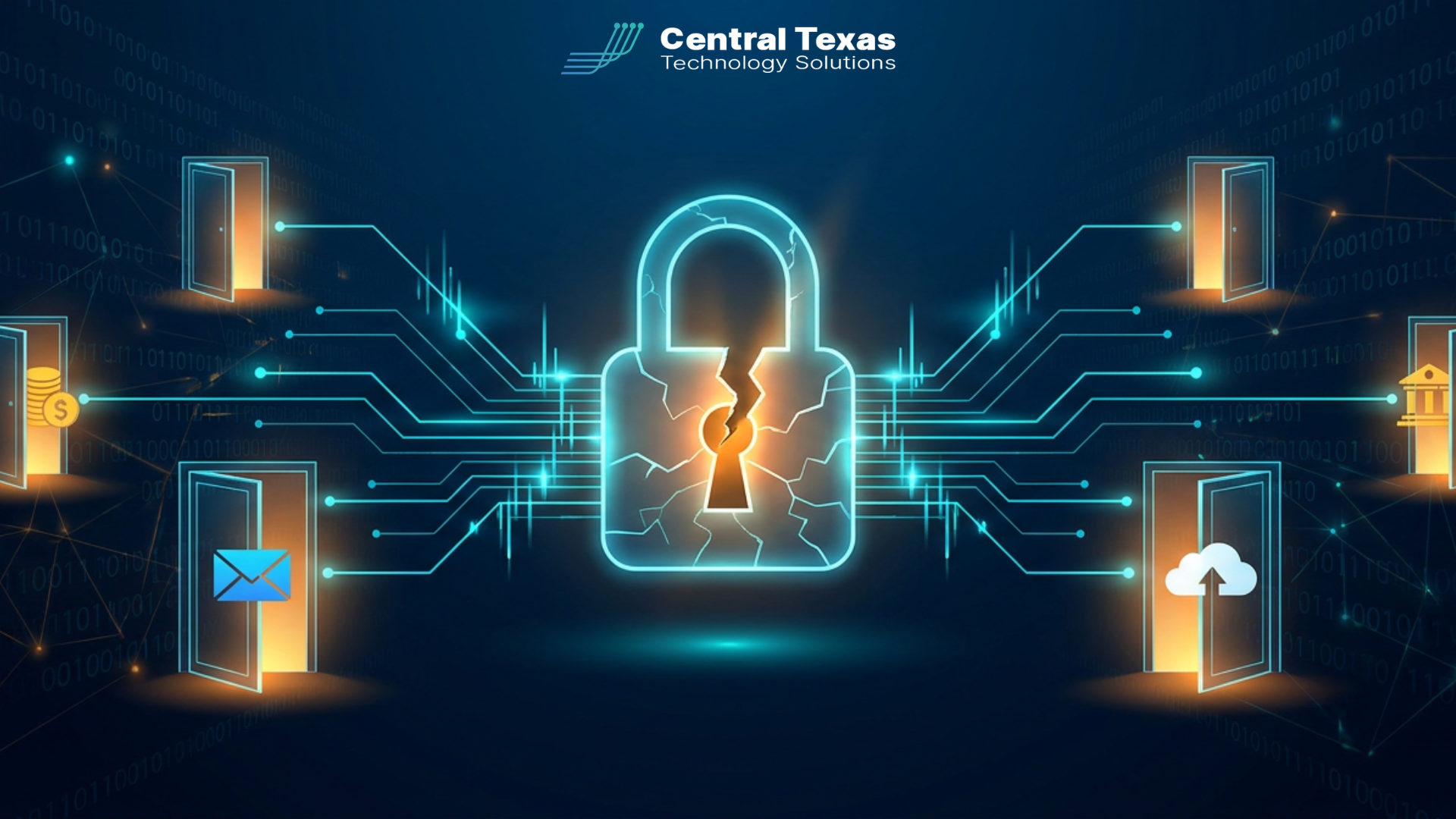
A password breach at a website you barely remember signing up for should not be able to shut down your business. Yet in 2026, that is exactly how most breaches start. Cybersecurity companies across the country are pointing to the same root cause again and again: employees reusing the same password across personal and business accounts, and one leaked list turning into a fast moving business emergency.
What Is at Stake
In June 2026, researchers found an unsecured database sitting in the open with more than 24 billion stolen username and password combinations, built from years of infostealer malware pulling credentials off infected computers. The collection was reportedly enriched with live vulnerability data, meaning attackers were not just guessing passwords. They were matching stolen logins to the exact systems most likely to still be exposed.
This is what security professionals call credential stuffing. Automated tools take a list of stolen usernames and passwords and quietly test them against banking portals, email providers, accounting platforms, and business software, one login attempt at a time, across thousands of sites at once. Because roughly nine in ten people reuse passwords somewhere, even a small success rate across billions of attempts adds up to real damage.
For a small or midsize business, the consequences are rarely contained to one account. An attacker who gets into an employee email account can reset passwords on other systems, intercept invoices, redirect payroll, or quietly sit and read messages for weeks before acting. Industry estimates now put the average cost of a breach at a company under 500 employees north of three million dollars, with downtime alone running tens of thousands of dollars an hour. That is not a cost most Central Texas businesses can absorb.
What makes this threat different from a typical hack attempt is patience. A stolen password does not have to be used the day it leaks. It can sit in a criminal marketplace for months, get bundled with other leaked lists, and resurface long after the original breach has been forgotten. A business owner might reasonably assume an old account breach from years ago is irrelevant today. Attackers count on exactly that assumption, and they are willing to wait for the right moment to test a login that nobody remembers using.
Why Central Texas Businesses Face This Challenge
Owners in New Braunfels and San Marcos often tell us the same thing: their team is busy running the business, not thinking about which password was used where. That is completely understandable, and it is exactly why credential based attacks work so well against smaller companies.
Most small businesses do not have a dedicated security team watching login activity around the clock. A stolen password from an old retail account or a personal streaming service does not feel like a business risk, until that same password shows up as the master key to a company email inbox. Attackers count on that gap. They know a construction firm in Buda or a professional services office in Georgetown is far less likely to catch a suspicious login at 2 a.m. than a large enterprise with a full security operations center.
Add in the shift to hybrid work, more cloud based business tools, and employees who juggle a dozen or more logins, and the odds of password reuse climb every year. The problem is not that Central Texas business owners are careless. It's that the tools available to fight back, like multi-factor authentication and password managers, are often adopted unevenly across a company, leaving gaps attackers eventually find.
We see this pattern across every industry we support, from professional offices to growing companies scaling up outside city limits. A new hire is set up with strong security on day one, then six months later is added to a shared vendor account that never got the same protection. Attackers do not need every door locked to get in. They only need to find the one that was overlooked, and reused passwords are consistently that door.
How CTTS Helps Cybersecurity Companies Level the Playing Field
This is where working with the right partner changes the equation. As one of the cybersecurity companies serving Central Texas since well before credential stuffing became a household term, CTTS builds identity protection into the foundation of a client's environment rather than bolting it on after an incident.
That starts with enforcing multi-factor authentication across every account that touches company data, not just email. It continues with deploying business grade password managers so employees get unique, complex passwords for every login without needing to memorize them. CTTS also monitors for credentials tied to a client's domain that show up in breach data, so a compromised password can be reset before it is ever tested against company systems.
Just as importantly, CTTS helps leadership teams set policy, not just install software. Clear rules about password managers, account lockout thresholds, and login monitoring turn a good tool into an actual habit across the whole company.
Best Practices to Stop Credential Based Attacks Before They Start
Require a Password Manager Company-Wide
Asking employees to memorize dozens of unique passwords is not realistic, so most eventually reuse one anyway. A business-grade password manager removes that pressure entirely. Employees get a strong, unique password for every account, generated and stored automatically, while IT retains visibility and control if someone leaves the company.
Turn On Multi-factor Authentication Everywhere, Not Just Email
Multi-factor authentication is the single most effective control against stolen passwords, but it only works where it is turned on. Banking portals, accounting software, remote access tools, and cloud file storage all need the same protection as the inbox. A stolen password without a second factor is far less useful to an attacker.
Monitor for Exposed Credentials Tied to Your Domain
Breach monitoring services can flag when an employee email address and password show up in a new leak, often within days of the exposure. Catching that early means resetting one password on your terms, rather than discovering the problem after an attacker already has.
Set and Enforce a Real Password Policy
A policy that exists only in an employee handbook does not stop credential stuffing. Pair the policy with technical enforcement, account lockouts after repeated failed logins, alerts on impossible travel logins, and regular reviews of dormant accounts that no longer need access.
Train Employees on What Reuse Actually Costs
Most employees do not reuse passwords out of carelessness. They do it because remembering unique passwords for dozens of accounts feels impossible. Short, practical training that explains how one old account can compromise the whole business, paired with an easy tool like a password manager, changes behavior far more effectively than a warning email ever will.
Take the Next Step
Password reuse is one of the few cybersecurity risks that is genuinely solvable with the right combination of tools and habits. You do not need to become a security expert to close this gap. You need a partner who already has, and who understands the day to day reality of running a business in Central Texas.
CTTS offers a free strategy session to walk through where your business stands today on password security, multifactor authentication, and breach monitoring, with no pressure and no jargon.
Schedule a free strategy session with CTTS today and find out exactly where the gaps are before an attacker does.
Frequently Asked Questions
What is credential stuffing and how is it different from hacking?
Credential stuffing does not require breaking into a system directly. Attackers use lists of usernames and passwords stolen from other, unrelated breaches and test them automatically against many other websites and business platforms. Because so many people reuse passwords, a percentage of those attempts succeed, giving attackers legitimate looking access without ever cracking a password themselves.
How can a small business tell if its passwords have already been exposed?
Breach monitoring tools can check whether an employee email address or domain appears in known leaked credential databases, often within days of a new exposure. Many managed IT providers, including CTTS, offer this monitoring as part of a broader security package so exposed passwords can be reset before they are tested against company systems.
Is multi-factor authentication really necessary if employees already use strong passwords?
Yes. Even a strong, unique password can be exposed through phishing, malware, or a breach at a third party service the employee also uses. Multi-factor authentication adds a second checkpoint, usually a phone prompt or authentication app, so a stolen password alone is not enough for an attacker to get in.
Contact CTTS today for IT support and managed services in Austin, TX. Let us handle your IT so you can focus on growing your business. Visit CTTSonline.com or call us at (512) 388-5559 to get started!