
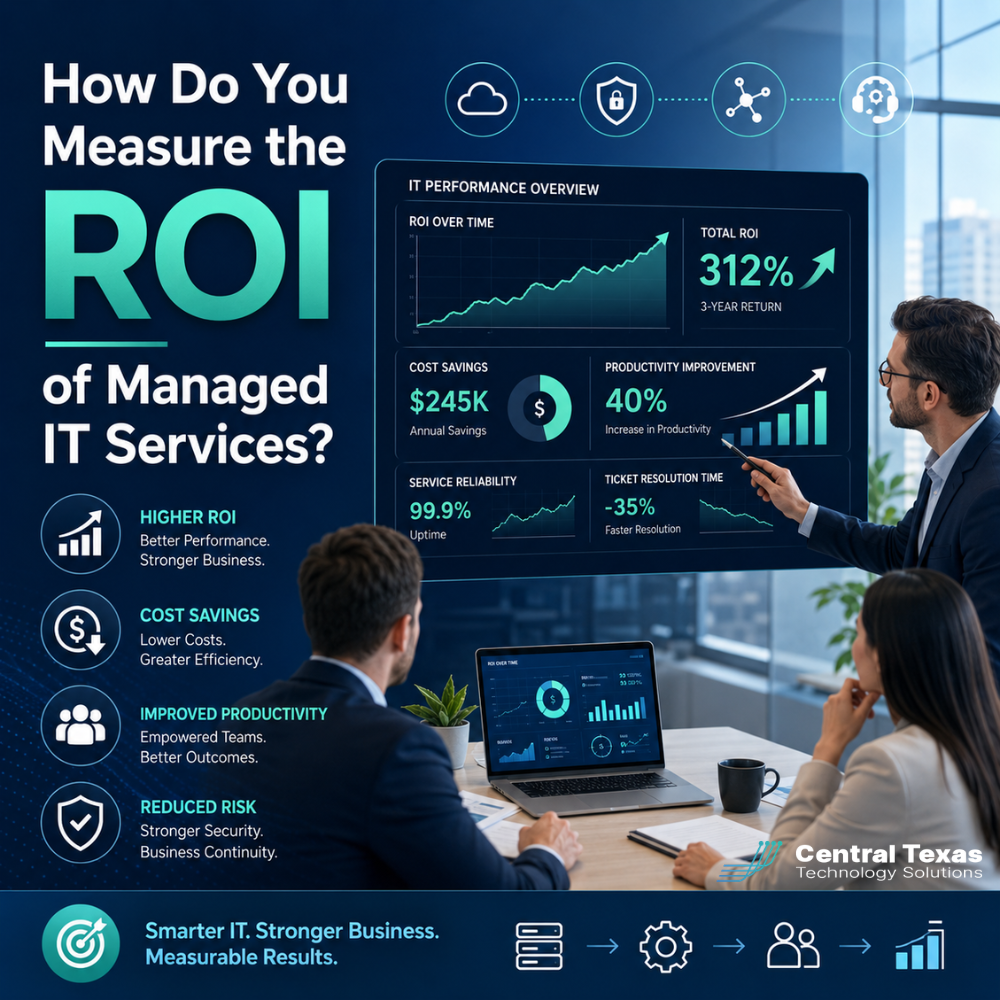
When business leaders look at managed IT services, one of the first questions they ask is simple:
“Is this really worth the investment?”
It is a fair question. Every dollar your business spends should help protect revenue, improve productivity, reduce risk, or support growth. But measuring the ROI of managed IT services can be harder than measuring the return on a new piece of equipment, a sales campaign, or a software subscription.
That is because managed IT services do more than fix computers. The right IT partner helps prevent downtime, reduce cybersecurity risk, improve employee productivity, support compliance, and align your technology with your business goals.
For businesses in Austin, Bastrop, New Braunfels, San Marcos, and across Central Texas, the real return is not just in what gets fixed. It is in the problems that never happen, the hours your team gets back, and the confidence you gain knowing your systems are being managed proactively.
Why Measuring Managed IT Services ROI Matters
Many businesses only evaluate IT costs when something breaks.
A server goes down.
An employee cannot access email.
A cybersecurity scare disrupts the workday.
A software issue slows down an entire department.
In those moments, IT feels urgent because the cost is visible. But when technology is running smoothly, it can be easy to overlook the value of prevention.
That is where ROI becomes important.
Measuring the ROI of managed IT services helps you understand whether your IT investment is helping your business:
- Reduce downtime
- Improve employee productivity
- Strengthen cybersecurity
- Support compliance requirements
- Control technology costs
- Scale more efficiently
- Improve business continuity
For organizations in healthcare, legal, professional services, construction, manufacturing, and nonprofits, technology is no longer just a support function. It is part of how work gets done, clients are served, records are protected, and revenue is generated.
The Real Cost of Reactive IT Support
One of the biggest mistakes businesses make is comparing managed IT services only to the cost of hourly break-fix support.
On paper, reactive IT can look cheaper. You only pay when something goes wrong.
But that approach ignores the hidden costs.
Reactive IT often leads to:
- More downtime
- Slower issue resolution
- Missed security updates
- Poor documentation
- Unplanned expenses
- Frustrated employees
- Increased cybersecurity risk
- Technology decisions made in crisis mode
For example, a law firm in Austin that loses access to case files for half a day may not just lose productivity. It may delay client work, create billing interruptions, and damage confidence.
A healthcare practice that experiences recurring network issues may face scheduling problems, patient delays, and compliance concerns.
A construction company with unreliable field technology may struggle to keep project managers, office staff, and job sites connected.
A manufacturing business with system downtime may interrupt production schedules.
A nonprofit may lose valuable staff time trying to work around outdated systems instead of focusing on its mission.
The ROI of managed IT services starts by reducing these avoidable disruptions.
How to Calculate the ROI of Managed IT Services
At its simplest, ROI compares the value you gain against the cost of your investment.
A basic formula looks like this:
ROI = Value Gained minus Cost of Managed IT Services, divided by Cost of Managed IT Services
But with managed IT services, the “value gained” often includes several categories.
To get a clearer picture, look at these areas.
1. Measure the Cost of Downtime
Downtime is one of the most important factors in managed IT services ROI.
Ask yourself:
- How many employees are affected when systems go down?
- What is the average hourly cost of those employees?
- How much revenue depends on those systems being available?
- How often do disruptions happen?
- How long does it usually take to recover?
Here is a simple example.
If 20 employees are unable to work for 2 hours, and their average loaded labor cost is $45 per hour, that disruption costs at least $1,800 in lost productivity alone.
That does not include missed calls, delayed projects, frustrated customers, overtime, or lost opportunities.
Managed IT services help reduce downtime through proactive monitoring, maintenance, patching, backup planning, and faster response when issues arise.
For many businesses, preventing just a few serious disruptions each year can create a measurable return.
2. Measure Employee Productivity Gains
Technology problems rarely show up neatly on a balance sheet, but your employees feel them every day.
Slow computers, unreliable Wi-Fi, login issues, printer problems, software glitches, and recurring help desk tickets all create friction.
Even small delays add up.
If 30 employees each lose 15 minutes per day to technology problems, that equals 7.5 hours of lost productivity every business day. Over a month, that can become more than 150 hours of wasted time.
Managed IT services improve productivity by helping your team:
- Get faster support
- Use reliable systems
- Reduce recurring issues
- Access files and applications securely
- Work more effectively from the office, home, or the field
- Avoid unnecessary technology workarounds
For professional services firms, construction teams, healthcare offices, legal practices, manufacturing companies, and nonprofits, productive employees are one of the clearest signs that IT is creating business value.
3. Measure Cybersecurity Risk Reduction
Cybersecurity ROI can be difficult to measure because success often means nothing happened.
No breach.
No ransomware incident.
No stolen credentials.
No business interruption.
No emergency recovery project.
But that does not mean the value is invisible.
Managed IT services can reduce cybersecurity risk through:
- Security monitoring
- Endpoint protection
- Multi-factor authentication
- Email security
- Patch management
- Data backup
- Employee cybersecurity training
- Access control
- Vendor coordination
- Incident response planning
The cost of a cybersecurity incident can include downtime, recovery expenses, legal costs, reputation damage, lost client trust, compliance penalties, and higher cyber insurance requirements.
For healthcare organizations handling patient information, law firms protecting sensitive client records, manufacturers managing operational systems, nonprofits protecting donor data, and professional services firms working with confidential business information, security is not optional.
A strong managed IT partner helps reduce the likelihood and impact of cybersecurity incidents before they become business emergencies.
4. Measure IT Cost Predictability
Unplanned IT expenses can create real financial strain.
A surprise server failure, emergency cybersecurity cleanup, urgent equipment replacement, or rushed software migration can quickly exceed the cost of proactive planning.
Managed IT services help make IT spending more predictable.
Instead of waiting for major problems, your business gets a clearer plan for:
- Monthly IT support costs
- Hardware lifecycle management
- Software renewals
- Security improvements
- Backup and recovery planning
- Cloud services
- User onboarding and offboarding
- Strategic technology upgrades
This predictability helps business leaders budget with more confidence.
For growing companies in Austin, Bastrop, New Braunfels, and San Marcos, predictable IT costs make it easier to plan for hiring, expansion, compliance needs, and system upgrades.
5. Measure Faster Issue Resolution
Not every IT problem can be prevented, but the speed and quality of response matter.
When employees have to wait hours or days for support, productivity suffers. When the provider does not understand your environment, resolution takes longer. When documentation is poor, the same issues keep coming back.
Managed IT services improve ROI by giving your business access to a team that understands your systems, users, vendors, and priorities.
Track metrics such as:
- Average response time
- Average resolution time
- Number of recurring issues
- Number of tickets by category
- Employee satisfaction with support
- Number of issues resolved remotely
- Escalation trends
The goal is not just to close tickets. The goal is to reduce the number of recurring problems that drain your team’s time.
6. Measure Strategic Business Value
The best managed IT services provider is not just a help desk. It is a strategic partner.
That matters because many technology decisions have long-term business consequences.
Should you move more systems to the cloud?
Is your cybersecurity ready for cyber insurance requirements?
Do you need better backup and disaster recovery?
Are your systems ready to support growth?
Are employees using the right tools securely?
Is your technology helping or slowing your business?
Managed IT services create ROI when your technology plan supports your business plan.
That may include:
- Preparing for growth
- Supporting remote or hybrid teams
- Improving compliance readiness
- Reducing vendor confusion
- Planning system upgrades
- Improving collaboration
- Strengthening business continuity
- Helping leadership make better IT decisions
For business leaders, this is where the conversation shifts from cost to value.
You are not just paying for technical support. You are investing in a better way to run the business.
Common Metrics for Managed IT Services ROI
To measure ROI more clearly, CTTS recommends tracking a combination of financial, operational, and risk-based metrics.
Important metrics include:
- Downtime hours reduced
- Help desk response times
- Help desk resolution times
- Employee productivity improvements
- Number of recurring IT issues
- Cybersecurity incidents prevented or reduced
- Backup success rates
- Patch compliance
- User onboarding time
- Technology spending predictability
- Cost of emergency repairs avoided
- Employee satisfaction with IT support
No single number tells the whole story. The clearest ROI comes from looking at how IT affects the entire business.
A Simple Managed IT Services ROI Example
Imagine a business with 40 employees.
Before using managed IT services, the company experiences:
- Frequent downtime
- Slow support response
- Recurring cybersecurity concerns
- Unplanned IT expenses
- No clear technology roadmap
Over the course of a year, those problems might cost the business through lost productivity, emergency fixes, delayed projects, and leadership time spent managing IT issues.
After moving to a proactive managed IT services model, the company may see:
- Fewer disruptions
- Faster issue resolution
- Better cybersecurity controls
- More predictable monthly costs
- Improved employee productivity
- Better planning for upgrades and growth
Even if the monthly investment is higher than occasional break-fix support, the total business impact may be significantly better.
That is the real ROI of managed IT services.
Why the Lowest IT Price Can Cost More
It is tempting to choose the lowest monthly IT quote.
But the cheapest option is not always the best value.
A low-cost provider may not include proactive monitoring, cybersecurity planning, strategic guidance, documentation, backup review, vendor management, or lifecycle planning. That can leave your business exposed to the same risks you were trying to solve.
The better question is not, “Who costs the least?”
The better question is, “Which provider will help us reduce risk, improve productivity, protect revenue, and make smarter technology decisions?”
That is where CTTS helps Central Texas businesses move forward with confidence.
How CTTS Helps Businesses Improve IT ROI
CTTS provides managed IT services for businesses across Central Texas, including Austin, Bastrop, New Braunfels, San Marcos, and surrounding communities.
Our approach is proactive, not reactive.
We help businesses prevent problems instead of only responding after something breaks. We work with leadership to understand business goals, identify risk, improve systems, and create a technology plan that supports long-term growth.
For healthcare, legal, professional services, construction, manufacturing, and nonprofit organizations, this kind of partnership can make a measurable difference.
With CTTS, your business gains:
- Proactive monitoring and maintenance
- Responsive help desk support
- Cybersecurity guidance
- Backup and disaster recovery planning
- Vendor coordination
- Strategic IT planning
- Microsoft 365 support
- Cloud and network management
- Technology alignment with business goals
You do not need more technology complexity. You need a trusted partner who helps make technology work for your business.
The Best ROI Comes From Preventing Problems
Managed IT services deliver the strongest return when they prevent issues before they interrupt your business.
That is the difference between reactive support and strategic IT leadership.
Reactive IT waits for problems.
Proactive IT reduces them.
Reactive IT creates uncertainty.
Proactive IT creates confidence.
Reactive IT focuses on tickets.
Proactive IT focuses on business outcomes.
When your technology is stable, secure, and aligned with your goals, your team can focus on serving clients, growing revenue, protecting data, and doing the work that matters most.
Ready to Measure the ROI of Your IT Support?
If you are unsure whether your current IT support is creating measurable value, CTTS can help you take a closer look.
We will help you identify hidden costs, recurring risks, productivity gaps, and opportunities to improve your technology strategy.
Schedule a consultation with CTTS today and find out whether your IT investment is truly helping your business move forward.
Frequently Asked Questions About the ROI of Managed IT Services
How do you calculate the ROI of managed IT services?
You calculate managed IT services ROI by comparing the value gained from reduced downtime, improved productivity, stronger cybersecurity, predictable costs, and better strategic planning against the cost of the service. The clearest ROI usually comes from looking at both direct savings and avoided business disruption.
Are managed IT services worth it for small businesses?
Yes, managed IT services can be especially valuable for small and midsize businesses because they provide access to a full IT team without the cost of hiring one internally. Businesses also benefit from proactive monitoring, cybersecurity support, faster issue resolution, and more predictable IT costs.
What is the biggest financial benefit of managed IT services?
The biggest financial benefit is often prevention. Managed IT services help prevent downtime, cybersecurity incidents, emergency repairs, and productivity loss. These avoided costs can create significant long-term value, especially for businesses that depend on technology every day.
Contact CTTS today for IT support and managed services in Austin, TX. Let us handle your IT so you can focus on growing your business. Visit CTTSonline.com or call us at (512) 388-5559 to get started!
Looking for clarity on your next IT move? These articles will help:
How to Choose the Right IT Consulting Firm in Austin
Questions to Ask Before Hiring an IT Support Company
What Makes a Managed Services Provider a True Business Partner?
Red Flags to Watch for When Evaluating IT Consulting Companies
What Professional IT Services Should Look Like in 2026
How Do You Evaluate an IT Provider’s Response Time Before Signing a Contract?
What Does a Strong IT Onboarding Process Look Like for Your Business?
How Can You Tell If an IT Company Is Being Proactive or Just Reactive?
What Should You Expect From Your First 90 Days With a New IT Partner?