
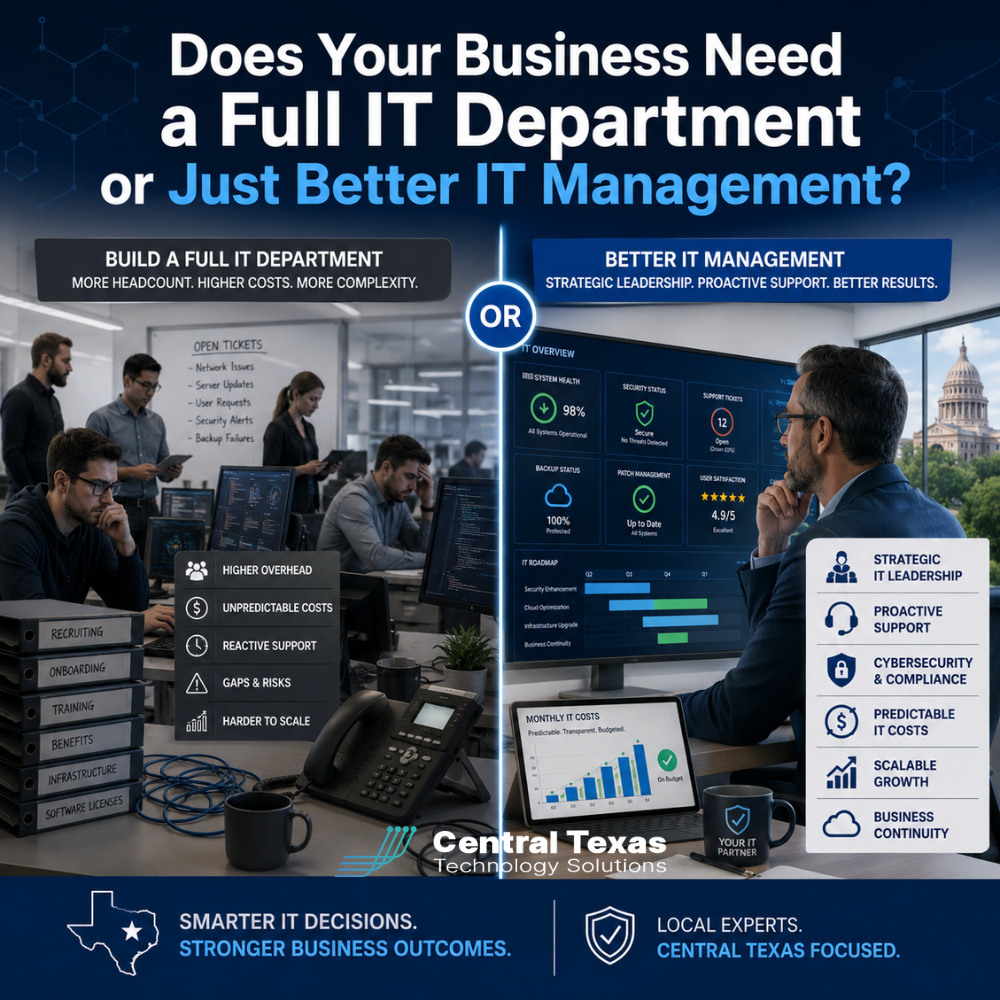
When a business starts growing, technology problems usually grow with it.
One person cannot keep up with every help desk ticket. Security risks become harder to manage. Employees need faster support. Leadership wants better visibility into costs, systems, software, and future planning.
That is when many business owners ask a major question:
Do we need to hire a full IT department?
For many growing companies in Austin, Round Rock, Georgetown, and Cedar Park, the real answer is not always more headcount. Often, the business does not need a larger internal team. It needs better IT management, clearer leadership, stronger processes, and a proactive technology partner who can help prevent problems before they disrupt the business.
That is where CTTS helps.
The Difference Between an IT Department and Better IT Management
A full IT department usually includes several roles. You may need someone to handle daily support, someone to manage cybersecurity, someone to oversee Microsoft 365, someone to maintain servers and networks, and someone to plan technology strategy.
For many small and mid-sized businesses, hiring all of those people is expensive and difficult.
Better IT management means your business still receives the structure, leadership, and technical coverage it needs without building a full department from scratch. Instead of reacting to problems one ticket at a time, your IT is managed through a clear plan.
That plan may include:
- Help desk support for employees
- Cybersecurity monitoring and protection
- Backup and disaster recovery planning
- Microsoft 365 management
- Network oversight
- Hardware lifecycle planning
- Vendor coordination
- Technology budgeting
- Strategic IT guidance
Healthcare, legal, professional services, construction, manufacturing, and nonprofit organizations all depend on reliable technology. But most do not need to carry the cost of a large internal IT team to get reliable support and leadership.
Why Adding IT Headcount Costs More Than Many Businesses Expect
Hiring one IT person may feel like the simplest next step. But one person can only cover so much.
They may be good at fixing computers but weak in cybersecurity. They may understand networks but not compliance. They may be available during normal business hours but unavailable when systems fail after hours. They may know your environment well, but if they leave, much of that knowledge may leave with them.
The real cost of adding IT headcount includes more than salary.
It may also include:
- Payroll taxes and benefits
- Recruiting costs
- Training and certifications
- Management time
- Coverage gaps during vacation or illness
- Tools and software licenses
- Escalation support for complex issues
- Cybersecurity resources
- Risk when one person becomes the single point of failure
For a growing business, one IT hire may solve some problems while creating others. The company may still lack documentation, long-term planning, security oversight, backup testing, vendor management, and executive-level IT leadership.
That is why the question is not simply, “Can we afford to hire someone?”
The better question is, “What level of IT leadership does our business actually need?”
Better IT Management Gives You Structure Without Building From Scratch
A business does not need chaos just because it is not ready for a full internal department.
Structured IT management gives leadership a clearer view of what is working, what is risky, what needs to be replaced, and what should be planned before it becomes urgent.
With CTTS, businesses get a proactive IT partner that helps manage technology as part of the business strategy, not just as a repair service.
That means your team has support when something breaks, but your business also has guidance before something breaks.
For example, a construction company may need better remote access for field teams. A healthcare office may need stronger security around patient data. A law firm may need reliable document access and backup protection. A manufacturer may need better network uptime. A nonprofit may need predictable IT costs. A professional services firm may need secure collaboration tools for a hybrid team.
Each situation is different, but the goal is the same.
Your technology should help your business move forward, not slow it down.
The Cost Difference Between Hiring and Partnering With CTTS
Hiring an internal IT employee can be valuable for the right business. But it is often only one part of the total solution.
A single hire gives you one person’s time, skill set, and availability.
Partnering with CTTS gives you access to a broader team, established processes, security tools, planning support, documentation practices, and strategic guidance.
That difference matters.
When you hire internally, you are paying for a role.
When you partner with CTTS, you are investing in a managed system.
That system can include help desk support, proactive monitoring, cybersecurity protections, backup oversight, Microsoft 365 management, network support, vendor coordination, and ongoing planning. Instead of placing the entire responsibility on one employee, your business has a team behind it.
For many businesses in Austin, Round Rock, Georgetown, and Cedar Park, that creates a more predictable and scalable way to manage IT.
When a Full IT Department May Make Sense
Some companies do reach a point where internal IT staff makes sense.
A full IT department may be appropriate if your business has a large employee base, complex internal systems, heavy compliance requirements, multiple locations, or daily technology needs that require constant onsite presence.
Even then, many businesses still benefit from partnering with CTTS for co-managed IT services.
In a co-managed model, CTTS supports the internal team instead of replacing it. This helps fill skill gaps, improve security, provide escalation support, and reduce the burden on internal staff.
That can be especially valuable when an internal IT person is overwhelmed by tickets and has no time left for planning, documentation, cybersecurity, or system improvements.
Signs You Need Better IT Management
Your business may not need a full department yet, but you may need stronger IT leadership if you notice these warning signs:
- Employees complain about slow support
- The same problems keep coming back
- No one owns the IT roadmap
- Cybersecurity is handled casually
- Backups are not tested regularly
- Software renewals are scattered
- Hardware replacement is unpredictable
- Leadership does not know what IT should cost
- One person knows too much and documents too little
- Technology decisions are made only when something breaks
These issues are not just technical problems. They are business risks.
Downtime affects productivity. Poor security increases exposure. Weak planning creates surprise expenses. Missing documentation makes transitions harder. For business leaders, the cost is not just frustration. It is lost time, lost confidence, and unnecessary risk.
Proactive IT Management Helps Prevent Expensive Surprises
Many businesses wait too long to improve IT management because they assume support is only needed when something breaks.
That thinking is expensive.
Reactive IT support waits for problems. Proactive IT management looks ahead.
CTTS helps businesses identify risks before they become emergencies. That may include aging hardware, weak passwords, unmanaged devices, missing backups, outdated systems, poor access controls, or software tools that no longer match the company’s needs.
This is especially important for growing companies. What worked for a 10-person team may not work for a 40-person team. What worked in one office may not work across several locations. What worked before remote work may not support today’s hybrid teams.
Better IT management helps your business grow with fewer disruptions.
IT Leadership Should Align Technology With Business Goals
Technology decisions should not happen in isolation.
Your IT strategy should support your hiring plans, customer experience, security needs, compliance expectations, financial goals, and growth strategy.
That is why CTTS does more than fix devices. CTTS helps business leaders understand what their technology needs to do next.
For example:
- A healthcare practice may need stronger compliance and secure access controls.
- A legal office may need dependable document management and data protection.
- A professional services firm may need better collaboration tools.
- A construction company may need secure mobile access for crews and project managers.
- A manufacturing company may need reliable uptime across production systems.
- A nonprofit may need cost-effective systems that protect donor and client information.
Better IT management connects those needs to a practical plan.
You Do Not Have to Build an IT Department Alone
Many business owners feel stuck between two bad options.
They either keep relying on reactive support, or they take on the cost of building a full IT department before they are ready.
There is a better path.
CTTS helps Central Texas businesses get the structure, support, and leadership they need without forcing them into unnecessary headcount. Your team gets dependable help. Your leadership gets clearer planning. Your business gets stronger protection. And your technology becomes easier to manage as you grow.
The goal is not to spend more on IT.
The goal is to make smarter IT decisions that reduce risk, improve productivity, and support long-term business growth.
Get the IT Leadership Your Business Needs
You do not have to choose between struggling with reactive support and building an expensive IT department before you are ready.
CTTS helps businesses across Austin, Round Rock, Georgetown, Cedar Park, and Central Texas manage IT with structure, strategy, and confidence.
Schedule a consultation with CTTS today and find out whether your business needs more headcount, better IT management, or the right combination of both.
FAQ: Full IT Department vs Better IT Management
Does every growing business eventually need a full IT department?
No. Some growing businesses benefit from internal IT staff, but many do not need a full department. A managed IT partner like CTTS can provide structured support, cybersecurity, planning, and leadership without requiring the business to hire multiple internal roles.
Is managed IT cheaper than hiring an IT employee?
In many cases, managed IT can be more cost-effective because it gives your business access to a broader team, tools, processes, and expertise for a predictable monthly cost. Hiring one employee may still leave gaps in cybersecurity, documentation, backup planning, and strategic leadership.
Can CTTS work with our existing IT person?
Yes. CTTS can provide co-managed IT support for businesses that already have internal IT staff. This gives your internal team help with complex issues, cybersecurity, planning, monitoring, and project work while allowing them to focus on daily business needs.
Contact CTTS today for IT support and managed services in Austin, TX. Let us handle your IT so you can focus on growing your business. Visit CTTSonline.com or call us at (512) 388-5559 to get started!
Get the answers business leaders are asking about IT services:
How Much Does IT Support Cost in Austin in 2026? A Real World Breakdown
Managed IT Services in Austin: What Are You Actually Paying For?
Is Outsourced IT Cheaper Than Hiring an In House IT Team?
Hidden Costs Businesses Miss When Choosing a Managed Services Provider
Why the Cheapest IT Support in Texas Often Costs You the Most
Why Do Managed IT Service Prices Vary So Much Between Providers in Austin?
What Is Included in a Typical Per User IT Support Pricing Model?
How Do IT Support Contracts Work and What Should You Expect to Sign?
What Are the Long Term Costs of Delaying IT Upgrades?
How Do Cybersecurity Requirements Impact Your IT Budget in 2026?