
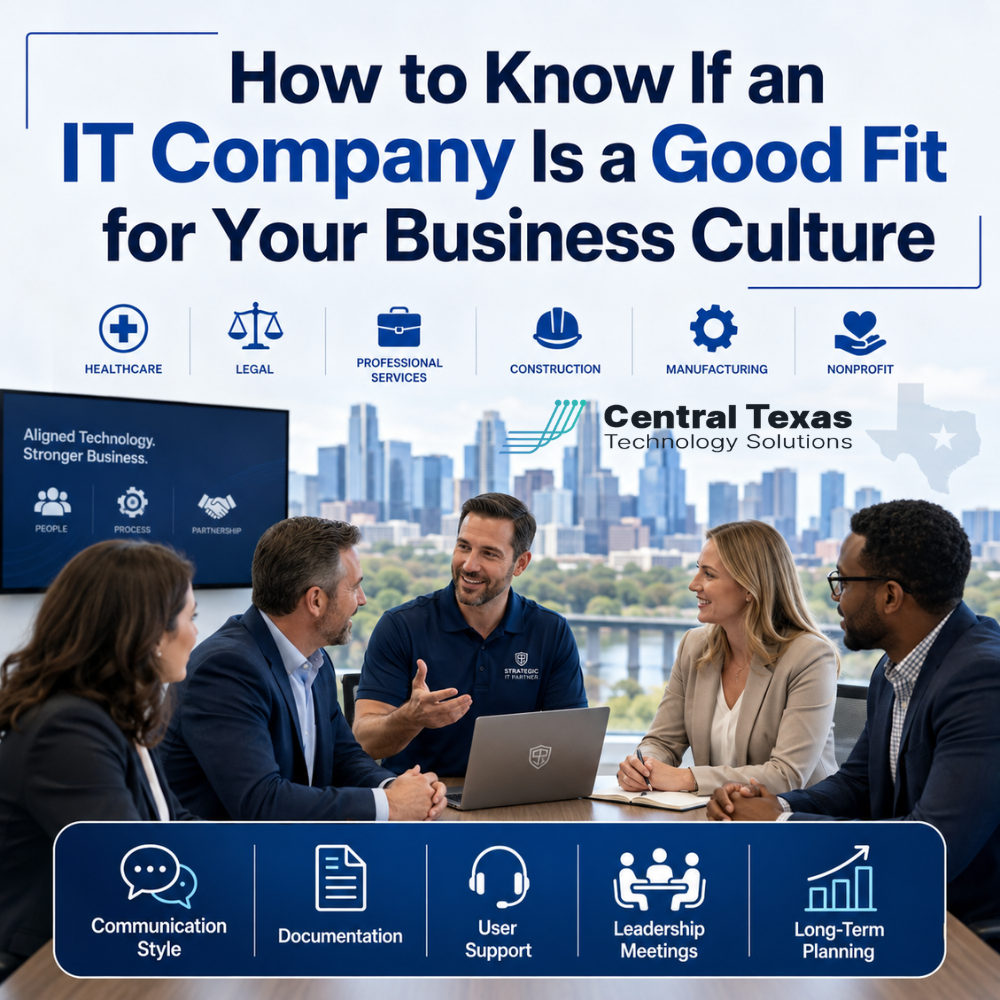
Choosing an IT company is not just about response times, tools, or pricing. Those things matter, but they do not tell the whole story.
The bigger question is whether the IT company understands how your business actually works.
For growing businesses in Austin and across Central Texas, the wrong IT partner can create frustration, confusion, and unnecessary delays. Your team may feel ignored. Your leaders may feel left out of important technology decisions. Your systems may get patched and repaired, but your business never really moves forward.
Whether you lead a healthcare practice, legal firm, professional services company, construction business, manufacturing operation, or nonprofit, your IT partner needs to fit the way your people communicate, make decisions, solve problems, and plan for growth.
That is where business culture matters.
A good IT company does more than fix technical issues. The right partner helps your team feel supported, keeps leadership informed, documents what matters, and builds a technology plan that supports your long-term goals.
Why IT Company Culture Fit Matters
Most business leaders do not want to manage IT problems every week. They want technology that helps their people do their jobs without disruption.
But when your IT company is not aligned with your culture, small problems become bigger issues.
You may notice:
- Employees feel uncomfortable asking for help
- Technical explanations create more confusion than clarity
- Support tickets get closed without solving the real problem
- Leadership meetings focus only on tools instead of business goals
- No one seems to know where key passwords, vendor details, or system notes are stored
- Technology decisions happen reactively instead of strategically
For a medical office in Georgetown, that could mean staff wasting time during patient check-in because recurring workstation issues never get addressed. For a law firm in Austin, it could mean attorneys struggling with secure document access before a deadline. For a construction company in Cedar Park, it could mean field teams losing productivity because mobile device support is inconsistent.
The right IT company should reduce friction, not add to it.
Look at the IT Company’s Communication Style
Communication is one of the clearest signs of whether an IT company will be a good fit for your business culture.
Some IT providers talk in technical terms that leave business leaders unsure what action to take. Others only communicate when something breaks. Neither approach helps your team feel confident.
A good IT company should communicate clearly, consistently, and in a way your people understand.
That means they should be able to explain:
- What happened
- Why it matters
- What they are doing about it
- How it affects your business
- What needs to happen next
This is especially important for industries like healthcare, legal, manufacturing, nonprofits, professional services, and construction, where downtime, security gaps, and workflow delays can directly affect clients, patients, projects, or revenue.
If your team values quick answers, the IT company should have a support process that respects that. If your leadership team prefers scheduled updates, the provider should be prepared for structured conversations. If your employees need extra guidance, your IT partner should be patient, helpful, and approachable.
Good IT communication is not about sounding smart. It is about helping your business make smart decisions.
Pay Attention to How They Support Your Users
Your employees experience your IT company more often than your leadership team does.
That makes user support one of the most important parts of culture fit.
When employees ask for help, they should feel respected, not talked down to. They should know where to go, what to expect, and how their issue will be handled. A good IT partner understands that every support interaction affects productivity and morale.
For example, a nonprofit team in Round Rock may not have time to chase down the status of a software issue during a fundraising campaign. A professional services firm in Austin may need fast support because client deadlines depend on working systems. A manufacturing company may need help that considers shift schedules, production demands, and uptime requirements.
The right IT company should have a support culture built around service, not just ticket closure.
Strong user support includes:
- Friendly help desk interactions
- Clear expectations for response and resolution
- Follow-through when an issue needs more work
- Support for remote and hybrid employees
- Guidance that helps users avoid repeat problems
If your employees dread contacting IT, that is a warning sign.
Your IT partner should make technology feel less stressful, not more.
Ask About Documentation Before You Need It
Documentation may not sound exciting, but it is one of the strongest signs of a mature IT company.
Without documentation, your business becomes dependent on memory, guesswork, and individual technicians. That creates risk when employees leave, vendors change, systems fail, or emergencies happen.
A good IT company should document important details such as:
- Network information
- Hardware and software inventory
- Vendor contacts
- License details
- Password and access processes
- Security settings
- Backup systems
- Standard procedures
- Known issues and past resolutions
For a healthcare practice, documentation supports compliance and continuity. For a law firm, it helps protect sensitive client data. For a construction company, it keeps office and field systems connected. For nonprofits, it protects institutional knowledge when staff or volunteers change. For manufacturers and professional services firms, it reduces downtime and improves decision-making.
Documentation also helps your IT company serve you better. When systems are clearly documented, support is faster, planning is easier, and fewer things fall through the cracks.
If an IT company cannot explain how they document your environment, they may be relying too much on reactive support.
That is not a strong foundation for growth.
Make Sure Leadership Meetings Are Part of the Relationship
The right IT company should not only talk to your team when something is broken.
Leadership meetings are where your IT partner should connect technology to business goals.
These conversations should help you understand where your systems stand today, what risks need attention, what investments should be planned, and how technology can better support your next stage of growth.
For example, a business expanding from Georgetown into Austin may need better cloud access, stronger cybersecurity, and a more scalable support structure. A legal firm adding staff may need improved document management and secure remote access. A healthcare practice preparing for an audit may need help reviewing policies, access controls, backups, and security documentation.
Good leadership meetings should cover:
- Business priorities
- Cybersecurity risk
- Hardware lifecycle planning
- Software and license management
- Compliance needs
- Employee support trends
- Backup and disaster recovery readiness
- Upcoming projects
- Budget planning
This is where CTTS takes a proactive approach. Instead of waiting for problems to become urgent, CTTS works with business leaders to identify risks, plan improvements, and align technology with business goals.
That matters because technology should not be a mystery expense. It should be a managed part of your business strategy.
Look for Long-Term Planning, Not Just Short-Term Fixes
A reactive IT company fixes what breaks.
A strategic IT partner helps prevent problems before they disrupt your business.
Long-term planning is a major part of culture fit because every business has different goals, pressures, and risk tolerance. A fast-growing professional services firm may need a roadmap for onboarding, cloud systems, and secure collaboration. A construction company may need better mobile device management and jobsite connectivity. A healthcare or legal organization may need stronger compliance planning. A nonprofit may need cost-conscious technology decisions that still protect data and operations.
The right IT company should help you plan for:
- Growth
- Hiring
- Office moves
- Remote work
- Cybersecurity maturity
- Compliance requirements
- Hardware replacement
- Software upgrades
- Business continuity
- Budget predictability
If every IT conversation feels like a surprise expense, your provider is not helping you plan.
A good IT partner helps you see what is coming, make informed decisions, and avoid preventable disruption.
Watch for Misalignment Between Their Process and Your Team
Even technically skilled IT companies can be the wrong fit if their process clashes with your culture.
For example, if your company values personal service but your IT provider relies only on automated ticket responses, your team may feel unsupported. If your leadership team wants strategic guidance but your provider only discusses technical alerts, you may not get the insight needed to make smart decisions. If your employees are not highly technical, but your provider explains everything in acronyms, confusion will grow.
A good fit should feel like a partnership.
Your IT company should understand:
- How your team prefers to communicate
- How quickly your work moves
- Which systems are most important
- What downtime costs your business
- Which compliance issues matter in your industry
- How leadership makes decisions
- What your growth plans look like
The best IT relationships are built on trust, clarity, and shared expectations.
Questions to Ask Before Choosing an IT Company
Before signing with an IT company, ask questions that reveal how they work, not just what they sell.
Helpful questions include:
- How do you communicate with leadership?
- How do users request support?
- How do you document our systems?
- How often do you meet with clients to review strategy?
- How do you help prevent recurring issues?
- How do you support remote or hybrid teams?
- How do you plan for hardware replacement and future technology needs?
- How do you tailor support for our industry?
- How will you help us understand risk without overwhelming us with technical jargon?
The answers will tell you a lot.
If the company only talks about tools, tickets, and pricing, they may not be thinking strategically. If they ask about your people, workflows, goals, and risks, they are more likely to become a true partner.
Why CTTS Focuses on Fit, Not Just Fixes
Businesses across Austin, Round Rock, Georgetown, Cedar Park, and the surrounding Central Texas area need more than basic IT support.
They need an IT partner who understands that technology affects every part of the business, from employee productivity to client service, cybersecurity, compliance, and long-term growth.
CTTS helps healthcare practices, legal firms, professional services companies, construction businesses, manufacturing organizations, and nonprofits move away from reactive IT problems and toward a more structured, proactive approach.
That means:
- Clear communication
- Friendly user support
- Strong documentation
- Regular leadership conversations
- Long-term technology planning
- Practical cybersecurity guidance
- IT decisions aligned with business goals
The goal is not simply to fix problems faster.
The goal is to prevent avoidable problems, support your people, and help your business move forward with confidence.
Choosing the Right IT Company Starts With the Right Conversation
If your current IT relationship feels disconnected from the way your business operates, it may be time to ask a better question.
Not just, “Can they fix our computers?”
But, “Do they understand how our business works?”
The right IT company should fit your culture, support your team, communicate clearly with leadership, and help you plan for what comes next.
If your business is ready for proactive IT support that feels aligned with your goals, CTTS can help.
Schedule a consultation with CTTS today and find out whether your technology is supporting your business or slowing it down.
Frequently Asked Questions About Choosing the Right IT Company
What makes an IT company a good fit for a business?
A good IT company understands your business goals, communication preferences, industry needs, and internal workflows. They should provide reliable support, clear documentation, proactive planning, and regular leadership guidance.
Why does communication style matter when choosing an IT provider?
Communication style matters because business leaders and employees need clear answers, not confusing technical language. A strong IT partner explains problems, risks, and next steps in a way your team can understand and act on.
How can long-term IT planning help my business?
Long-term IT planning helps your business avoid surprise expenses, reduce downtime, improve security, and prepare for growth. It turns technology from a reactive cost into a strategic business advantage.
Contact CTTS today for IT support and managed services in Austin, TX. Let us handle your IT so you can focus on growing your business. Visit CTTSonline.com or call us at (512) 388-5559 to get started!
Choosing the right IT partner starts here:
How to Choose the Right IT Consulting Firm in Austin
Questions to Ask Before Hiring an IT Support Company
What Makes a Managed Services Provider a True Business Partner?
Red Flags to Watch for When Evaluating IT Consulting Companies
What Professional IT Services Should Look Like in 2026
How Do You Evaluate an IT Provider’s Response Time Before Signing a Contract?
What Does a Strong IT Onboarding Process Look Like for Your Business?
How Can You Tell If an IT Company Is Being Proactive or Just Reactive?
What Should You Expect From Your First 90 Days With a New IT Partner?