
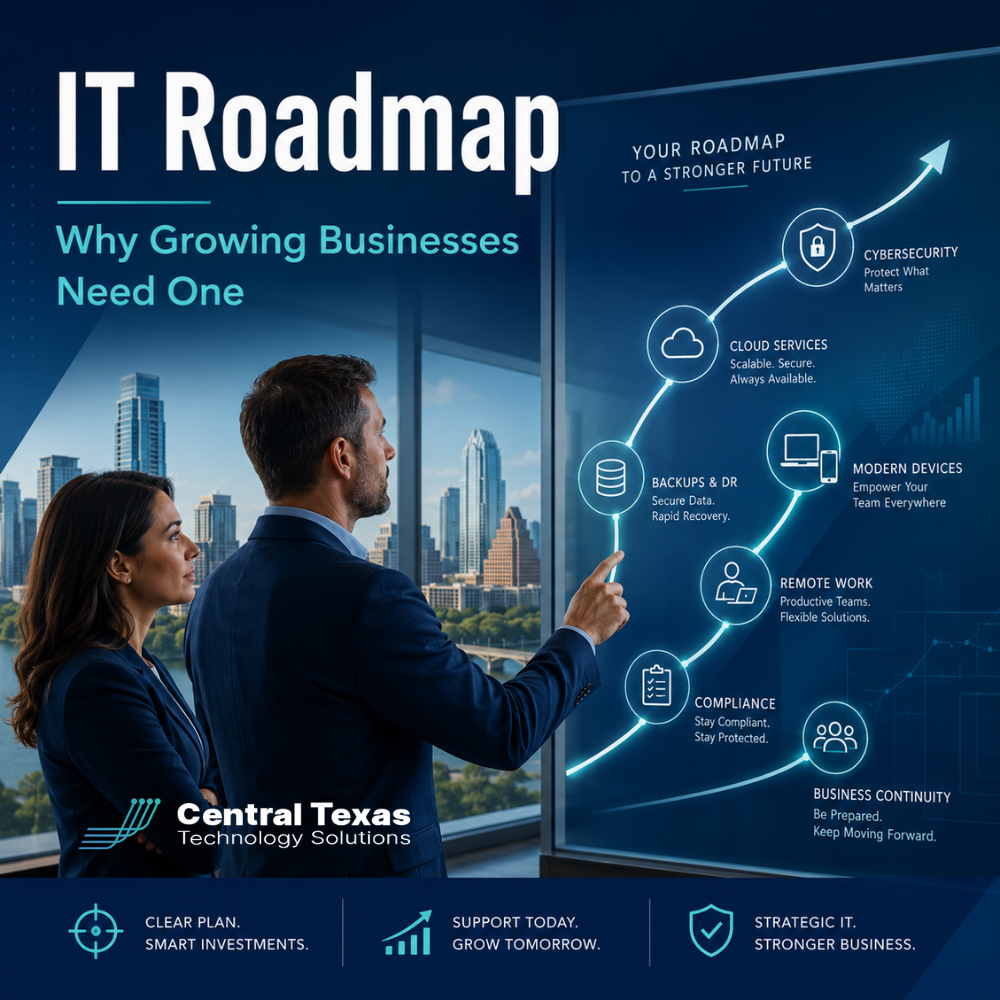
When your business is growing, technology can either help you move faster or quietly hold you back.
At first, small IT issues may seem manageable. A slow computer here. A software subscription there. A server that needs attention. A cybersecurity tool that someone meant to review months ago. But as your team grows, your technology environment becomes more complex.
Without a clear plan, your business may end up making IT decisions only when something breaks, when a renewal deadline appears, or when a security concern becomes urgent.
That is where an IT roadmap becomes essential.
An IT roadmap gives your business a clear technology plan for where you are now, where you are going, and what needs to happen next. For growing businesses in Austin, Round Rock, Georgetown, Cedar Park, and across Central Texas, it can be the difference between reacting to problems and building a technology strategy that supports long-term success.
What Is an IT Roadmap?
An IT roadmap is a strategic plan that outlines your technology goals, priorities, projects, risks, timelines, and budget needs.
It helps business leaders answer important questions such as:
- What technology do we need to support growth?
- Which systems are outdated or creating risk?
- What cybersecurity improvements should come first?
- When should we upgrade hardware, software, servers, or cloud tools?
- How should IT spending align with business goals?
- What needs to happen before we add new locations, employees, or services?
An IT roadmap is not just a list of technology projects. It is a business planning tool.
For example, if a healthcare practice plans to add providers, a legal firm needs better document security, a construction company is expanding field operations, a manufacturing business wants less downtime, a nonprofit is preparing for an audit, or a professional services firm is growing its remote team, each of those goals depends on the right technology foundation.
Why Growing Businesses Need an IT Roadmap
Growth creates pressure.
More employees need access to files, software, email, printers, applications, and support. More devices connect to your network. More data needs to be protected. More clients depend on your systems working properly.
Without an IT roadmap, businesses often fall into a reactive cycle.
Something breaks, so they fix it.
A system expires, so they renew it.
A cyber insurance form asks questions, so they scramble for answers.
An employee cannot work remotely, so someone looks for a quick workaround.
The problem is that quick fixes often create long-term risk. They may solve the immediate issue, but they do not always support the bigger picture.
An IT roadmap helps your business make technology decisions before problems disrupt productivity, security, or customer service.
An IT Roadmap Aligns Technology With Business Goals
Your technology should support where your business is going, not just where it is today.
If you are hiring new employees, opening another location, changing software platforms, improving compliance, or supporting hybrid work, your IT environment needs to be ready.
A strong IT roadmap connects technology planning to business outcomes such as:
- Better productivity
- Stronger cybersecurity
- Fewer disruptions
- More predictable IT costs
- Improved employee experience
- Easier compliance preparation
- More reliable business continuity
This is especially important for Central Texas businesses in industries where downtime, data loss, or weak security can create serious consequences.
Healthcare organizations need reliable access to patient information.
Legal firms need secure communication and document management.
Professional services firms need efficient collaboration tools.
Construction companies need field teams to stay connected.
Manufacturing companies need systems that support operations without costly interruptions.
Nonprofits need secure, cost-conscious technology that supports their mission.
An IT roadmap helps each of these organizations make smarter technology decisions with confidence.
IT Roadmaps Help Prevent Expensive Surprises
One of the biggest benefits of an IT roadmap is predictability.
Without a roadmap, business leaders are often surprised by sudden expenses, such as emergency server replacement, outdated software, unsupported hardware, failed backups, or cybersecurity gaps that require immediate action.
With a roadmap, you can plan ahead.
You can see which systems are aging, which tools need to be reviewed, which risks need to be addressed, and which investments should be prioritized over the next quarter, year, or several years.
This helps you avoid the kind of panic spending that happens when technology decisions are delayed too long.
Instead of asking, “Why are we dealing with this now?” your business can ask, “What is the smartest next step?”
What Should Be Included in an IT Roadmap?
A useful IT roadmap should be practical, clear, and tied to real business needs.
Most growing businesses should include the following areas:
Current Technology Assessment
Before you can plan the future, you need to understand your current environment.
This includes reviewing:
- Computers and devices
- Servers and cloud systems
- Network equipment
- Software and licensing
- Backup and disaster recovery tools
- Cybersecurity protections
- User access and permissions
- Vendor relationships
- Support history and recurring issues
This step helps identify what is working, what is outdated, and what may be creating risk.
Cybersecurity Priorities
Cybersecurity should never be treated as an afterthought.
A good IT roadmap should identify security gaps and prioritize improvements such as multi-factor authentication, endpoint protection, secure backups, employee training, email security, access controls, and cyber insurance readiness.
For many businesses, cybersecurity requirements are no longer optional. Clients, vendors, insurance carriers, and regulators increasingly expect stronger safeguards.
Hardware and Software Lifecycle Planning
Every device and application has a useful life.
An IT roadmap helps your business plan for replacements and upgrades before outdated systems create problems. This may include computers, servers, firewalls, Wi-Fi equipment, phone systems, business applications, and Microsoft 365 licensing.
Waiting until equipment fails often costs more than planning ahead.
Cloud and Remote Work Strategy
As teams become more mobile, businesses need secure and reliable access to systems from anywhere.
An IT roadmap can help determine whether your current tools support remote work, hybrid teams, file sharing, collaboration, and secure access.
This is especially valuable for companies with employees in multiple locations or field-based teams across Austin and surrounding areas.
Backup and Business Continuity Planning
Every growing business needs to know what happens if systems go down.
An IT roadmap should include backup strategy, recovery testing, disaster recovery planning, and business continuity goals.
The key question is simple: if something fails, how quickly can your business get back to work?
Budget and Timeline
An IT roadmap should help leadership understand when technology investments are needed and why they matter.
This allows your business to budget more effectively, avoid surprises, and make decisions based on priority rather than urgency.
The Risk of Growing Without an IT Roadmap
Many businesses do not realize they need an IT roadmap until they experience a major problem.
That problem might be a data breach, a failed server, a compliance issue, a lost file, a failed software migration, or an employee productivity crisis.
By that point, the cost is usually higher.
Without an IT roadmap, your business may face:
- More frequent downtime
- Higher emergency IT costs
- Unclear cybersecurity priorities
- Aging systems that create risk
- Poor software decisions
- Weak backup and recovery processes
- Confusion around IT budgets
- Technology that does not support growth
The larger your business becomes, the more expensive these issues can be.
An IT roadmap helps you move from uncertainty to clarity.
How CTTS Helps Build an IT Roadmap for Growing Businesses
CTTS helps Central Texas businesses take a proactive approach to technology planning.
Instead of waiting for problems to happen, CTTS works with business leaders to understand their goals, assess their current environment, identify risks, and build a practical IT roadmap that supports growth.
The goal is not to sell technology for the sake of technology.
The goal is to help your business make confident decisions that improve efficiency, security, productivity, and continuity.
With CTTS, your business gains a strategic IT partner who helps you answer:
- What should we fix first?
- What can wait?
- What risks are we carrying?
- What should we budget for?
- How can technology better support our business goals?
- What does our IT environment need to look like one, three, or five years from now?
That is the difference between reactive IT support and a proactive IT strategy.
IT Roadmap Planning for Austin and Central Texas Businesses
Businesses across Austin, Round Rock, Georgetown, Cedar Park, and the surrounding Central Texas area are growing quickly. As that growth continues, technology decisions become more important.
A business that once managed IT informally may eventually need stronger systems, clearer policies, better security, and more reliable support.
An IT roadmap gives leadership a way to plan before technology becomes a bottleneck.
Whether your organization is preparing for growth, improving cybersecurity, reducing recurring IT problems, supporting remote teams, or planning a major system upgrade, the right roadmap can help you move forward with less risk and more confidence.
Build a Technology Plan That Supports Growth
Your business should not have to guess what comes next with technology.
An IT roadmap gives you the clarity to plan ahead, reduce risk, and align your systems with your goals.
CTTS helps growing businesses in Austin and Central Texas create practical IT roadmaps that support productivity, cybersecurity, and long-term success.
Schedule a consultation with CTTS today to build an IT roadmap that helps your business move forward with confidence.
Frequently Asked Questions About IT Roadmaps
What is the main purpose of an IT roadmap?
The main purpose of an IT roadmap is to help a business plan technology decisions in advance. It connects IT projects, cybersecurity needs, upgrades, budgets, and timelines to the company’s larger business goals.
How often should a business update its IT roadmap?
Most businesses should review their IT roadmap at least once or twice a year. It should also be updated whenever the business is hiring, expanding, changing software, opening new locations, preparing for audits, or experiencing recurring IT issues.
Does a small or mid-sized business really need an IT roadmap?
Yes. Small and mid-sized businesses often benefit the most from an IT roadmap because it helps them avoid surprise expenses, reduce security risks, and make smarter technology decisions as they grow.
Contact CTTS today for IT support and managed services in Austin, TX. Let us handle your IT so you can focus on growing your business. Visit CTTSonline.com or call us at (512) 388-5559 to get started!
Get the answers business leaders are asking about IT services:
What Do Managed IT Services Actually Include?
How Remote IT Support Works and When It Makes Sense
What IT Network Support Does for Business Stability and Growth
How IT Consulting Helps Businesses Scale Without Chaos
What Professional IT Support Services Mean for Day to Day Operations
What Does Proactive IT Support Actually Look Like Behind the Scenes?
How IT Monitoring Tools Detect Problems Before Your Team Notices Them
What Happens During a Routine IT Maintenance Cycle?
How Backup and Disaster Recovery Plans Work in Real World Scenarios