
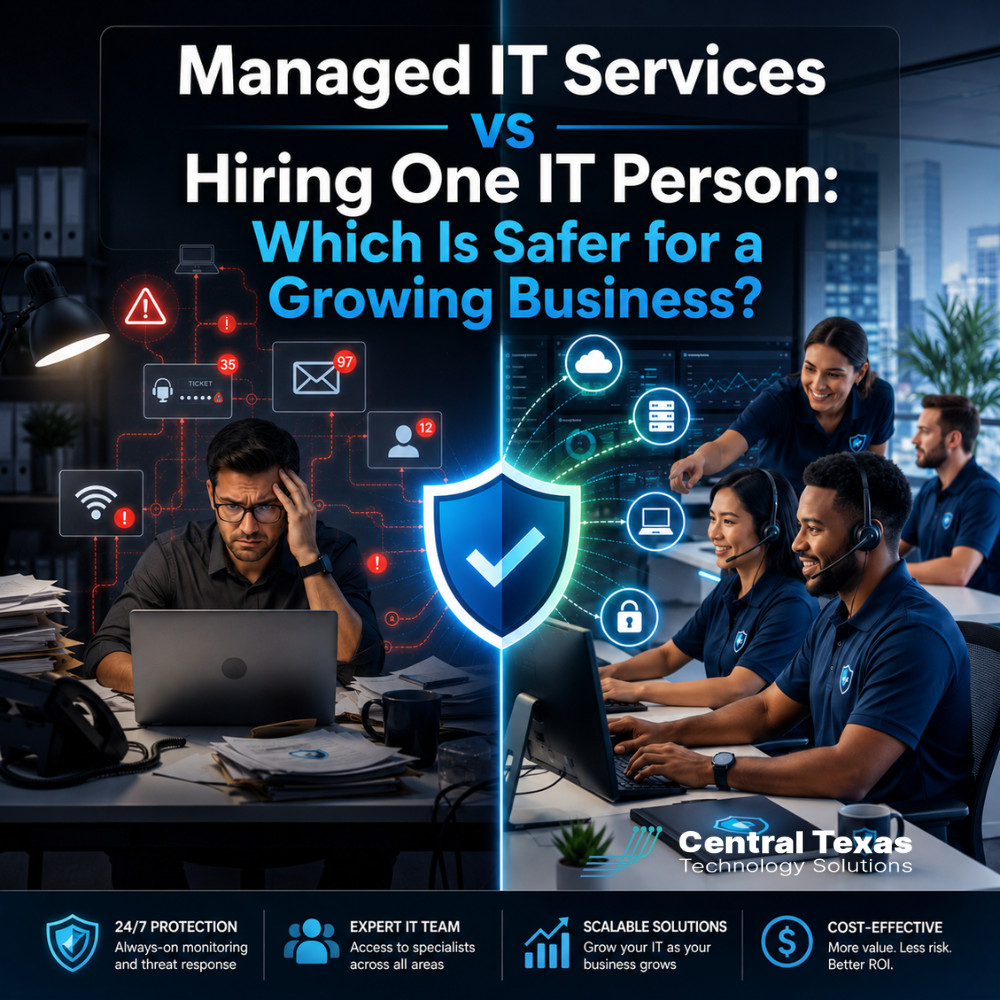
When a business starts growing, IT problems become harder to ignore.
The team gets bigger. More devices connect to the network. More people use cloud apps, email, shared files, and remote access tools. What used to be a quick fix can suddenly become a serious business risk.
At that point, many business leaders ask a practical question:
Should we hire one internal IT person, or should we work with a managed IT services provider?
It is a fair question. Hiring one IT person can feel simple. You have someone on-site, someone your team knows, and someone who understands your systems. But for a growing business in Austin, Round Rock, Georgetown, Cedar Park, and across Central Texas, the safer choice is often not one person. It is a proactive IT team.
For businesses in healthcare, legal, professional services, construction, manufacturing, and nonprofits, technology is no longer just a support function. It touches security, productivity, compliance, customer service, and business continuity.
That means the real question is not just, “Who can fix our computers?”
The better question is, “Which option gives our business the safest, most reliable path forward?”
Why Growing Businesses Outgrow One-Person IT Support
A single IT person can be valuable. Many businesses have relied on one dedicated technician or internal IT employee for years. The challenge is that business growth quickly creates needs that one person cannot reasonably cover alone.
A growing business may need help with:
- Cybersecurity monitoring
- Microsoft 365 security
- Backup and disaster recovery
- Vendor management
- Compliance support
- Remote access security
- Help desk tickets
- Network performance
- Hardware planning
- Cloud applications
- Employee onboarding and offboarding
- Strategic IT budgeting
That is a lot for one person.
Even a highly skilled IT professional has limits. They can get sick. They can go on vacation. They may be strong in networking but less experienced in cybersecurity. They may know your systems well but not have the time to document them properly, plan upgrades, monitor threats, and respond to daily support requests.
For a small business, that may be manageable for a while. For a growing company, it can create hidden risk.
Managed IT Services vs Hiring IT Staff: The Safety Difference
When comparing managed IT services vs hiring IT staff, safety comes down to coverage, consistency, and depth.
One IT person gives you an individual.
Managed IT services give you a team, a process, and a proactive strategy.
That difference matters when your business depends on secure systems and reliable access to information. If your legal team cannot access case files, your healthcare office cannot reach patient records, your construction team cannot open project documents, or your manufacturing operation loses access to key systems, the problem is bigger than IT.
It becomes a business interruption.
Managed IT services help reduce that risk by making sure your technology is not dependent on one person’s availability, memory, or bandwidth.
The Risk of Depending on One IT Person
The biggest risk with hiring one IT person is not whether they are talented. They may be excellent.
The risk is dependency.
If one person holds all the knowledge, all the passwords, all the vendor relationships, and all the troubleshooting history, your business becomes vulnerable.
That can create problems such as:
- Delayed response when that person is unavailable
- Lack of documentation
- Limited cybersecurity oversight
- No backup support during emergencies
- Slow progress on strategic projects
- Overloaded support queues
- Security gaps caused by competing priorities
- Difficulty scaling as the company grows
This is especially important for organizations with compliance, uptime, or confidentiality concerns. Healthcare businesses must protect sensitive patient information. Legal firms need secure access to confidential client files. Professional services firms rely on productivity and communication. Construction companies need field teams and office teams connected. Manufacturing businesses need systems that support operations. Nonprofits must protect donor data while often working with limited budgets.
A single IT person may work hard to support all of that, but hard work alone does not remove the risk of limited capacity.
Why Managed IT Services Are Safer for Business Continuity
Business continuity means your company can keep operating when something goes wrong.
That might include a cyberattack, a server failure, a bad software update, an internet outage, a lost laptop, or an employee clicking a malicious link.
With one IT person, business continuity often depends on how quickly that person can respond.
With managed IT services, the goal is different. The goal is to prevent avoidable problems before they disrupt the business.
A proactive managed IT services provider can help with:
- Monitoring systems before they fail
- Applying security updates
- Managing backups
- Testing recovery processes
- Reviewing security settings
- Documenting systems and access
- Planning hardware replacement
- Supporting remote and hybrid teams
- Identifying weak points before they become outages
This approach helps growing businesses stay ahead of problems instead of constantly reacting to them.
That is one of the biggest differences between traditional IT support and a managed IT partnership. The best IT strategy is not built around waiting for something to break. It is built around keeping the business moving.
Managed IT Services Provide a Wider Range of Expertise
No single IT person can be an expert in everything.
Modern business technology includes cybersecurity, cloud services, Microsoft 365, networking, backup systems, endpoint protection, mobile devices, compliance, and vendor coordination. Each area requires its own knowledge and attention.
A managed IT services provider gives your business access to a broader team. Instead of relying on one person to know everything, you can benefit from multiple specialists who work together.
That matters when your business faces situations like:
- Preparing for a compliance audit
- Moving systems to the cloud
- Securing remote employees
- Responding to suspicious email activity
- Replacing aging equipment
- Evaluating cybersecurity insurance requirements
- Reducing downtime
- Planning technology for a new location
- Supporting rapid employee growth
For businesses in Austin and nearby communities like Pflugerville, Leander, and Round Rock, growth can move quickly. Your IT support needs to keep pace.
A managed IT team can help your technology scale with the business instead of holding it back.
One IT Person Can Become a Bottleneck
A common misconception is that hiring one IT person gives a business more control.
Sometimes it does. But as the business grows, that person can also become a bottleneck.
When every support ticket, vendor call, password reset, security alert, computer setup, and system question goes through one person, response times can suffer. Strategic projects get pushed aside because urgent issues take priority.
That creates a frustrating cycle.
The IT person is always busy. Employees wait longer for help. Leadership does not get the planning support it needs. Security work gets delayed. Documentation falls behind. The business keeps growing, but the IT structure does not.
Managed IT services solve this by spreading responsibilities across a team with defined processes. Help desk support, cybersecurity monitoring, system maintenance, project planning, and strategic guidance do not all depend on one person’s schedule.
That creates a more stable experience for employees and a safer operating environment for the business.
Managed IT Services Help Align Technology With Business Goals
Hiring an IT person often focuses on daily support.
Managed IT services should go further.
A strong managed IT provider helps business leaders connect technology decisions to business goals. That includes questions such as:
- Are our systems ready for growth?
- Are we spending money on the right tools?
- Where are we exposed to security risk?
- What should we replace this year?
- Are our backups reliable?
- Do we have the right access controls?
- Can our remote team work securely?
- Are we prepared for an audit or insurance review?
These questions matter because IT decisions affect budgets, risk, productivity, and customer experience.
CTTS helps Central Texas businesses look beyond the immediate technical issue and understand what needs to happen next. That kind of strategic guidance is especially valuable for business leaders who do not want technology to slow down growth.
The Cybersecurity Advantage of Managed IT Services
Cybersecurity is one of the clearest areas where managed IT services are safer than relying on one person.
Threats change constantly. Attackers target email accounts, passwords, cloud applications, remote access tools, vendors, and employees. One person may not have the time or resources to monitor every risk.
A managed IT services provider can help strengthen cybersecurity through:
- Multi-factor authentication
- Endpoint protection
- Email security
- Security policy reviews
- Patch management
- Backup planning
- User access reviews
- Threat monitoring
- Security awareness support
- Microsoft 365 configuration
- Incident response planning
This is not just a technical concern. It is a leadership concern.
If a business experiences a cyberattack, the cost can include downtime, lost trust, legal exposure, recovery expenses, and operational disruption.
For healthcare, legal, professional services, construction, manufacturing, and nonprofit organizations, the safer approach is to build security into daily operations instead of treating it as an afterthought.
When Hiring One IT Person Might Make Sense
There are situations where hiring an internal IT person can be helpful.
A business may need someone on-site every day to support a large workforce, manage internal applications, or coordinate technology across departments. In some cases, an internal IT person can be a valuable part of the team.
But that does not mean they should work alone.
Many growing businesses choose a co-managed IT model. In this approach, the internal IT person handles certain day-to-day responsibilities while a managed IT provider supplies additional support, cybersecurity tools, escalation help, documentation, monitoring, and strategic guidance.
This can be a strong option because it gives the business both internal familiarity and external depth.
Instead of replacing the internal IT person, CTTS can help support them.
That reduces burnout, improves response times, and gives leadership a stronger IT foundation.
The Cost Question: Is Managed IT More Expensive Than One Employee?
At first glance, hiring one IT person may seem less expensive than managed IT services. But the full cost comparison is not always that simple.
When hiring internally, businesses must consider:
- Salary
- Benefits
- Payroll taxes
- Training
- Certifications
- Tools and software
- Vacation coverage
- Recruiting costs
- Turnover risk
- Limited skill coverage
- Emergency support gaps
Managed IT services typically provide access to a wider team, support tools, security systems, monitoring, documentation, and strategic planning for a predictable monthly cost.
The real issue is not just the monthly expense. It is the cost of risk.
If one person misses a security gap, fails to test backups, leaves without documentation, or cannot respond during a critical outage, the business may pay far more than expected.
For growing businesses, predictable IT support is often safer than unpredictable IT risk.
What Growing Businesses Should Look For in Managed IT Services
Not all managed IT providers are the same. The safer choice is not simply the provider that answers the phone when something breaks.
Look for a managed IT services provider that offers:
- Proactive monitoring
- Clear documentation
- Strong cybersecurity practices
- Backup and disaster recovery planning
- Help desk support
- Strategic technology planning
- Local business understanding
- Clear communication
- Vendor coordination
- Regular reviews and recommendations
A good IT partner should help your business understand what is working, what is risky, what needs attention, and what can wait.
You should not feel confused, ignored, or pressured into tools you do not understand.
You should feel guided.
Why CTTS Is a Safer IT Partner for Growing Central Texas Businesses
CTTS helps businesses across Austin, Round Rock, Georgetown, and Central Texas move from reactive IT support to proactive IT strategy.
That means we do more than fix problems when they happen. We help prevent problems from becoming business disruptions.
Our team works with growing businesses that need secure, reliable technology without depending on one person to carry the entire load. Whether you operate in healthcare, legal, professional services, construction, manufacturing, or the nonprofit sector, your technology needs to support your goals, protect your people, and keep your business moving.
CTTS helps by providing:
- Proactive support
- Cybersecurity guidance
- Reliable help desk coverage
- Backup and recovery planning
- Microsoft 365 support
- Network management
- Strategic IT planning
- Clear communication for business leaders
You do not have to guess whether your systems are safe enough, documented enough, or ready for growth. You can have a trusted IT partner helping you make confident decisions.
Managed IT Services vs One IT Person: Which Is Safer?
For most growing businesses, managed IT services are the safer choice.
One IT person may be helpful, but one person cannot provide the same coverage, depth, continuity, and strategic support as a proactive IT team.
The safest option is the one that reduces dependency, improves security, supports growth, and protects the business from unnecessary downtime.
For some companies, that may mean fully managed IT services. For others, it may mean co-managed IT support that strengthens an existing internal IT employee.
Either way, the goal is the same:
Your business should not be one vacation, one resignation, one missed alert, or one undocumented password away from a serious IT problem.
Schedule a Consultation With CTTS
Your business deserves IT support that grows with you.
If you are trying to decide between hiring one IT person and working with a managed IT services provider, CTTS can help you understand the safest path forward.
Schedule a consultation with CTTS today and get a clearer picture of how proactive IT support can protect your business, support your team, and help you grow with confidence.
Frequently Asked Questions About Managed IT Services vs Hiring One IT Person
Is managed IT better than hiring an internal IT person?
For many growing businesses, managed IT services are safer because they provide access to a full team, proactive monitoring, cybersecurity support, documentation, and strategic planning. An internal IT person can be valuable, but relying on one person alone can create risk.
Can managed IT services work with our current IT employee?
Yes. This is called co-managed IT. CTTS can work alongside your internal IT person to provide additional support, cybersecurity tools, project assistance, monitoring, and strategic guidance. This helps reduce burnout and gives the business stronger coverage.
How do I know if my business has outgrown one-person IT support?
Common signs include slower response times, recurring IT issues, poor documentation, security concerns, delayed projects, trouble supporting remote employees, and uncertainty about backups or compliance. If your business depends heavily on one person to keep everything running, it may be time to consider managed IT services.
Contact CTTS today for IT support and managed services in Austin, TX. Let us handle your IT so you can focus on growing your business. Visit CTTSonline.com or call us at (512) 388-5559 to get started!
Looking for clarity on your next IT move? These articles will help:
Managed IT Services vs Break Fix IT Support: Which Is Right for Your Business?
Local IT Support in Austin vs National IT Providers
In House IT vs Outsourced IT Support: Pros and Cons for Growing Companies
Microsoft 365 Support Through a Partner vs Doing It Yourself
Cloud First IT Consulting vs Traditional IT Infrastructure
Fully Managed IT vs Co Managed IT: Which Model Fits Your Business Best?
IT Generalists vs IT Specialists: What Does Your Business Really Need?
Should You Standardize Your Technology Stack or Stay Flexible?
One IT Vendor vs Multiple Vendors: Which Approach Reduces Risk?
Is It Better to Upgrade Your Current Systems or Start Fresh?