
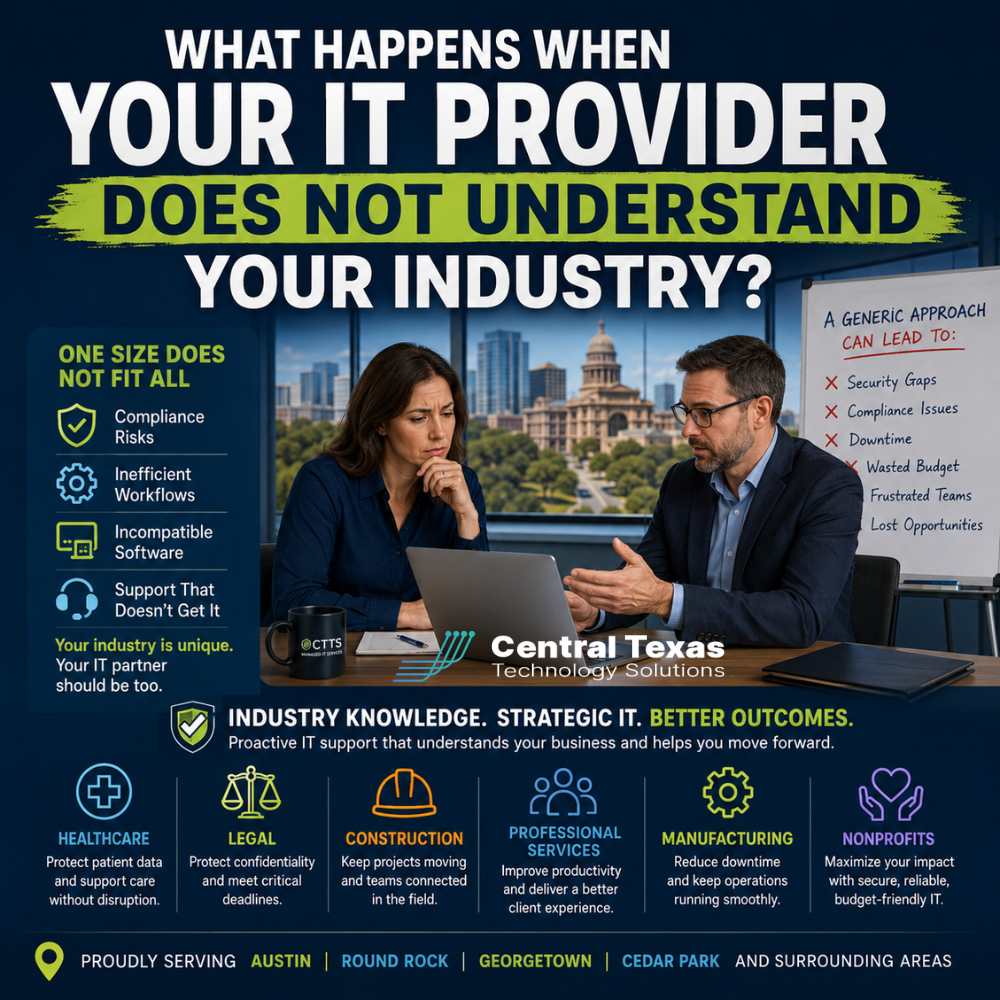
Every business depends on technology, but not every business uses technology the same way.
A healthcare clinic in Austin does not face the same IT risks as a construction company in Georgetown. A law firm in Round Rock does not use software the same way a nonprofit in Cedar Park does. A manufacturer does not measure downtime the same way a professional services firm does.
That is why choosing an IT provider based only on price, response time, or a list of services can create problems later.
If your IT provider does not understand your industry, they may still be able to reset passwords, replace computers, and answer support tickets. But they may miss the bigger picture: your compliance needs, your workflow, your software dependencies, your security risks, and the business outcomes your technology is supposed to support.
For growing organizations across Central Texas, the right IT partner does more than fix problems. The right partner understands how your business operates and helps technology support your goals.
Why Industry Knowledge Matters in Managed IT Services
Managed IT services are not one size fits all.
Many businesses assume IT support is the same everywhere. Keep the network running. Protect email. Back up files. Fix computers when they break.
Those things matter, but they are only the foundation.
A strong IT provider should also understand:
- How your team works each day
- Which systems are mission critical
- What compliance standards apply to your industry
- How downtime affects your customers, clients, patients, projects, or production
- What software your team depends on
- How your business plans to grow
When an IT provider does not understand those details, they may recommend tools that look good on paper but do not fit your real environment.
That can lead to wasted money, frustrated employees, security gaps, and preventable downtime.
Healthcare IT Requires More Than Basic Support
Healthcare organizations need IT support that protects patient care and sensitive information.
A medical practice, dental office, specialty clinic, or healthcare nonprofit cannot afford casual technology decisions. Patient records, appointment systems, imaging platforms, billing tools, and communications all need to work reliably and securely.
Healthcare IT often involves:
- HIPAA-related security expectations
- Access control for patient information
- Secure email and file sharing
- Backup and disaster recovery planning
- Reliable systems for scheduling, billing, and patient communication
- Device management for clinical and administrative staff
If an IT provider treats healthcare like a standard office environment, important risks can be overlooked.
For example, a basic file-sharing setup may be convenient, but convenience alone is not enough when patient data is involved. Healthcare leaders need systems that support productivity while reducing the risk of unauthorized access, accidental disclosure, or data loss.
CTTS helps healthcare organizations across Austin, Round Rock, Georgetown, and Central Texas build technology environments that are secure, reliable, and aligned with the way care teams actually work.
Legal IT Must Protect Confidentiality and Deadlines
Law firms rely on trust, confidentiality, and timing.
When a legal team cannot access case files, email, court documents, billing systems, or client communications, the impact is immediate. Missed deadlines, lost productivity, and client frustration can follow quickly.
Legal IT support needs to account for:
- Confidential client data
- Secure document storage
- Practice management software
- Email security
- Remote access for attorneys and staff
- Backup protection for case files
- Clear user permissions
A provider that does not understand legal workflows may focus only on device support while missing larger risks around access, retention, and confidentiality.
For a law firm in Austin, Georgetown, Round Rock, or Cedar Park, the issue is not just whether the computer works. The issue is whether attorneys and staff can securely access the right information at the right time without putting sensitive client data at risk.
CTTS works as a strategic IT partner by helping legal teams reduce risk, improve reliability, and support the daily demands of client service.
Construction IT Has to Support Teams in the Field
Construction companies have a different challenge: work does not happen in one place.
Project managers, estimators, field crews, office staff, vendors, and clients may all need access to documents, schedules, plans, photos, change orders, and communications from different locations.
Construction IT support often needs to address:
- Mobile device access
- Cloud file sharing
- Jobsite connectivity
- Project management software
- Secure access for remote teams
- Backup of contracts, bids, plans, and financial records
- Communication between field and office teams
A provider that only understands traditional office IT may not design systems that work well for field teams.
That can create delays when someone cannot access the latest plans, upload jobsite photos, or communicate changes quickly. Small technology issues can become expensive project delays.
For construction companies serving Central Texas, reliable technology helps keep jobs moving, teams connected, and projects on schedule.
CTTS helps construction businesses build practical IT systems that support both office operations and field productivity.
Professional Services IT Should Improve Productivity and Client Experience
Professional services firms depend on responsiveness, accuracy, and client trust.
Accounting firms, consultants, financial service providers, marketing agencies, engineering firms, and other professional services organizations need systems that help their teams work efficiently and serve clients well.
Professional services IT often includes:
- Secure email and communication tools
- Document collaboration
- Client data protection
- Remote and hybrid work support
- Line-of-business software
- Reliable backup and recovery
- Productivity tools like Microsoft 365
When IT is poorly aligned with the way a professional services firm works, employees waste time searching for files, dealing with login issues, fighting slow systems, or using disconnected tools.
Those problems may seem small at first. Over time, they reduce billable productivity, weaken client service, and make growth harder.
CTTS helps professional services firms turn technology into a stronger operating foundation, not a daily obstacle.
Manufacturing IT Must Reduce Downtime and Protect Operations
Manufacturing companies have little room for downtime.
When systems are slow, disconnected, or unavailable, the impact can reach production schedules, inventory management, shipping, vendor communication, and customer commitments.
Manufacturing IT support may involve:
- Network reliability
- Secure access to production systems
- Backup and recovery planning
- Support for inventory or ERP software
- Cybersecurity for operational systems
- Device and user management
- Planning for upgrades without disrupting production
A provider that does not understand manufacturing may underestimate the cost of downtime.
For a manufacturer, a technology issue is not just an inconvenience. It can slow production, delay orders, and affect revenue.
Manufacturing leaders need an IT partner who can think ahead, identify risks before they become outages, and help align technology with operational goals.
CTTS takes a proactive approach that helps manufacturers reduce disruptions and keep their business moving.
Nonprofit IT Must Balance Security, Budget, and Mission
Nonprofits often face a difficult technology challenge.
They need secure, reliable systems, but they also need to be careful with budgets. Staff may wear multiple hats, volunteers may need limited access, and donor information must be protected.
Nonprofit IT support often includes:
- Donor database protection
- Email security
- Microsoft 365 or Google Workspace management
- Access control for staff and volunteers
- Budget-conscious planning
- Grant and compliance documentation support
- Backup and disaster recovery
A provider that does not understand nonprofits may recommend solutions that are too expensive, too complex, or poorly matched to the organization’s mission.
Nonprofits need practical guidance. They need technology that supports fundraising, operations, communications, programs, and community service without creating unnecessary complexity.
CTTS helps nonprofits across Central Texas make smart IT decisions that protect their mission and support long-term stability.
Compliance Needs Vary by Industry
Compliance is one of the clearest reasons industry knowledge matters.
Different industries have different expectations for security, privacy, documentation, access, and audit readiness.
Healthcare organizations may need to think carefully about HIPAA-related safeguards. Legal firms must protect confidential client information. Nonprofits may need documentation for grants, donors, or board oversight. Manufacturers may need stronger controls around operational systems, vendors, or customer requirements. Professional services firms may need to protect sensitive financial, business, or client records. Construction companies may need secure access to contracts, plans, bids, and employee information.
A generic IT provider may say, “You are secure.”
A strategic IT partner asks better questions:
- Who has access to sensitive information?
- How is that access approved and removed?
- Are files backed up and recoverable?
- Are employees using personal devices?
- Are systems protected with multi-factor authentication?
- Are security policies documented?
- Can the business prove what protections are in place?
Compliance is not just about checking a box. It is about reducing risk, protecting trust, and helping your organization operate with confidence.
Workflow Matters Just as Much as Technology
The best technology plan starts with understanding how people actually work.
A law firm may need fast document retrieval. A healthcare clinic may need secure access to patient records from multiple workstations. A construction team may need field access from mobile devices. A manufacturing company may need systems that support production schedules. A nonprofit may need staff and volunteers to collaborate without exposing sensitive donor data. A professional services firm may need secure client communication and shared project files.
If your IT provider does not understand your workflow, they may create systems that look organized but slow your team down.
That often leads to workarounds.
Employees start emailing files to personal accounts. Teams create duplicate folders. Passwords get shared. Old software stays in use because no one planned the transition. Remote workers struggle with access. Managers lose visibility.
Those issues are not just annoying. They create security risks and productivity problems.
CTTS helps businesses design technology around the way their teams actually work, so security and efficiency move together.
Industry Software Needs Better Support
Every industry has tools that are central to the business.
Healthcare organizations may rely on electronic health record systems, billing platforms, and scheduling tools. Legal teams may use practice management and document management software. Construction firms may depend on estimating, project management, and field reporting tools. Professional services firms may rely on accounting, CRM, or collaboration platforms. Manufacturers may use inventory, ERP, or production-related systems. Nonprofits may depend on donor management and fundraising platforms.
Your IT provider does not have to replace every software vendor.
But they should understand how those systems fit into your business.
That includes knowing:
- Which applications are mission critical
- How users access them
- How data is backed up
- How permissions are managed
- How software updates affect operations
- Who to contact when vendor support is needed
- How to plan upgrades or migrations
When IT support and software support are disconnected, employees get stuck between vendors. The software company blames the network. The IT provider blames the software. Meanwhile, your team loses time.
A proactive IT partner helps coordinate the moving pieces so your business is not left managing the confusion.
Support Expectations Are Different for Every Business
Support needs vary widely by industry.
A small nonprofit may need fast help with email, access, and donor systems before a fundraising deadline. A healthcare clinic may need immediate support when patient scheduling or billing systems stop working. A law firm may need urgent help when a court deadline is approaching. A construction company may need field access restored quickly so a project does not stall. A manufacturer may need support that considers production impact. A professional services firm may need responsive help that protects billable time.
Generic support does not always understand urgency in context.
Every ticket is not equal.
A printer issue may be minor in one office and mission critical in another. A login issue may affect one employee, or it may prevent an entire team from serving clients. A software outage may be inconvenient, or it may stop revenue-producing work.
CTTS works to understand the business impact behind the support request, not just the technical issue on the screen.
The Risk of Choosing an IT Provider That Does Not Understand Your Industry
When your IT provider lacks industry context, the problems often build slowly.
At first, everything may seem fine. Tickets get answered. Computers are patched. Email keeps working.
But over time, gaps appear.
You may notice:
- Recurring issues never fully get solved
- Employees create risky workarounds
- Compliance questions go unanswered
- Software vendors and IT support point fingers
- Remote teams struggle with access
- Security tools are installed but not aligned with your real risks
- Leadership has no clear IT roadmap
- Budget decisions feel reactive instead of planned
The real danger is not always a dramatic outage. Sometimes the greater risk is quiet misalignment.
Technology should support your business strategy. It should help your team work better, protect sensitive information, reduce downtime, and prepare for growth.
If your IT provider does not understand your industry, they may keep your systems running while your business outgrows the support model behind them.
What a Better IT Partnership Looks Like
A better IT partnership starts with better questions.
Before making recommendations, CTTS looks at how your business operates, what your team needs, where your risks are, and what goals your technology should support.
That means looking beyond the help desk.
A strategic IT partner should help you:
- Identify industry-specific risks
- Plan for compliance and audit readiness
- Improve security without slowing down employees
- Support industry software and vendor coordination
- Build reliable backup and recovery plans
- Improve remote and hybrid work access
- Reduce recurring issues
- Create a technology roadmap
- Align IT spending with business priorities
This is the difference between reactive support and proactive IT management.
Reactive support waits for something to break.
Proactive IT management helps prevent problems, reduce risk, and support growth.
Choose an IT Provider That Understands Your Business
Your industry shapes the way your business uses technology.
Healthcare, legal, construction, professional services, manufacturing, and nonprofit organizations all need dependable IT support. But they do not all need the same plan.
The right IT provider should understand your compliance concerns, workflow, software, support expectations, and growth goals.
CTTS helps businesses in Austin, Round Rock, Georgetown, Cedar Park, and across Central Texas move away from reactive IT support and toward a smarter, more strategic approach.
You do not need technology that simply works in theory.
You need technology that works for your industry, your team, and your business goals.
If your current IT support does not understand how your business operates, it may be time for a better conversation.
Schedule a consultation with CTTS today and find out how proactive managed IT services can support your industry, protect your business, and help your team move forward with confidence.
Frequently Asked Questions About Industry-Specific IT Support
Why does my IT provider need to understand my industry?
Your industry affects your compliance needs, software tools, workflows, security risks, and support priorities. An IT provider that understands your industry can make better recommendations and help prevent problems that generic support may miss.
What industries does CTTS support?
CTTS supports businesses and organizations across healthcare, legal, construction, professional services, manufacturing, and nonprofits throughout Austin, Round Rock, Georgetown, Cedar Park, and Central Texas.
How do I know if my current IT provider is not a good fit?
Warning signs include recurring IT problems, unclear security guidance, poor support for industry software, weak documentation, slow response to critical issues, and a lack of strategic planning. If your provider only fixes tickets but does not help you plan ahead, your business may need a more proactive IT partner.
Contact CTTS today for IT support and managed services in Austin, TX. Let us handle your IT so you can focus on growing your business. Visit CTTSonline.com or call us at (512) 388-5559 to get started!
Explore our related articles for practical insights into common IT challenges and risks:
What Happens When Businesses Wait Too Long to Fix Their IT Problems?
The Most Common IT Support Mistakes Austin Businesses Make
How Poor IT Network Support Puts Your Business at Risk
Why Ransomware Attacks Target Small and Mid Sized Texas Businesses
Signs Your Current IT Support Is Failing Your Business
What Happens to Your Business During a Full Day of IT Downtime?
How Do You Know If Your Business Is One Click Away From a Cyberattack?
What Are the Risks of Letting Employees Manage Their Own Technology?
How Outdated Systems Quietly Hurt Productivity and Revenue
What Could a Data Breach Actually Cost Your Business in Texas?