
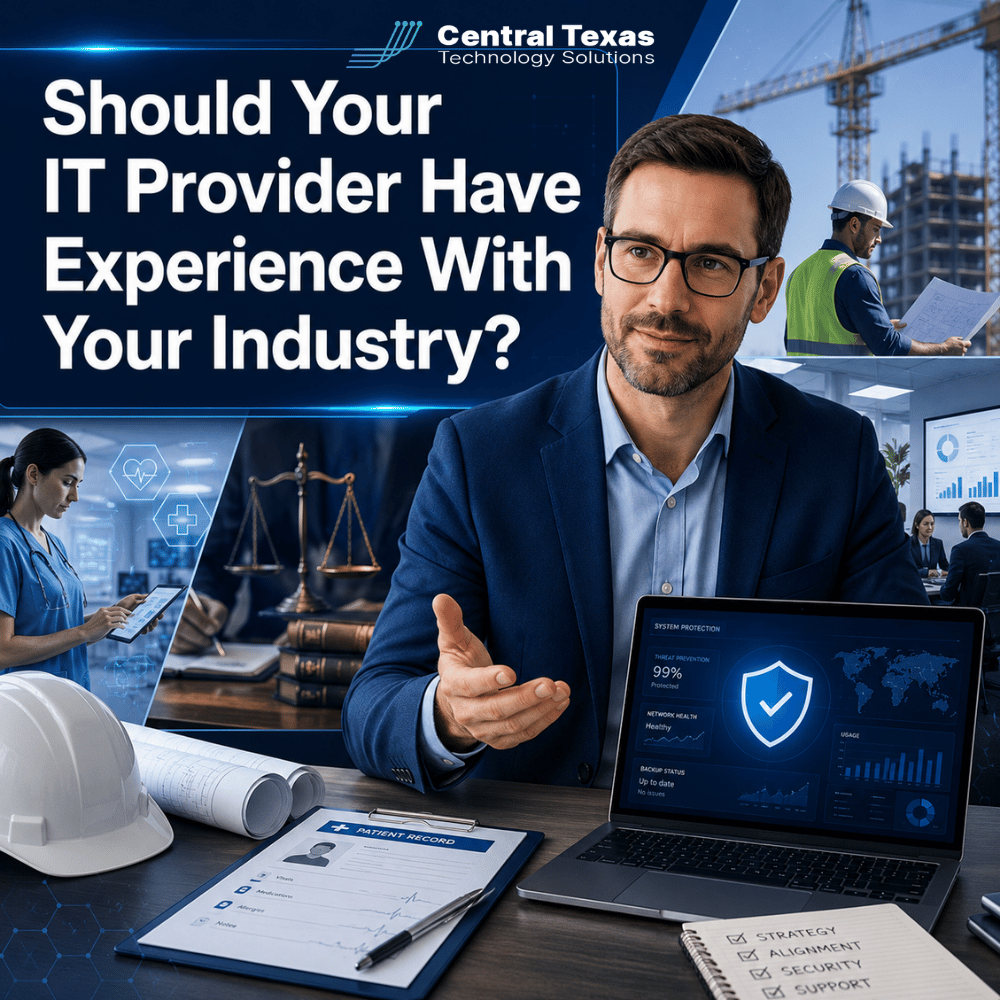
Choosing an IT provider is not just about finding someone who understands computers, networks, Microsoft 365, cybersecurity, and backups. Your technology exists to support the way your business actually operates.
That raises an important question: Should your IT provider have experience with your industry?
In many cases, the answer is yes, but industry experience is not the only thing that matters.
A strong managed IT provider should understand technology well enough to support many types of businesses. At the same time, there are situations where familiarity with your industry's regulations, applications, workflows, vendors, and security risks can make a significant difference.
The goal is not necessarily to find an IT company that works exclusively with businesses exactly like yours. You need a technology partner that can understand how your organization works, recognize the risks that matter to you, and build an IT strategy around your business.
When Does Industry Experience Matter Most?
Industry experience becomes particularly valuable when technology is closely tied to regulations, specialized software, operational processes, or unique security concerns.
A small professional services firm using Microsoft 365 and a few cloud applications may not require an IT provider with extremely specialized industry knowledge.
A healthcare organization, manufacturer, construction company, law firm, or nonprofit organization may have very different IT requirements.
The more complicated your technology environment becomes, the more important it is that your IT provider understands what happens outside the server room.
Your provider should be asking questions such as:
- What regulations affect your organization?
- Which applications are essential to daily operations?
- How do employees actually perform their jobs?
- Which vendors depend on access to your systems?
- What information would cause the greatest damage if it were stolen?
- How long could your business operate if a critical system went down?
Those questions help move the conversation from simply maintaining computers to protecting and supporting the business.
Compliance Can Make Industry Knowledge Critical
Compliance is one of the clearest situations where industry experience matters.
Different organizations may face requirements involving how information is stored, protected, accessed, transmitted, and retained.
Healthcare organizations may have obligations involving patient information. Government contractors may have cybersecurity requirements tied to contracts. Financial and professional services organizations may have their own regulatory or client requirements.
Even businesses that are not heavily regulated may have cybersecurity obligations contained in contracts, insurance policies, customer agreements, or vendor relationships.
An IT provider does not replace your attorney, compliance consultant, or auditor. However, your technology provider may be responsible for implementing many of the technical safeguards those requirements depend upon.
That can include:
- Multi-factor authentication
- Access controls
- Encryption
- Endpoint security
- Data backups
- Security monitoring
- Email protection
- Logging
- Device management
- Vulnerability management
- Incident response planning
An IT company that understands your compliance environment may be better prepared to recognize gaps before they become problems.
Your Industry Applications Can Change Everything
Almost every industry has software that outsiders rarely encounter.
A construction company may depend on estimating, project management, blueprint, accounting, and field-service applications.
A healthcare organization may rely on electronic health record systems, imaging software, scheduling platforms, and specialized medical devices.
A law firm may use practice management, document management, billing, e-discovery, and legal research systems.
A manufacturer could have production software, inventory platforms, warehouse systems, industrial equipment, and specialized databases.
Understanding these applications can matter because technology problems are rarely isolated.
An application may depend on a particular server, internet connection, database, operating system, firewall configuration, or vendor.
When something stops working, an experienced IT provider should be able to determine whether the problem involves the network, computer, cloud platform, application, security configuration, or third-party vendor.
Industry familiarity can shorten that troubleshooting process.
Your IT Provider Should Understand Your Workflows
Technology should support the way your employees work.
That sounds obvious, but problems often occur when technology decisions are made without understanding business processes.
Consider something as simple as file access.
An accounting department, field technician, salesperson, executive, and remote employee may all need access to different information in different ways.
A good IT provider should understand who needs access to what, when they need it, and from where.
That understanding affects decisions involving:
- Microsoft 365
- SharePoint
- Teams
- Remote access
- File permissions
- Mobile devices
- Cloud applications
- Identity management
- Security policies
Security becomes much easier to manage when your technology partner understands normal business behavior.
If a security policy makes it nearly impossible for employees to do their jobs, employees will eventually look for ways around it.
The better approach is to design security around real workflows whenever possible.
Vendor Relationships Are Often Part of IT Support
Many businesses depend on technology provided by outside vendors.
The challenge comes when something goes wrong.
Your internet provider may blame your firewall. Your software company may blame your network. Your copier vendor may blame Microsoft 365. Your phone provider may blame your internet connection.
Meanwhile, your employees still cannot work.
An experienced managed IT provider should be willing to coordinate with other technology vendors rather than simply telling you the problem belongs to someone else.
Industry experience can help because the IT company may already understand the major vendors, applications, integrations, and common problems associated with your type of business.
Even when the IT provider has never worked with a particular vendor, they should be comfortable communicating with that company's technical team and helping drive the issue toward a resolution.
Your employees should not have to become the middleman between five different technology companies.
Security Risks Are Different From One Industry to Another
Cybercriminals do not attack every organization the same way.
Different industries have different valuable assets, common weaknesses, and attack methods.
A healthcare organization may be targeted because of sensitive patient information.
A construction company could face fraudulent payment requests or attempts to redirect wire transfers.
A law firm may hold confidential client information, contracts, financial records, and privileged communications.
A manufacturer could be especially vulnerable to operational downtime.
Professional services firms may face phishing attacks designed to steal credentials and gain access to email accounts.
A strong cybersecurity strategy should consider the information and systems attackers would value most in your particular business.
That requires more than installing antivirus software.
Your IT provider should think about questions such as:
- What would an attacker try to steal?
- Which employee accounts would be most valuable?
- What systems could bring operations to a halt?
- How are financial transactions approved?
- Which third parties have access?
- Where is sensitive information stored?
- How quickly could the business recover from an attack?
Understanding your industry helps put those risks into context.
Industry Experience Should Not Replace Technical Expertise
There is another side to this discussion.
Hiring an IT provider simply because they have worked with someone in your industry does not automatically make them the right choice.
Technology changes quickly.
You still need a provider with strong technical capabilities, security practices, responsive support, documentation, backup planning, strategic guidance, and qualified people.
A company could have years of experience supporting your industry and still provide outdated technology or poor service.
Look for both.
You want an IT provider that understands modern technology and is willing to understand your business.
What If the IT Provider Has Never Worked With Your Exact Industry?
That does not necessarily mean you should eliminate them.
Many technology challenges are common across industries.
Microsoft 365, cybersecurity, backups, networks, cloud services, endpoint management, identity protection, business continuity, and help desk support are used by organizations of almost every type.
What matters is whether the IT provider knows how to learn.
Ask how they approach a new client.
A thoughtful provider should want to understand:
- Your organizational structure
- Your employees and locations
- Your critical applications
- Your compliance requirements
- Your vendors
- Your current technology
- Your business goals
- Your cybersecurity concerns
- Your biggest frustrations
- Your plans for growth
An IT provider that takes time to understand your organization may ultimately serve you better than one that simply says, "We already work with companies like yours."
Ask About Experience With Businesses Similar to Yours
When evaluating an IT provider, ask about the types of organizations they already support.
You do not necessarily need the names of their clients. In many cases, confidentiality may prevent them from sharing that information.
Instead, ask about situations.
For example:
"Have you supported businesses with multiple locations?"
"Have you worked with companies that have remote employees?"
"Are you familiar with the compliance requirements we face?"
"Have you supported our primary business application?"
"How do you work with third-party software vendors?"
"How would you protect the type of information we store?"
"How would you help us recover if our main system went offline?"
The answers will usually tell you far more than simply asking whether they have clients in your industry.
Look for a Technology Partner, Not Just an IT Help Desk
Your IT provider should certainly be able to fix problems.
But fixing problems should not be the entire relationship.
The right technology partner should help you think ahead.
That means discussing upcoming hardware replacements, cybersecurity improvements, software changes, cloud strategy, business continuity, budgeting, compliance, and future technology needs.
They should understand where your business is going and help make sure your technology can support it.
Industry experience makes those conversations easier because the provider may already understand many of the challenges your organization faces.
But curiosity matters too.
A provider that continuously asks questions about your business will often identify opportunities and risks that a purely technical help desk might miss.
The Best IT Provider Understands Both Technology and Your Business
So, should your IT provider have experience with your industry?
It can be extremely valuable, particularly when your organization deals with complicated compliance requirements, specialized applications, unique workflows, multiple technology vendors, or industry-specific security threats.
But do not make industry experience your only requirement.
Look for an IT company that combines technical expertise with a genuine effort to understand how your organization operates.
At Central Texas Technology Solutions, we believe technology decisions should start with the business, not the hardware. We work with organizations throughout Central Texas to understand their operations, identify their risks, and develop technology strategies that support where they want to go.
If you are wondering whether your current IT provider truly understands your business, schedule a free strategy call with CTTS. We can talk about your technology, your industry, and what your organization needs from an IT partner.
Frequently Asked Questions
Does my IT provider need experience in my exact industry?
Not always. Strong technical expertise, cybersecurity knowledge, responsiveness, and strategic planning are still essential. However, industry experience becomes more important when your business has specialized compliance requirements, applications, workflows, vendors, or security risks.
Why does industry knowledge matter for cybersecurity?
Different industries face different threats. A law firm may be targeted for confidential client information, while a construction company may be more vulnerable to payment fraud or account compromise. An IT provider that understands your business can build security around the risks that are most likely to affect you.
What should I ask an IT provider about their industry experience?
Ask whether they have supported businesses with similar compliance requirements, software, workflows, locations, and security concerns. You should also ask how they work with third-party vendors and how they would learn your business if they have not worked with your exact industry before.
Contact CTTS today for IT support and managed services in Austin, TX. Let us handle your IT so you can focus on growing your business. Visit CTTSonline.com or call us at (512) 388-5559 to get started!
Looking for clarity on your next IT move? These articles will help:
What Should You Expect From Your First 90 Days With a New IT Partner?
How Do You Measure the ROI of Managed IT Services?
How to Compare IT Support Proposals Without Getting Lost in Technical Details
What Should an IT Provider Ask Before Giving You a Proposal?
How to Know If an IT Company Is a Good Fit for Your Business Culture
What Questions Should Your Leadership Team Ask Before Switching IT Providers?
How to Choose an IT Partner Before a Cybersecurity Insurance Renewal
How to Verify an IT Company’s Cybersecurity Experience Before Hiring Them
What Should You Look for in an IT Provider’s Service Level Agreement?