
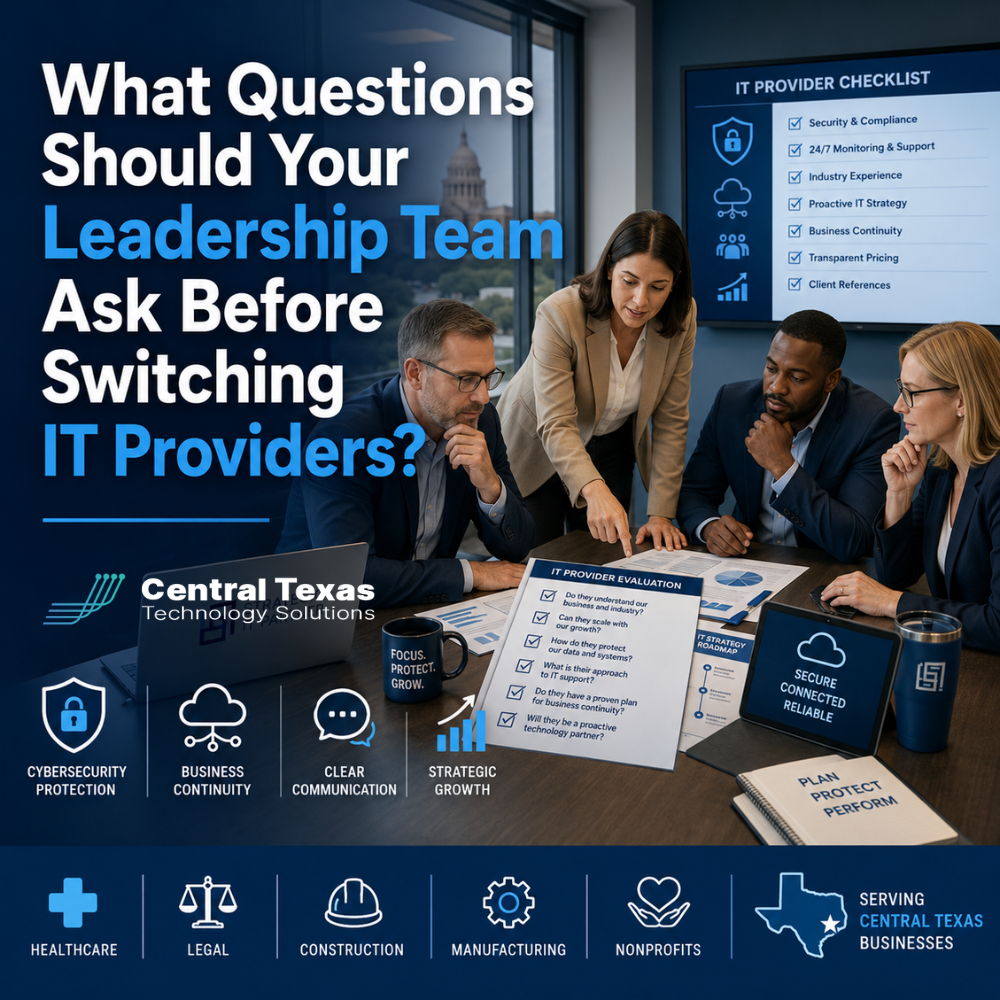
Switching IT providers is not just a technology decision. It is a business decision.
When your current IT support no longer fits, the signs usually show up in familiar ways. Tickets take too long to resolve. The same problems keep coming back. Security feels uncertain. Leadership has trouble getting clear answers. Growth creates more complexity, but your IT provider still acts like their only job is to fix things after they break.
For business leaders in healthcare, legal, professional services, construction, manufacturing, and nonprofits, that kind of uncertainty creates real risk. Downtime affects productivity. Weak security affects compliance. Poor planning affects growth. A lack of visibility makes every technology decision feel reactive.
Before your leadership team starts talking to salespeople, it helps to get clear internally. The right questions can help you understand what is really broken, what your business needs next, and what kind of IT partner can help you move forward with confidence.
Why Switching IT Providers Should Start With Leadership Questions
Many companies begin the search for a new IT provider by asking, “Who can give us a quote?”
That is the wrong starting point.
A quote only helps when you already understand what problem you are trying to solve. If your leadership team does not define the real issues first, every proposal will be hard to compare. One provider may focus on help desk response. Another may focus on cybersecurity tools. Another may offer the lowest monthly price but leave out strategic planning, documentation, or proactive monitoring.
The better first question is this:
What does our business need from technology that we are not getting today?
That question moves the conversation away from price alone and toward outcomes that matter, including:
- Better security
- Fewer recurring IT problems
- Faster response times
- Stronger compliance support
- Better planning for growth
- Improved employee productivity
- More predictable IT costs
- Clearer communication with leadership
For companies in Austin, Georgetown, Cedar Park, and Taylor, TX, switching IT providers should not be about finding someone who can simply answer tickets. It should be about finding a strategic partner who understands how technology supports the business.
What Problems Are We Trying to Solve by Switching IT Providers?
Before your leadership team meets with a potential IT provider, write down the top problems that are causing frustration.
Be specific.
Instead of saying, “Our IT support is bad,” ask:
- Are employees waiting too long for help?
- Are the same issues being fixed repeatedly?
- Do we lack a clear cybersecurity plan?
- Are we unsure whether backups are working?
- Do we have poor documentation?
- Are technology costs unpredictable?
- Does leadership only hear from IT when something goes wrong?
- Are remote or hybrid employees difficult to support?
- Are we worried about compliance, audits, or insurance requirements?
This matters because different problems require different solutions.
For example, a law firm may need stronger protection around client files and email security. A healthcare organization may need better support for compliance and access control. A construction company may need reliable support for field teams, mobile devices, and cloud-based project tools. A manufacturer may need stable systems that protect production schedules. A nonprofit may need secure, cost-conscious IT planning that protects donor and operational data.
A good managed IT provider should help you identify the root cause of the issue, not just treat the symptom.
Are We Looking for Reactive Support or Proactive Managed IT Services?
One of the most important questions your leadership team can ask is whether your current IT model is reactive or proactive.
Reactive IT waits for problems.
Proactive IT works to prevent them.
A reactive provider may be helpful when something breaks, but that model often leaves your business exposed to avoidable disruption. If your network, devices, backups, security tools, and software updates are not being monitored and managed consistently, your team may only discover problems after they have already created downtime or risk.
Proactive managed IT services should include regular maintenance, monitoring, planning, documentation, and security review. The goal is not simply to close tickets. The goal is to reduce the number of tickets your team has to open in the first place.
Your leadership team should ask:
- What problems should our provider be preventing?
- What systems should be monitored?
- How often should our environment be reviewed?
- What reports should leadership receive?
- How should IT priorities connect to business goals?
This is where CTTS takes a clear position: IT support should not be treated like a repair shop. Your provider should help prevent downtime, reduce risk, and keep technology aligned with where the business is going.
Do We Know Where Our Current IT Risks Are?
Many businesses switch IT providers because something feels wrong, but they do not have a clear picture of their risk.
That is a dangerous place to be.
Leadership should ask whether the business has visibility into:
- Cybersecurity gaps
- Outdated hardware
- Unsupported software
- Backup reliability
- Microsoft 365 security settings
- Email protection
- Endpoint protection
- Remote access security
- Vendor access
- User permissions
- Compliance requirements
- Disaster recovery readiness
These questions are especially important for businesses preparing for audits, cyber insurance renewals, system upgrades, or growth into new locations.
If your current provider cannot clearly explain where your risks are, what has been done to reduce them, and what still needs attention, your leadership team does not have the information needed to make good decisions.
A strong IT partner should be able to translate technical risk into business impact. That means leadership should not just hear, “You need a firewall update.” They should understand what risk that update reduces, what could happen if it is ignored, and how it fits into a larger security plan.
What Should Communication Look Like With a New IT Provider?
Poor communication is one of the most common reasons businesses become frustrated with IT providers.
Sometimes the provider is doing work, but leadership has no visibility. Other times, the provider is only responding to tickets and not communicating strategically. In both cases, the result is the same. Decision makers feel uncertain.
Before switching IT providers, ask:
- Who will communicate with our leadership team?
- How often should we review IT performance?
- Will we receive regular reports?
- How will urgent issues be escalated?
- How will employees request support?
- How will we know whether problems are truly resolved?
- Will we have strategic planning conversations, not just support conversations?
This is especially important for growing businesses in professional services, healthcare, construction, manufacturing, legal, and nonprofit organizations where technology affects daily operations.
Your leadership team should expect clear, plain-language communication. You should not need a technical background to understand whether your IT environment is healthy, secure, and prepared for growth.
What Does a Better IT Provider Need to Understand About Our Business?
The best IT providers do not start by selling tools. They start by understanding the business.
Before your first conversation with a potential provider, your leadership team should be ready to explain:
- How many employees you have
- Whether your team works in-office, remotely, or in the field
- What software your business depends on
- What compliance requirements apply
- What growth plans are ahead
- What recurring issues are frustrating your team
- What security concerns keep leadership up at night
- What your current provider does well
- Where your current provider is falling short
This context helps separate a true IT partner from a vendor.
A vendor may give you a list of services. A strategic IT partner will ask how your systems support revenue, productivity, client service, compliance, and continuity.
That difference matters.
Are We Comparing IT Providers the Right Way?
Price matters, but it should not be the only factor.
A lower monthly cost can become expensive if it leaves out critical services. If cybersecurity, backups, documentation, strategic planning, or onsite support are not included, your business may still face surprise costs and preventable issues.
When comparing IT providers, leadership should ask:
- What is included in the monthly agreement?
- What is not included?
- How are after-hours issues handled?
- Are onsite visits included or billed separately?
- What security services are included?
- How are backups monitored and tested?
- How are projects scoped and priced?
- Will we receive documentation?
- How will the provider help us plan ahead?
- What does onboarding include?
A good proposal should make it easy to understand both the cost and the value. If a provider cannot explain their services clearly, that may be a sign of future communication problems.
What Should We Ask Before Sales Gets Involved?
Before your leadership team takes a sales call, hold an internal conversation around these questions:
- What are the top three reasons we are considering a change?
- What risks are we most concerned about?
- What recurring problems need to stop?
- What business goals should IT help support over the next 12 to 24 months?
- What do employees complain about most often?
- What information do we wish we had from our current provider?
- What would make leadership feel confident in a new IT partner?
- What services do we believe are essential?
- What would make a provider the wrong fit?
- How will we measure success after switching?
These questions help your team enter the conversation with clarity.
Instead of reacting to a polished sales pitch, you can evaluate whether the provider understands your real needs and has a practical plan to help.
How CTTS Helps Businesses Switch IT Providers With Confidence
Changing IT providers can feel risky, especially if your current environment is poorly documented or your leadership team is unsure what is being managed.
CTTS helps Central Texas businesses make that transition with a proactive, structured approach. The goal is not to simply replace one help desk with another. The goal is to understand your environment, identify risk, improve visibility, and align your technology with your business goals.
CTTS works with businesses across Austin, Georgetown, Cedar Park, Taylor, and the surrounding Central Texas area to provide managed IT services, cybersecurity support, strategic planning, and responsive help desk service.
For business leaders, that means you get a partner who helps answer the questions that matter:
- Are we secure?
- Are we prepared?
- Are we spending wisely?
- Are we reducing risk?
- Are we supporting our team well?
- Are we planning for what comes next?
That is what a proactive IT partner should do.
Final Thoughts on Questions to Ask Before Switching IT Providers
Switching IT providers should not begin with a quote. It should begin with clarity.
When your leadership team knows what problems need to be solved, what risks need to be reduced, and what outcomes matter most, you are in a stronger position to choose the right partner.
The right provider will not pressure you into a quick decision. They will help you understand your current situation, explain your options clearly, and build a plan that supports your business.
If your current IT support feels reactive, unclear, or disconnected from your goals, it may be time for a better conversation.
Schedule a consultation with CTTS to talk through your IT challenges and find out what a proactive managed IT partnership could look like for your business.
Frequently Asked Questions About Switching IT Providers
When should a business consider switching IT providers?
A business should consider switching IT providers when support becomes slow, recurring problems continue, security concerns are not clearly addressed, communication is poor, or leadership does not receive strategic guidance. If your provider only responds after something breaks, your business may need a more proactive managed IT partner.
What should we prepare before meeting with a new IT provider?
Before meeting with a new IT provider, prepare a list of recurring issues, current frustrations, critical software, compliance requirements, security concerns, employee support needs, and future business goals. This helps the provider understand your real needs instead of offering a generic proposal.
Is switching IT providers risky?
Switching IT providers can feel risky, especially if documentation is poor. However, a structured onboarding process can reduce that risk. A good managed IT provider will review your systems, gather documentation, assess security, identify urgent issues, and build a transition plan that protects business continuity.
Contact CTTS today for IT support and managed services in Austin, TX. Let us handle your IT so you can focus on growing your business. Visit CTTSonline.com or call us at (512) 388-5559 to get started!
Choosing the right IT partner starts here:
Red Flags to Watch for When Evaluating IT Consulting Companies
What Professional IT Services Should Look Like in 2026
How Do You Evaluate an IT Provider’s Response Time Before Signing a Contract?
What Does a Strong IT Onboarding Process Look Like for Your Business?
How Can You Tell If an IT Company Is Being Proactive or Just Reactive?
What Should You Expect From Your First 90 Days With a New IT Partner?
How Do You Measure the ROI of Managed IT Services?
How to Compare IT Support Proposals Without Getting Lost in Technical Details
What Should an IT Provider Ask Before Giving You a Proposal?
How to Know If an IT Company Is a Good Fit for Your Business Culture