
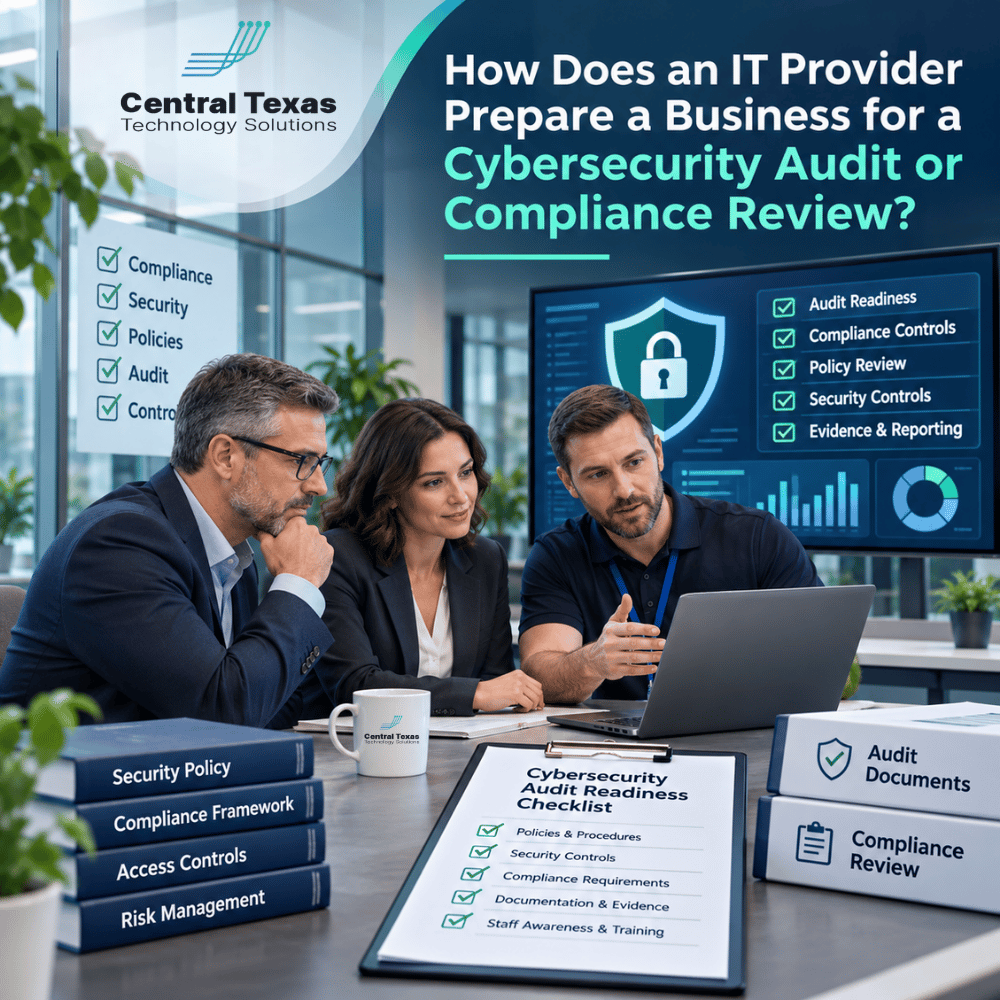
 A cybersecurity audit can reveal problems that business owners never knew existed. Missing security policies, outdated software, inconsistent access controls, and incomplete documentation can create serious concerns, even when a company's technology appears to be working properly.
For many small and mid-sized businesses, preparing for an audit or compliance review feels overwhelming. Requirements can be complicated, and gathering the necessary evidence often takes more time than expected.
The right IT provider makes the process more manageable by identifying weaknesses, implementing appropriate safeguards, and maintaining the documentation needed to demonstrate responsible security practices.
More importantly, effective audit preparation is not simply about passing an inspection. It is about building a stronger, more secure business that stays prepared throughout the year.
1. Cybersecurity Audit Preparation Starts With a Gap Assessment
Before a business can demonstrate that its systems meet security requirements, it needs to understand where it currently stands.
A cybersecurity gap assessment compares existing security practices against a defined set of requirements or standards. These might include the NIST Cybersecurity Framework, HIPAA Security Rule requirements, contractual security obligations, or other applicable regulations.
The assessment helps answer several important questions:
-
Are sensitive files and business systems adequately protected?
-
Do employees have access only to the information they need?
-
Are security updates installed consistently?
-
Are backups properly configured and tested?
-
Can the company detect and respond to suspicious activity?
-
Are security policies documented and followed?
An experienced IT provider evaluates both technical systems and operational practices. This is important because compliance problems are not always caused by missing technology.
For example, a business might have excellent endpoint protection but no formal process for removing access when employees leave. That oversight could create an audit finding and expose sensitive information.
A gap assessment establishes a baseline and helps leadership understand which improvements deserve immediate attention.
The goal is to discover and address weaknesses before an auditor or security incident exposes them.
2. Security Policies and Documentation Demonstrate Accountability
One of the biggest misconceptions about cybersecurity compliance is that installing the right security software is enough.
Auditors frequently want evidence that an organization has established appropriate policies, assigned responsibilities, and consistently follows documented procedures.
An IT provider can help develop and maintain the technical documentation that supports these requirements.
Common examples include:
-
Information security policies: Explain how the organization protects business information and technology systems.
-
Access control policies: Define who can access sensitive systems and how permissions are approved, reviewed, and removed.
-
Incident response plans: Establish procedures for identifying, containing, reporting, and recovering from cybersecurity incidents.
-
Backup and recovery procedures: Document how critical information is protected and restored.
-
Acceptable use policies: Establish expectations for employee use of company devices, networks, and applications.
-
Security awareness records: Demonstrate that employees receive appropriate cybersecurity education.
Documentation must also reflect what actually happens within the organization.
A policy stating that employee access is reviewed quarterly provides little value if nobody performs those reviews or records the results.
The IT provider should work with business leadership to establish realistic procedures, assign responsibility, and maintain supporting records.
For businesses in regulated industries, legal counsel or qualified compliance specialists may also need to review policies to ensure they satisfy applicable requirements.
3. Technical Security Controls Help Businesses Meet Compliance Requirements
Once the assessment identifies weaknesses, the next step is implementing technical safeguards that address them.
A qualified IT provider helps businesses select and configure controls appropriate for their operations, risk exposure, and compliance obligations.
Important technical controls often include:
Multi-factor authentication (MFA)
MFA requires an additional verification step beyond a password. It helps prevent unauthorized access when employee credentials are stolen or compromised.
Endpoint protection
Workstations, laptops, and servers need protection against malware, ransomware, and other threats. Modern endpoint security solutions can also help identify suspicious behavior before it spreads.
Network security
Firewalls, secure wireless configurations, network segmentation, and appropriate monitoring help limit unauthorized access to business systems.
Data backup and recovery
Reliable data backup and recovery procedures help organizations restore critical information after ransomware attacks, hardware failures, or accidental deletion. Recovery testing provides evidence that backups are usable.
Email protection
Appropriate email security controls reduce exposure to phishing, malicious attachments, and business email compromise.
Employee security education
Ongoing security awareness training helps employees recognize suspicious messages, protect credentials, and report potential incidents.
These safeguards should work together rather than operate as disconnected products.
Through our cybersecurity services, CTTS helps organizations evaluate their exposure and implement practical protections that support both business operations and security requirements.
However, installing a control does not automatically establish compliance. Its configuration, effectiveness, and supporting evidence must also be evaluated.
4. Remediation Plans Turn Audit Findings Into Measurable Improvements
A gap assessment often uncovers more issues than a business can reasonably address at once.
Some findings may represent immediate security threats. Others might involve missing documentation, inconsistent procedures, or improvements that require additional planning and investment.
A good IT provider helps prioritize remediation based on risk, business impact, applicable requirements, and available resources.
For example, an assessment might identify:
-
Several employee accounts without MFA
-
Former employees who still have active accounts
-
Computers running unsupported software
-
Missing documentation for backup testing
-
No formal incident response procedure
These findings should not necessarily receive equal priority.
An exposed administrative account might require immediate action, while updating a policy document could be scheduled as part of a broader improvement plan.
An effective remediation plan identifies the problem, assigns responsibility, establishes a target completion date, and defines how the correction will be verified.
When an issue cannot be resolved immediately, leadership should understand the remaining risk and any temporary safeguards.
This structured approach helps businesses demonstrate that identified weaknesses are being addressed rather than ignored.
It also prevents cybersecurity improvements from becoming a collection of disconnected projects with no clear ownership.
5. Evidence Gathering Makes the Cybersecurity Audit Process Easier
During a cybersecurity audit or compliance review, an organization may need to prove that required safeguards are in place and functioning.
That means providing evidence, not simply assuring an auditor that the company takes security seriously.
Depending on the audit requirements, supporting evidence might include:
-
Records showing security updates were installed
-
MFA configuration reports
-
User access review records
-
Backup completion and recovery test reports
-
Employee training completion records
-
Vulnerability assessment results
-
Incident response exercise documentation
-
Security monitoring and remediation records
An IT provider can help collect, organize, and maintain this information so it is easier to retrieve when requested.
For example, if an auditor asks whether terminated employees lose access promptly, the organization may need records showing when accounts were disabled and how that action was verified.
A written policy alone may not satisfy that request.
Evidence must also be accurate, relevant to the review period, and handled securely. Sensitive configurations, logs, and employee information should only be shared through approved channels.
Consistent evidence gathering reduces last-minute scrambling and helps businesses demonstrate that security procedures are part of normal operations.
It also allows leadership to identify recurring problems before they become formal audit findings.
6. Ongoing Monitoring Keeps Businesses Prepared Between Audits
A successful cybersecurity audit represents a point-in-time evaluation. It does not guarantee that the organization will remain secure or compliant afterward.
Employees join and leave. Software changes. New devices connect to networks. Cloud applications are added, and cybercriminals develop new attack methods.
Without ongoing oversight, security practices can gradually drift away from established requirements.
This is where proactive IT management becomes particularly valuable.
Through Complete Care Coverage, CTTS helps businesses maintain visibility into their technology environment and address problems before they become larger operational concerns.
Depending on the organization's needs, ongoing activities may include:
-
Monitoring endpoints and networks for security concerns
-
Reviewing system updates and vulnerability findings
-
Checking backup status and testing recovery procedures
-
Evaluating user permissions and account changes
-
Reviewing security alerts and incident records
-
Updating technical documentation as systems change
-
Reporting security trends and unresolved risks to leadership
Regular management reviews also help connect cybersecurity decisions with business priorities.
For example, an expanding organization may need stronger access controls as it opens additional offices or introduces remote work arrangements.
A proactive IT provider helps leadership understand how those changes affect security requirements and what adjustments are necessary.
The result is a more sustainable approach to audit readiness, with fewer surprises when the next review begins.
7. Why Businesses Benefit From an IT Partner That Understands Compliance
Cybersecurity requirements vary by industry, and an effective IT provider recognizes that different organizations face different obligations.
Healthcare organizations may need to demonstrate safeguards for electronic protected health information under HIPAA. Law firms must consider client confidentiality and applicable professional responsibilities.
Professional services firms frequently handle sensitive financial or customer information. Construction companies may face security requirements imposed by commercial or government contracts.
Manufacturing businesses must consider the security of operational systems and supply chains, while nonprofits often need to protect donor information and demonstrate responsible stewardship of limited resources.
These differences matter because a generic security checklist may overlook important risks.
For businesses throughout Austin, Georgetown, Cedar Park, and Temple, working with an IT provider that understands local business operations can make compliance preparation more practical.
CTTS helps organizations evaluate technical risks, strengthen security practices, and maintain the systems and documentation that support audit readiness.
The IT provider should also coordinate with internal compliance officers, legal advisors, and independent auditors when specialized expertise is required.
Ultimately, the objective is not to promise that every audit will be passed. It is to help businesses establish defensible security practices and demonstrate consistent improvement.
Prepare for Your Next Cybersecurity Audit Before It Becomes Urgent
Waiting until an audit is scheduled can leave your business facing unnecessary costs, rushed decisions, and preventable security findings.
With the right preparation, cybersecurity compliance becomes part of everyday business operations rather than a disruptive event.
CTTS helps Central Texas businesses identify security gaps, strengthen technical controls, and establish ongoing practices that support audit readiness.
Schedule a free consultation with CTTS today and discuss your cybersecurity and compliance preparation needs.
Frequently Asked Questions About Cybersecurity Audits
What is the difference between a cybersecurity audit and a compliance review?
A cybersecurity audit evaluates security controls, processes, and evidence against defined criteria. A compliance review focuses on whether an organization satisfies specific regulatory, contractual, or industry requirements. The two often overlap, but their scope and expectations can differ. An IT provider helps prepare technical systems and supporting documentation for either process, while an independent auditor or qualified compliance professional may be responsible for the formal assessment.
How long does it take to prepare a business for a cybersecurity audit?
Preparation time depends on the organization's size, existing security practices, applicable requirements, and the number of weaknesses discovered. A business with established policies and monitoring may need only a few weeks to organize evidence and resolve minor issues. An organization with outdated systems, missing documentation, or significant security gaps may require several months. Beginning with a gap assessment provides a more realistic timeline and helps prioritize necessary improvements.
Can a managed IT provider guarantee that a business will pass a compliance audit?
No responsible IT provider should guarantee an audit outcome. Compliance depends on the specific requirements, the organization's actual practices, and the findings of the reviewing authority. An IT provider can implement technical safeguards, maintain documentation, identify weaknesses, and help correct deficiencies. However, management remains accountable for organizational compliance, and certain requirements may need legal or specialized compliance expertise. The best approach is continuous preparation rather than relying on a last-minute audit checklist.
Contact CTTS today for IT support and managed services in Austin, TX. Let us handle your IT so you can focus on growing your business. Visit CTTSonline.com or call us at (512) 388-5559 to get started!
Looking for clarity on your next IT move? These articles will help:
What Is a Technology Business Review and What Should It Accomplish?
What Actually Happens During Managed IT Services Onboarding?
How Does an IT Provider Decide What Technology Your Business Should Replace First?
How Should Your IT Provider Help Build an Annual Technology Budget?
What Happens Behind the Scenes When You Submit an IT Support Ticket?