
Technology decisions are easy to postpone when everything seems to be working.
Computers turn on. Employees can access email. The internet is running. Nothing appears urgent.
But technology problems rarely begin on the day something breaks. Aging equipment, security gaps, growing software costs, poor backup strategies, and unsupported systems can build quietly for months.
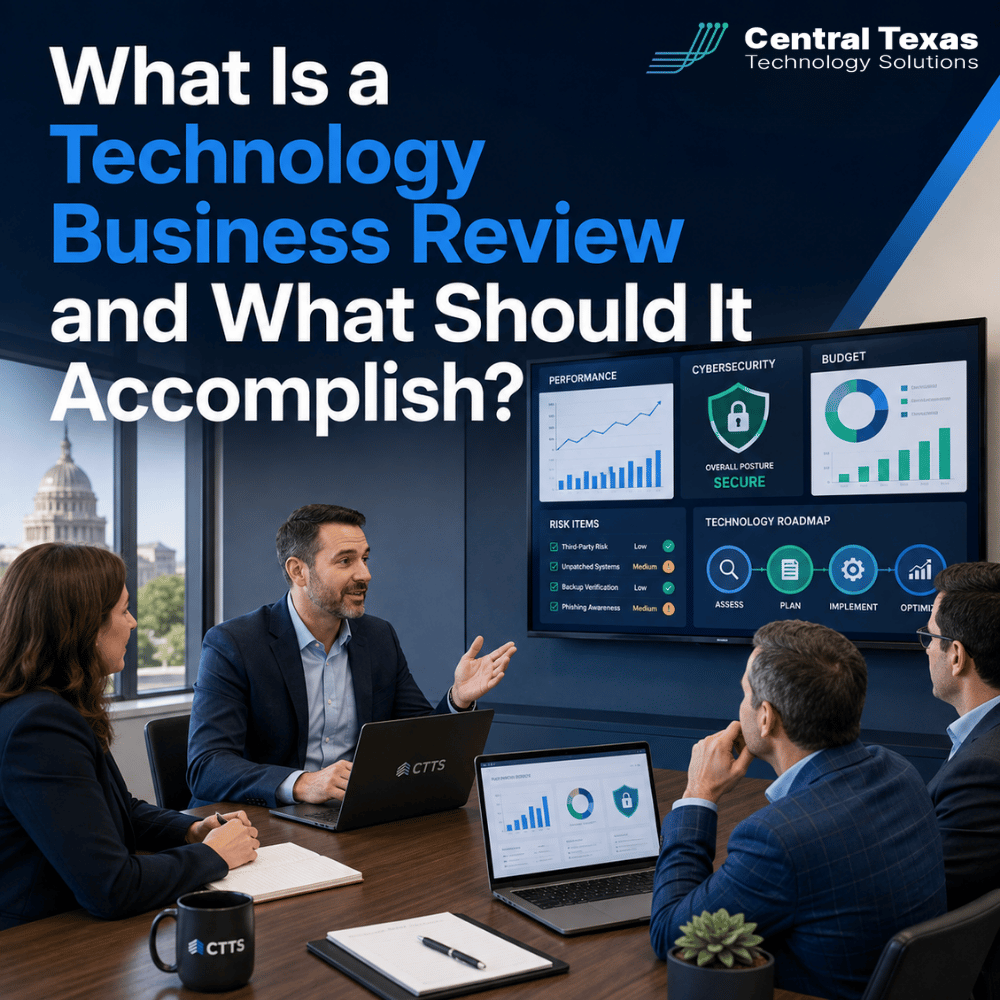
A Technology Business Review, sometimes called a TBR, gives business leaders a regular opportunity to evaluate those issues before they become emergencies. More importantly, it connects technology performance with cybersecurity, budgeting, business risk, and the company's future plans.
For businesses in Austin, Georgetown, Cedar Park, New Braunfels, and throughout Central Texas, a good Technology Business Review should help answer one important question:
Is our technology helping the business move forward, or creating risks we have not addressed yet?
What Is a Technology Business Review?
A Technology Business Review is a scheduled meeting between business leadership and an IT partner to evaluate the organization's technology environment from a business perspective.
It should not simply be a list of help desk tickets or a technical report filled with statistics.
The purpose is to identify what is working, what needs attention, what risks are developing, and what technology decisions should be made next.
A productive TBR may examine:
- Technology performance and recurring problems
- Cybersecurity risks and improvements
- Backup and disaster recovery readiness
- Aging computers, servers, and networking equipment
- Microsoft 365 and other cloud services
- Software licensing and technology expenses
- Upcoming projects and upgrades
- Compliance requirements
- Technology budgets and forecasts
- Business growth plans
The conversation should ultimately lead to priorities and decisions, not just information.
How Technology Business Reviews Connect IT Performance With Business Goals
Technology does not operate separately from the rest of the company.
If leadership plans to hire 15 employees, open another location, implement new software, acquire another company, or expand remote work, those decisions create technology requirements.
A Technology Business Review gives leadership and the IT provider an opportunity to discuss those plans early.
For example, a construction company preparing to open another office may need new internet service, networking equipment, cybersecurity controls, computers, phones, and secure access to company applications. Waiting until two weeks before the opening can create unnecessary costs and delays.
The same principle applies across industries.
Healthcare organizations may be planning system upgrades or preparing for compliance reviews. Legal firms may need stronger controls around confidential client information. Professional services firms may be adding employees or adopting new cloud applications. Manufacturers may depend on technology that supports production and operations. Nonprofits may need to balance cybersecurity improvements against limited budgets.
When CTTS understands those business goals, technology can be planned around them instead of becoming an obstacle later.
How a TBR Should Address Cybersecurity and Business Risk
Cybersecurity should be part of every Technology Business Review.
The conversation should go beyond asking whether antivirus software is installed.
A meaningful review considers the organization's current risks and whether its defenses are keeping pace with changes in the business.
That might include reviewing:
- Multi-factor authentication
- Endpoint security
- Email protection
- Vulnerability management
- User access and permissions
- Security awareness
- Backup protection
- Remote access
- Cyber insurance requirements
- Compliance obligations
Risk also extends beyond cyberattacks.
An aging server could become a business continuity risk. An unsupported operating system could create both security and reliability concerns. A single internet connection could leave an office unable to work if that connection fails.
A proactive IT partner identifies these risks while there is still time to address them intentionally.
That is much better than discovering them during a ransomware attack, equipment failure, insurance renewal, or audit.
Why Technology Budgeting Belongs in Every Business Review
Unexpected IT expenses are frustrating, but many technology expenses should not actually be unexpected.
Computers age. Servers need replacement. Software subscriptions change. Security requirements increase. Network equipment eventually reaches the end of its useful life.
A strong Technology Business Review helps leadership see those expenses coming.
For example, instead of discovering that 25 computers need replacement at the same time, leadership may develop a lifecycle plan that replaces a portion of the fleet each year.
The same approach can be used for:
- Servers
- Firewalls
- Wi-Fi equipment
- Backup systems
- Microsoft licensing
- Cybersecurity tools
- Major software upgrades
This turns technology spending from an emergency expense into a manageable business investment.
It also gives businesses the opportunity to compare upcoming technology projects against other priorities.
The goal is not necessarily to spend more on IT. The goal is to spend intentionally.
What Should Come Out of a Technology Business Review?
A Technology Business Review should produce clear next steps.
Leadership should leave the meeting understanding the organization's technology position and the most important actions to take next.
Ideally, the review identifies three categories.
Immediate Priorities
These are issues that create significant security, operational, or business risk and should be addressed soon.
Planned Improvements
These are projects that should be scheduled and budgeted but may not require immediate action.
Long-term Strategy
These are technology decisions connected to business plans over the next year or several years.
Each recommendation should also explain the business reason behind it.
For example, "replace the firewall" provides very little useful context.
A better recommendation explains that the firewall will reach the end of vendor support next year, which means it may stop receiving security updates. Leadership can then understand the risk, estimated cost, and appropriate timeline.
That is the difference between technical reporting and strategic technology planning.
A Technology Business Review Should Be More Than an IT Status Meeting
One common misconception is that Technology Business Reviews are simply an opportunity for an IT company to present reports.
They should accomplish much more.
Help desk statistics can be useful. So can cybersecurity reports, hardware inventories, backup results, and licensing information.
But numbers without context do not help leadership make better decisions.
A strategic IT partner should interpret that information and explain what it means for the business.
CTTS uses regular technology conversations to help organizations look beyond today's support issues and prepare for what comes next. That includes identifying emerging risks, planning technology investments, preparing for growth, and making sure technology supports business priorities.
For businesses across Central Texas, that proactive approach can reduce surprises and create a much clearer technology roadmap.
How Often Should Technology Business Reviews Be Held?
The right schedule depends on the organization.
Many businesses benefit from quarterly reviews because three months provides enough time to measure progress while still allowing leadership to respond to changing priorities.
Organizations experiencing rapid growth, significant cybersecurity requirements, major technology projects, or compliance concerns may benefit from more frequent conversations.
The important point is consistency.
Technology planning should not happen only when something breaks or when an expensive project suddenly becomes unavoidable.
Regular reviews create accountability and keep technology decisions connected to the direction of the business.
Turn Technology Into a Business Advantage
Your IT provider should do more than respond when something breaks.
Regular Technology Business Reviews give you the information and guidance needed to anticipate risks, plan expenses, prepare for growth, and make better technology decisions.
CTTS helps businesses throughout Central Texas align technology with where their organization is going, not just where it is today.
Schedule a free strategy call with CTTS to discuss your current technology environment and the priorities your next Technology Business Review should address.
Frequently Asked Questions About Technology Business Reviews
What is the main purpose of a Technology Business Review?
The primary purpose is to connect technology decisions with business priorities. A good TBR examines performance, cybersecurity, risk, budgeting, upcoming projects, and company goals so leadership can make informed decisions before problems become urgent.
Who should attend a Technology Business Review?
Someone with authority to discuss business plans, budgets, risks, and priorities should participate. Depending on the organization, that may include an owner, executive, office administrator, operations leader, finance leader, or internal IT manager.
Is a Technology Business Review the same as an IT support meeting?
No. An IT support meeting typically focuses on current technical issues. A Technology Business Review should take a broader view by evaluating technology strategy, cybersecurity, budgeting, risk, lifecycle planning, and future business needs.
Contact CTTS today for IT support and managed services in Austin, TX. Let us handle your IT so you can focus on growing your business. Visit CTTSonline.com or call us at (512) 388-5559 to get started!
If you're evaluating IT providers, these resources will guide you:
What Is an IT Roadmap and Why Every Growing Business Needs One
What Happens During an IT Assessment and Why Does It Matter?
How IT Documentation Protects Your Business From Confusion and Downtime
What Is Vendor Management and Why Should Your IT Partner Handle It?
How a Proactive IT Partner Plans for Business Growth
What Happens Behind the Scenes When CTTS Monitors Your Network?
What Happens When You Submit an IT Support Ticket?
How Does an IT Provider Onboard a New Employee?
What Happens When an Employee Leaves Your Company?
How Does an IT Provider Prepare Your Business for a New Office?