
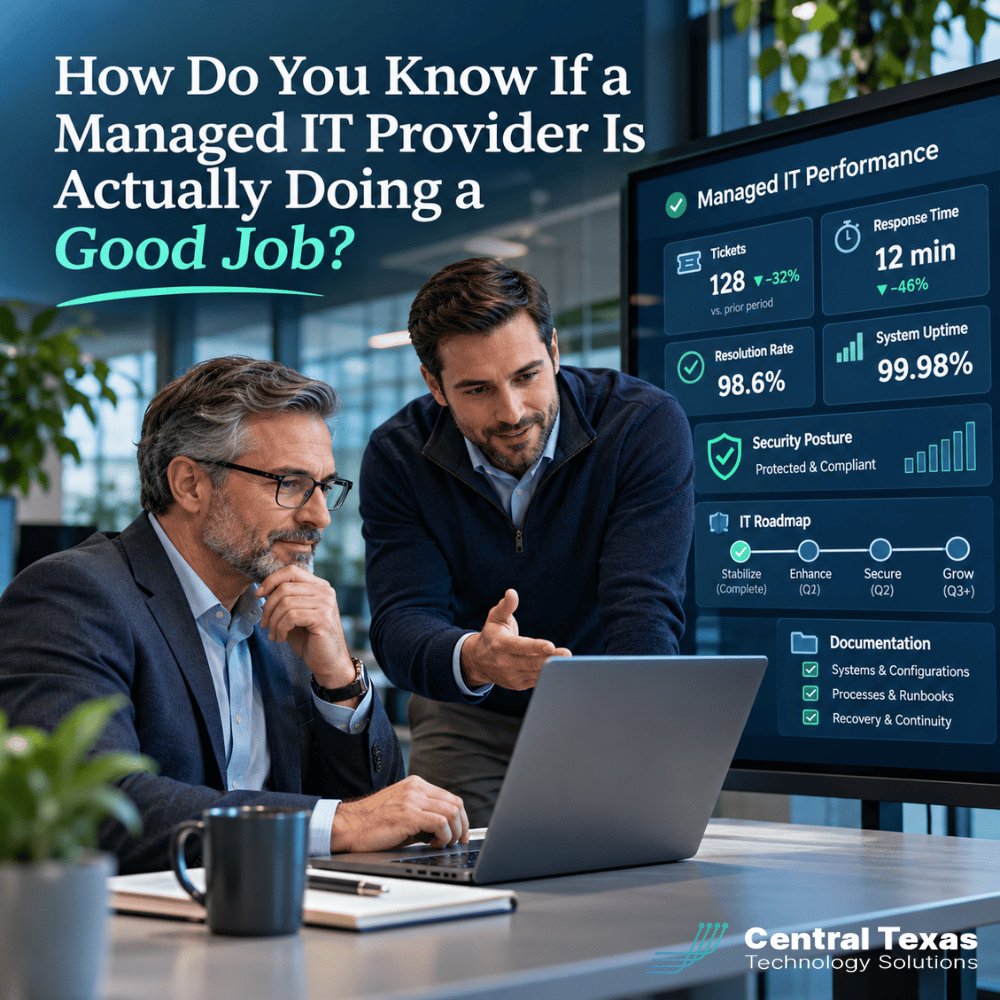
Your IT provider is friendly, responds when you call, and usually fixes whatever breaks. But does that mean you're getting your money's worth?
For many business owners, evaluating IT support is difficult because much of the work happens behind the scenes. When everything runs smoothly, you may wonder what you're paying for. When something goes wrong, you wonder why your provider didn't prevent it.
The truth is that a good managed IT provider should be measured by more than how quickly technicians fix problems. The real value comes from preventing disruptions, protecting your business, and helping technology support your long-term goals.
Here are six measurable ways to determine whether your IT provider is delivering the value your business deserves.
1. Are Recurring IT Problems Actually Being Eliminated?
One of the clearest indicators of managed IT service quality is whether the same problems keep happening.
Consider an employee whose computer disconnects from the network several times each week. Your IT provider responds quickly, reconnects the computer, and closes the ticket.
That's helpful, but it doesn't solve the underlying problem.
A proactive provider investigates why the connection keeps failing. Perhaps the issue involves outdated network equipment, incorrect configurations, or unreliable wireless coverage.
The goal should be to eliminate the cause, not repeatedly address the symptoms.
What to measure:
-
Number of support tickets submitted each month
-
Frequency of repeated issues involving the same systems
-
Number of recurring problems permanently resolved
-
Unplanned downtime affecting business operations
-
Trends in IT problems over the previous three to six months
Ticket volume alone doesn't tell the whole story. An increase may reflect business growth or employees becoming more comfortable requesting assistance.
However, repeated incidents without lasting solutions should raise questions.
A provider delivering effective managed network services should identify patterns and recommend improvements that reduce future disruptions.
2. Are IT Response and Resolution Times Meeting Expectations?
Fast responses matter, especially when technology problems prevent employees from working.
However, there's an important difference between acknowledging a support request and resolving the issue.
Response time measures how long it takes your provider to acknowledge a request or begin working on it.
Resolution time measures how long it takes to restore service or solve the problem.
A provider might respond to every ticket within 15 minutes but take several days to resolve routine issues. That may satisfy a response-time commitment while leaving employees frustrated.
Effective IT help desk services should track both measurements and prioritize issues according to their business impact.
For example, an entire office losing internet access should receive greater urgency than a single employee requesting a software installation.
Ask your provider to report:
-
Average response time by ticket priority
-
Average resolution time by ticket priority
-
Percentage of tickets meeting agreed service levels
-
Number of unresolved or overdue tickets
-
Employee satisfaction with IT support
These measurements should be reviewed over time rather than judged by a single month.
A strong provider also communicates clearly when complex problems require additional time.
3. Is Your Managed IT Provider Improving Your Cybersecurity?
A business can experience very few technical problems and still have serious security weaknesses.
That is why cybersecurity should be evaluated separately from everyday IT support.
Your provider should be able to explain what protections are in place, identify outstanding risks, and demonstrate how those risks are being addressed.
Effective cybersecurity services involve ongoing monitoring, maintenance, and improvement rather than simply installing security software.
Important measurements include:
-
Patch compliance: What percentage of supported computers and servers have required security updates installed within agreed deadlines?
-
Endpoint protection: Are all supported devices covered by active security monitoring?
-
Multifactor authentication: Are important business accounts protected by additional login verification?
-
Backup reliability: Are scheduled backups completing successfully, and are restores tested?
-
Security awareness: Are employees receiving training to recognize phishing and other threats?
-
Risk remediation: Are identified vulnerabilities being corrected within appropriate timeframes?
For example, a provider may report that 98% of computers have current security updates. That's useful information, but you should also know which devices make up the remaining 2% and whether they create significant risk.
Similarly, successful data backup and recovery requires more than confirming that backup software is running. Your provider should periodically test whether important information can actually be restored.
No provider can guarantee that a business will never experience a cyberattack. What matters is whether security risks are being identified, prioritized, and reduced.
4. Does Your IT Provider Maintain Accurate Documentation?
Documentation rarely receives attention until something goes wrong.
Imagine your business needs to replace a server, recover from an outage, or transition to another IT provider. Does anyone have an accurate record of your systems, software licenses, network configurations, and administrative access?
Without reliable documentation, even routine changes can become expensive and disruptive.
A professional managed IT provider should maintain organized, secure records of the technology it manages.
These typically include:
-
Hardware and software inventories
-
Network diagrams and configurations
-
Software licensing and renewal information
-
Backup and recovery procedures
-
Vendor contacts and service agreements
-
Administrative access records stored securely
-
Standard procedures for common IT tasks
Documentation should be updated as systems change.
Business owners don't necessarily need access to every technical detail. However, they should understand what records exist, how they're protected, and how the business can obtain the information it owns when necessary.
Good documentation reduces dependence on individual technicians and makes your business more resilient.
It also allows support teams to resolve problems more efficiently because they aren't starting from scratch every time something changes.
5. Is Your Managed IT Provider Helping You Plan for the Future?
Perhaps the biggest difference between basic technical support and a strategic IT partnership is planning.
A reactive provider waits until equipment fails, software becomes unsupported, or employees complain about slow systems.
A proactive provider identifies those concerns before they disrupt operations.
For businesses in Austin, Georgetown, Cedar Park, and Taylor, technology planning becomes especially important as teams expand, operations change, and cybersecurity requirements grow.
A useful IT roadmap should address:
-
Equipment replacement schedules
-
Software upgrades and licensing
-
Cybersecurity improvements
-
Cloud services and infrastructure needs
-
Technology budgets and expected expenses
-
Business growth and changing operational requirements
Your provider should also conduct periodic technology reviews that connect these recommendations to business priorities.
For example, a construction company opening another office needs reliable access to project files and communication systems. A growing healthcare practice may need stronger access controls and carefully managed systems that support compliance requirements.
Legal firms, manufacturing businesses, professional services organizations, and nonprofits face different challenges, but all benefit from technology decisions that support productivity and reduce operational risk.
CTTS approaches this through ongoing technology planning and strategic conversations that help business leaders make informed decisions rather than react to emergencies.
If your provider never discusses your business goals, upcoming changes, or technology budget, you may be receiving technical maintenance without meaningful strategic guidance.
6. Are You Receiving Reports That Demonstrate Real Business Value?
If you're paying a monthly fee for managed IT services, you should have a reasonable understanding of what you're receiving.
That doesn't mean reviewing hundreds of technical statistics.
Instead, your provider should deliver reports that translate IT activity into meaningful business information.
A useful monthly or quarterly report might include:
-
Support ticket trends and service-level performance
-
Recurring issues identified and resolved
-
Security updates and outstanding risks
-
Backup status and recovery testing results
-
Equipment approaching replacement
-
Completed improvement projects
-
Upcoming recommendations and budget considerations
More importantly, your provider should explain what those measurements mean.
For example, reporting that 75 support tickets were closed doesn't necessarily demonstrate value.
Explaining that a recurring network problem was permanently corrected, eliminating repeated employee interruptions, tells a much more meaningful story.
You should also expect transparency when performance falls short. A trustworthy provider acknowledges problems, explains corrective actions, and follows through.
The purpose of reporting isn't to prove that technicians are busy. It's to demonstrate that your business technology is becoming more reliable, secure, and efficient.
How to Evaluate Whether You're Getting Your Money's Worth
The lowest monthly IT bill doesn't necessarily represent the best value.
A provider charging less may appear attractive until recurring downtime, security incidents, and unexpected equipment failures create additional expenses.
Likewise, paying more doesn't automatically mean you're receiving better service.
The better question is whether your provider is delivering measurable improvements that justify the investment.
Managed IT Provider Performance Scorecard
Use this simple checklist during your next IT service review. Check each item your provider can demonstrate with evidence.
[ ] Recurring technical problems are being identified and reduced.
[ ] Response and resolution times meet agreed expectations.
[ ] Cybersecurity risks are tracked and addressed.
[ ] Backups are monitored and recovery procedures are tested.
[ ] IT documentation is accurate and regularly updated.
[ ] A technology roadmap and budget recommendations are maintained.
[ ] Regular reports explain performance and business outcomes.
This is a discussion tool, not a formal provider rating. Unchecked items are opportunities to request additional information.
If several areas are difficult to verify, start by asking your provider for documentation and a performance review. Missing reports don't automatically mean poor service, but your provider should be willing to explain what work is being performed and how success is measured.
The goal isn't perfection. It's accountability, continuous improvement, and confidence that your IT investment supports your business.
Your IT Provider Should Deliver More Than Friendly Support
Friendly, knowledgeable technicians are important, but they are only part of what makes a managed IT provider valuable.
The right partner should help your business experience fewer recurring problems, stronger security, more predictable technology expenses, and greater confidence in its systems.
At CTTS, our Complete Care Coverage is designed to combine dependable day-to-day support with proactive maintenance, cybersecurity, and long-term technology planning.
Wondering whether your current IT provider is delivering the value you deserve? Schedule a free IT assessment with CTTS today and let's discuss how your business technology can work better for you.
Frequently Asked Questions About Managed IT Provider Performance
How often should I review my managed IT provider's performance?
Most businesses benefit from reviewing operational metrics monthly and conducting a broader strategic review quarterly. Monthly reviews should focus on support performance, recurring problems, and security concerns. Quarterly discussions should address technology planning, budgets, and business priorities. Smaller organizations may need a different schedule, but regular communication is important. Your provider should also notify you promptly about significant risks rather than waiting for a scheduled meeting.
What are the warning signs of a poor managed IT provider?
Common warning signs include recurring problems that never get resolved, slow responses to critical issues, unexplained downtime, outdated systems, and limited communication about cybersecurity risks. Another concern is a provider that cannot produce meaningful reports or explain its recommendations. Occasional technical problems are unavoidable, but a consistent lack of accountability or improvement suggests the relationship needs attention.
Should I switch IT providers if I'm not satisfied with the service?
Not necessarily. Start by documenting your concerns and requesting a meeting to discuss measurable improvements. Establish clear expectations, responsibilities, and reasonable deadlines for corrective action. If your provider responds constructively and demonstrates progress, the relationship may be worth preserving. However, if serious issues continue or your provider cannot demonstrate accountability, evaluating alternative managed IT providers may be appropriate.
Contact CTTS today for IT support and managed services in Austin, TX. Let us handle your IT so you can focus on growing your business. Visit CTTSonline.com or call us at (512) 388-5559 to get started!
If you're evaluating IT providers, these resources will guide you:
What Should You Ask an IT Provider Before Giving Them Administrative Access to Your Business?
How Can You Tell Whether an IT Company's Cybersecurity Claims Are Actually Meaningful?
What Should a Managed IT Provider Show You During the Sales Process?
How Long Should You Give a New IT Provider Before Deciding Whether You Made the Right Choice?
What Are the Biggest Red Flags in a Managed IT Services Contract?