
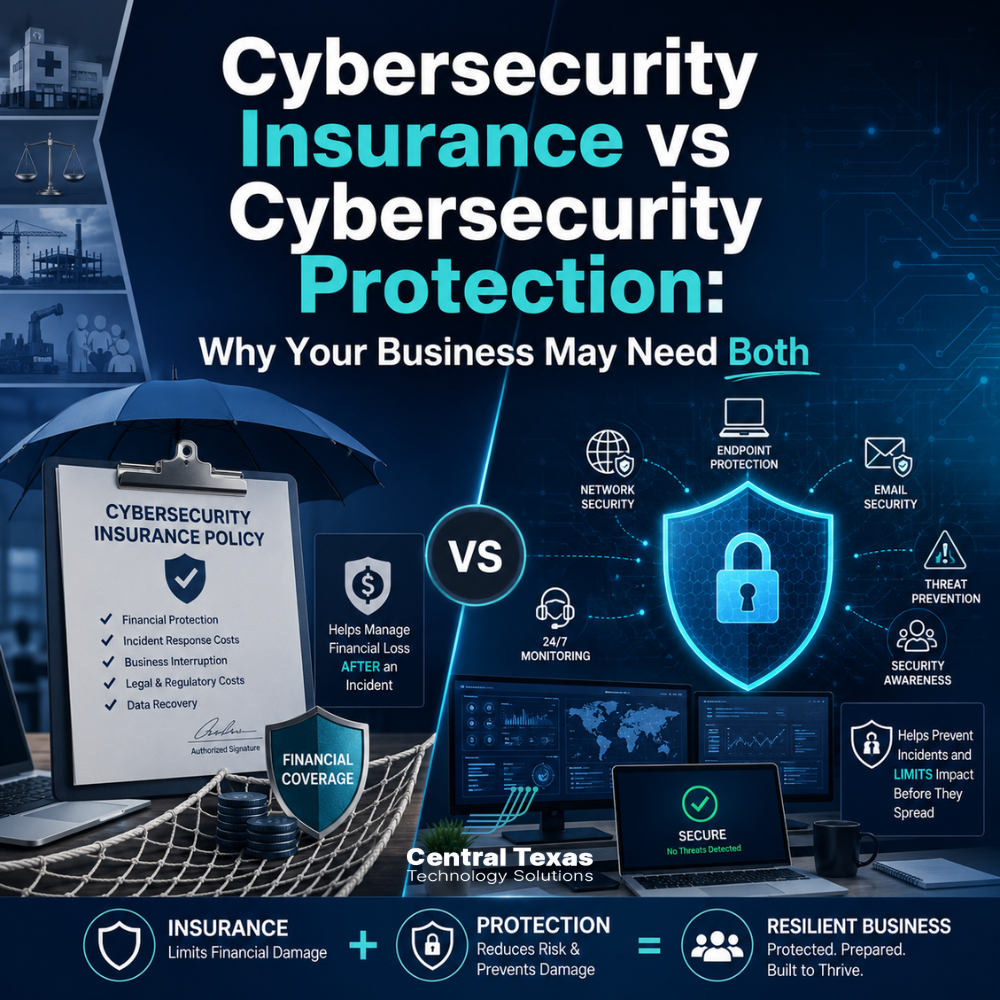
Cybersecurity insurance and cybersecurity protection are often discussed as if they solve the same problem. They do not.
Cybersecurity insurance helps your business manage some of the financial damage after a covered incident. Cybersecurity protection uses technology, policies, monitoring, and employee training to prevent incidents and limit their impact.
One helps you recover financially. The other helps reduce the chances that you will need to file a claim in the first place.
For businesses in Austin, Round Rock, Georgetown, Cedar Park, and across Central Texas, a complete risk strategy often requires both.
What Is Cybersecurity Insurance?
Cybersecurity insurance is designed to help cover certain expenses associated with a cyberattack, data breach, ransomware incident, or other covered security event.
Depending on the policy, coverage may help with costs such as:
- Legal services
- Data breach notifications
- Forensic investigations
- Business interruption
- Data recovery
- Public relations support
- Regulatory response
- Ransomware negotiation or payment
- Claims made by customers or other third parties
Coverage varies significantly between providers and policies. A policy may contain exclusions, coverage limits, waiting periods, deductibles, and specific security requirements.
Insurance does not automatically make an organization financially whole after an incident. It helps transfer part of the financial risk under the terms of the policy.
What Is Cybersecurity Protection?
Cybersecurity protection includes the safeguards used to prevent attacks, detect suspicious activity, limit unauthorized access, and recover business systems.
These protections may include:
- Multifactor authentication
- Endpoint detection and response
- Email security
- Data backups
- Security awareness training
- Vulnerability management
- Access controls
- Network monitoring
- Security patching
- Incident response planning
Effective cybersecurity protection is not based on one product. It requires multiple layers that work together.
For example, email filtering may stop a phishing message before it reaches an employee. Multifactor authentication can make it harder for an attacker to use a stolen password. Endpoint security may detect unusual behavior on a laptop. Reliable backups can help restore files if ransomware gets through.
Each control has a specific role in reducing business risk.
Why Cybersecurity Insurance Is Not a Substitute for Security
A business owner would not remove the locks from a building simply because the company has property insurance. The same principle applies to cybersecurity.
Insurance does not monitor your network, secure Microsoft 365, train your employees, install updates, or stop someone from clicking a malicious link.
It responds after a covered loss has occurred.
A serious cyber incident can still create consequences that insurance cannot fully repair, including:
- Lost customer trust
- Missed deadlines
- Employee downtime
- Damaged business relationships
- Permanent data loss
- Leadership distraction
- Delays in operations
- Reputational harm
A healthcare provider may face disruption to patient services. A law firm could lose access to sensitive case files. A manufacturer may experience production delays. A construction company could lose access to project documents and schedules.
Professional services firms and nonprofits may also face financial and reputational damage that extends beyond the amount covered by an insurance policy.
Security controls reduce the likelihood and potential scope of these events.
Why Security Controls Can Affect Your Insurance Coverage
Cybersecurity insurance providers increasingly expect businesses to maintain specific protections before issuing or renewing a policy.
Applications may ask whether your organization uses:
- Multifactor authentication
- Endpoint security
- Tested backups
- Employee security training
- Email filtering
- Privileged access controls
- Incident response plans
- Regular software patching
These questions are not merely administrative. They help the insurer estimate the level of risk.
A business that provides inaccurate information may face problems when filing a claim. An insurer may also require additional documentation showing that the stated controls were active and properly managed.
This is why businesses should not treat the application as a simple form that can be completed without technical input. Your answers should accurately reflect your environment.
A managed IT partner can help review the requirements, identify gaps, and document the protections your organization has in place.
How Insurance and Cybersecurity Protection Work Together
Cybersecurity protection reduces the likelihood that an incident will happen and limits the damage when one occurs. Cybersecurity insurance helps address certain financial costs that remain.
Consider a business email compromise incident.
An attacker gains access to an employee’s email account and sends fraudulent payment instructions to the accounting department.
Strong security controls could help by:
- Blocking the initial phishing email
- Requiring multifactor authentication
- Alerting the IT team to an unusual login
- Limiting access to financial information
- Training employees to verify payment changes
- Preserving logs for an investigation
If the attack still causes a covered financial loss, cybersecurity insurance may help with investigation expenses, legal support, notification costs, or other covered claims.
The protection controls reduce the risk and support a faster response. The insurance policy provides an additional financial layer.
Neither should be viewed as a complete solution by itself.
Common Mistakes Businesses Make
Buying Insurance Without Improving Security
A policy may provide a false sense of confidence if the business still relies on weak passwords, outdated software, unprotected email accounts, or untested backups.
Insurance cannot prevent downtime or restore trust after a breach.
Buying Security Tools Without Reviewing Coverage
Even businesses with strong protections still face risk. Employees make mistakes, vendors may be compromised, and new vulnerabilities continue to appear.
Insurance can help address some of the remaining financial exposure.
Assuming Every Incident Is Covered
Policies often contain conditions and exclusions. Social engineering, wire fraud, ransomware, regulatory penalties, and business interruption may have separate limits or requirements.
Business leaders should understand what the policy covers before an incident occurs.
Completing the Insurance Application Without IT Support
A business owner or office manager may not know whether every device has endpoint protection or whether multifactor authentication is enforced across all accounts.
Technical questions should be verified by someone who understands the environment.
Build a Cybersecurity Strategy Around Business Risk
The right approach begins with understanding what your business needs to protect.
A healthcare organization may prioritize patient data and HIPAA requirements. A legal practice may focus on client confidentiality and secure document access. Construction and manufacturing companies may need to protect project systems, field devices, production equipment, and vendor communications.
Professional services firms may depend heavily on Microsoft 365 and remote access. Nonprofits may need to protect donor information while operating with limited internal resources.
A practical risk strategy should address:
- Which systems are essential to daily operations
- What information would create the greatest harm if exposed
- How long the business could operate without critical systems
- Which insurance requirements must be maintained
- Who is responsible for responding to an incident
- How quickly systems and data can be restored
CTTS helps Central Texas businesses take a proactive approach to these questions. Instead of waiting for an incident, we align cybersecurity controls, business continuity planning, documentation, and ongoing monitoring with the organization’s goals.
Protect the Business Before and After an Incident
Cybersecurity insurance and cybersecurity protection solve different parts of the same business problem.
Insurance can help manage certain financial consequences. Security controls help prevent attacks, detect threats, reduce downtime, and limit damage.
CTTS helps businesses in Austin and throughout Central Texas build a practical cybersecurity strategy that supports insurance requirements and daily operations.
Schedule a free strategy call with CTTS to review your cybersecurity protections, insurance requirements, and areas of risk.
Frequently Asked Questions
Does cybersecurity insurance prevent cyberattacks?
No. Cybersecurity insurance helps manage certain financial losses after a covered incident. It does not prevent phishing, ransomware, account compromise, or data theft. Prevention requires security controls such as multifactor authentication, endpoint protection, backups, monitoring, employee training, and access management.
Will insurance cover every cost after a cyberattack?
Not necessarily. Coverage depends on the policy, limits, exclusions, deductibles, and whether the business met the insurer’s security requirements. Business leaders should review the policy carefully and confirm that the company’s actual security practices match the information submitted on the application.
Can an IT provider help with a cybersecurity insurance renewal?
Yes. A qualified IT partner can review the insurer’s technical questions, verify existing controls, identify gaps, and provide supporting documentation. This can help the business submit accurate information and strengthen its security before renewal.
Contact CTTS today for IT support and managed services in Austin, TX. Let us handle your IT so you can focus on growing your business. Visit CTTSonline.com or call us at (512) 388-5559 to get started!
Explore these expert insights before making your next IT decision:
Fully Managed IT vs Co Managed IT: Which Model Fits Your Business Best?
IT Generalists vs IT Specialists: What Does Your Business Really Need?
Should You Standardize Your Technology Stack or Stay Flexible?
One IT Vendor vs Multiple Vendors: Which Approach Reduces Risk?
Is It Better to Upgrade Your Current Systems or Start Fresh?
Cloud Backup vs Local Backup: Which Does Your Business Need?
Managed IT Services vs Hiring One IT Person: Which Is Safer for a Growing Business?
Cybersecurity Software vs Cybersecurity Strategy: What Is the Difference?
Hourly IT Support vs Monthly Managed IT Services: Which Gives You Better Control?
Microsoft 365 Basic Setup vs Managed Microsoft 365 Support: What Are You Missing?