
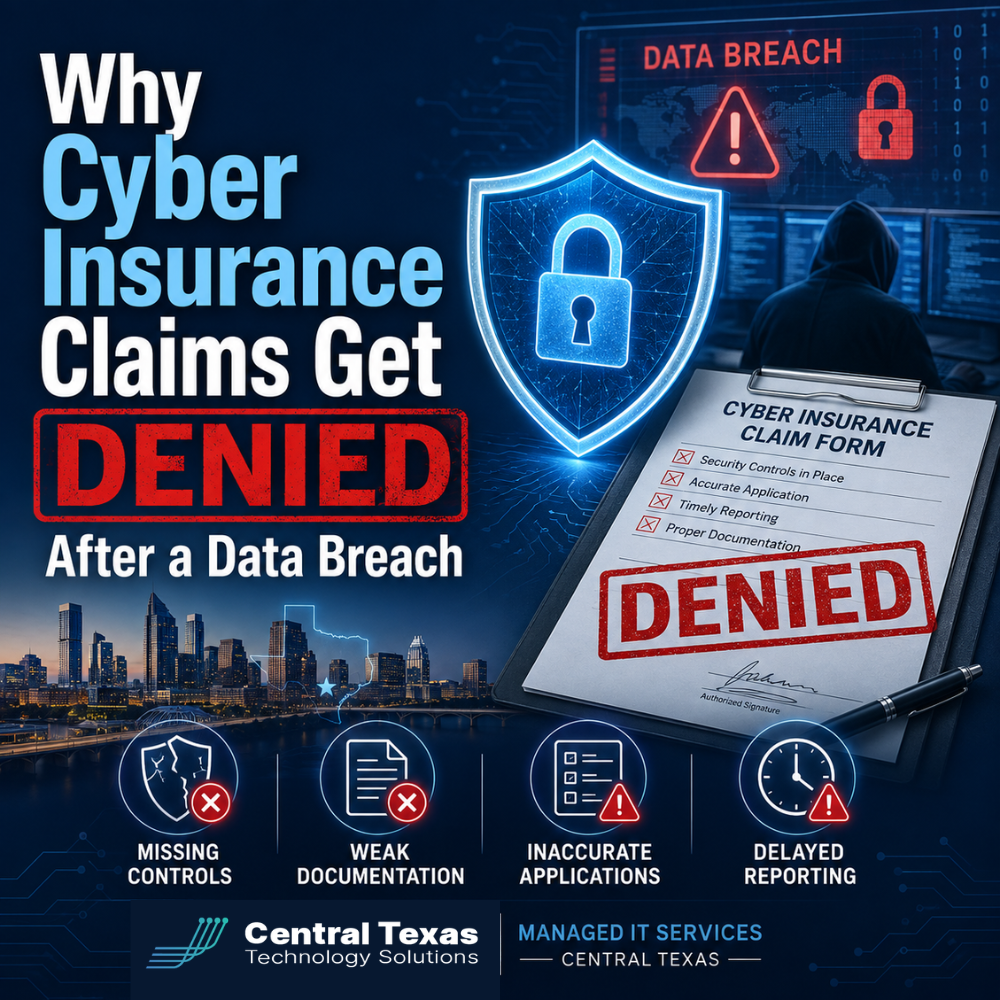
Cyber insurance can help a business recover from ransomware, data theft, business interruption, legal expenses, and other cyber incidents. But having a policy does not automatically mean every loss will be covered.
Insurance policies contain specific conditions, exclusions, reporting requirements, and representations about the security practices a company has in place. The Federal Trade Commission recommends that businesses understand exactly what their cyber policy covers, including data breaches, network attacks, vendor incidents, and other common cyber risks.
When a claim runs into trouble, the issue is often not simply that a breach occurred. The problem may be what happened before or immediately after the breach.
For businesses in Austin, Buda, San Marcos, and New Braunfels, understanding these risks before an incident can make the difference between having cyber insurance and having coverage you can actually use.
Why Cyber Insurance Claims Can Be Denied
Cyber insurance policies vary considerably, so there is no universal list of circumstances that will cause every carrier to deny a claim. Coverage ultimately depends on the policy language, the facts surrounding the incident, and applicable law.
However, four issues deserve particular attention:
- Security controls that were represented as being in place but were missing or disabled
- Inaccurate information on the insurance application
- Poor documentation of cybersecurity practices
- Failure to report an incident within required timeframes
These are not simply insurance problems. They are technology management problems that should be addressed long before an attack occurs.
Missing Cybersecurity Controls Can Create Coverage Problems
Cyber insurance applications increasingly ask detailed questions about how an organization protects its systems.
A company may be asked whether it uses controls such as:
- Multi-factor authentication
- Endpoint security
- Email security
- Secure remote access
- Data backups
- Security monitoring
- Patch and vulnerability management
- Employee security training
- An incident response plan
These controls also align with widely recommended cybersecurity practices. For example, CISA recommends maintaining and regularly exercising an incident response plan that includes communication and notification procedures for ransomware and data breach incidents.
Problems can arise when a business states that a control is implemented but its actual environment does not match that answer.
Imagine that a company indicates on its application that multi-factor authentication protects remote access. Six months later, attackers compromise an account that was never protected by MFA. The insurer may examine whether the company's representation was accurate and whether the policy contains provisions affecting coverage in that situation.
That is why cybersecurity controls should not exist only on an insurance questionnaire.
They should actually be deployed, monitored, maintained, and periodically verified.
An Inaccurate Cyber Insurance Application Can Become a Serious Problem
Insurance applications are often completed by an owner, CFO, office manager, insurance broker, or another employee who may not know the technical details of the company's network.
That creates an easy trap.
Someone sees a question such as, "Does your organization require MFA for all remote network access?" and checks "yes" because they believe MFA is being used.
But perhaps it is only enabled for Microsoft 365. A legacy VPN may not require it. An administrator account might have been excluded. A cloud application might use separate authentication.
What looked like a reasonable answer may not accurately describe the environment.
The safer approach is to have whoever manages your technology review the cybersecurity portions of the application before it is submitted.
CTTS can help businesses verify what is actually deployed so leadership and their insurance advisor can answer technical questions with better information.
This is particularly valuable for healthcare organizations managing sensitive patient information, legal firms protecting confidential client files, professional services companies using cloud applications, construction firms supporting employees in the field, manufacturers protecting operational systems, and nonprofits that may have limited internal IT resources.
Weak Documentation Makes It Harder to Prove What You Were Doing
Good cybersecurity is not just about installing tools.
You also need evidence showing what protections existed and how they were managed.
After a breach, investigators, legal counsel, regulators, and insurers may need information about the environment before and during the incident. FTC guidance on responding to data breaches emphasizes quickly securing operations, preserving relevant evidence, determining what happened, and working with appropriate forensic professionals.
Useful documentation may include:
- MFA configuration records
- Endpoint protection reports
- Backup testing results
- Security awareness training records
- Vulnerability scans
- Patch management reports
- Incident response procedures
- User access reviews
- Firewall and security logs
- Policies governing account creation and termination
Documentation helps answer a critical question after an incident:
What protections were actually in place when the breach occurred?
Without those records, a business may struggle to reconstruct its cybersecurity posture after systems have already been compromised.
A proactive Managed IT Services Provider should help maintain that evidence as part of normal operations, not scramble to create it after an incident.
Delayed Reporting Can Complicate a Cyber Insurance Claim
One of the biggest mistakes after discovering suspicious activity is waiting too long to involve the appropriate people.
Cyber policies can contain specific requirements governing when and how incidents or claims must be reported. Businesses should understand those requirements before an emergency occurs rather than trying to interpret the policy during a ransomware attack.
Rapid escalation matters outside insurance as well. Depending on the organization and type of data involved, breach notification requirements may apply. For example, the FTC Safeguards Rule includes breach reporting requirements for certain covered financial institutions, and other industries may face separate state or federal obligations.
Your incident response plan should identify who needs to be contacted, which may include:
- Your Managed IT Services Provider
- Cyber insurance carrier or broker
- Approved breach counsel
- Digital forensics professionals
- Company leadership
- Regulatory or law enforcement authorities when appropriate
Do not assume that investigating the problem internally for several days before notifying anyone is always the best approach.
Your policy and incident response plan should guide the process.
Cyber Insurance Works Better When IT and Risk Management Work Together
A common misconception is that buying cyber insurance transfers cybersecurity responsibility to the insurance company.
It does not.
Insurance helps transfer some financial risk. Cybersecurity helps reduce the likelihood and impact of the incident in the first place.
The strongest approach connects the two.
Before your next cyber insurance renewal, have your IT team review the technical questions on the application. Confirm that the controls being represented are actually deployed. Identify gaps and correct them before signing the application.
Then maintain evidence showing those protections remain active.
For Central Texas organizations, CTTS takes this proactive approach by helping businesses align technology, cybersecurity, documentation, and long-term risk management instead of simply responding when something breaks.
What Should You Review Before Renewing Cyber Insurance?
Before submitting your next application, schedule a cybersecurity review and compare the questions on the application with your actual environment.
Look closely at:
- MFA coverage
- Backup systems and recovery testing
- Endpoint protection
- Email security
- Remote access
- Administrative accounts
- Employee security training
- Vulnerability management
- Security monitoring
- Incident response procedures
Do not answer based on what you think your company has.
Verify it.
That small step can uncover security gaps before attackers find them and help ensure that the information provided to your insurer accurately reflects your environment.
Make Sure Your Cyber Insurance Application Matches Your Cybersecurity
Cyber insurance should be one layer of your risk management strategy, not your entire strategy.
CTTS helps businesses identify security gaps, implement proactive protections, document cybersecurity controls, and build an IT environment that supports both business continuity and long-term growth.
If you are approaching a cyber insurance renewal or are not sure whether the answers on your current policy accurately reflect your network, schedule a free strategy call with CTTS. We can review the technology behind those answers and help you identify gaps before they become much larger problems.
Frequently Asked Questions About Cyber Insurance Claims
Can a cyber insurance company deny a claim because we did not have MFA?
Potentially, depending on the policy, application representations, circumstances of the incident, and applicable law. If your organization told the insurer MFA was required in certain areas but it was not actually implemented there, that discrepancy could become important during a claim review. Have your IT provider verify MFA coverage before completing or renewing your application.
Should my IT provider review my cyber insurance application?
Yes, particularly the technical cybersecurity questions. Your insurance agent understands insurance, while your IT provider should understand how your systems are actually configured. Having both involved can reduce the risk of accidentally providing inaccurate information about MFA, backups, endpoint security, remote access, or other controls.
What should we do first after discovering a possible data breach?
Follow your documented incident response plan. That normally includes containing the threat, preserving evidence, contacting the appropriate technical and legal resources, and reviewing your cyber insurance policy's reporting requirements. FTC breach response guidance also emphasizes quickly securing systems and preserving evidence so investigators can determine what happened.
Contact CTTS today for IT support and managed services in Austin, TX. Let us handle your IT so you can focus on growing your business. Visit CTTSonline.com or call us at (512) 388-5559 to get started!
Explore these expert insights before making your next IT decision:
What Are the Risks of Letting Employees Manage Their Own Technology?
How Outdated Systems Quietly Hurt Productivity and Revenue
What Could a Data Breach Actually Cost Your Business in Texas?
How One Weak Password Can Put Your Entire Business at Risk
What Are the Warning Signs Your Business Has Outgrown Its Current IT Support?
What Happens When Your IT Provider Does Not Understand Your Industry?
Why Small IT Problems Keep Coming Back and What That Really Means
Could Your Business Keep Running If Your Main Server Failed Today?
What Happens When Your Only IT Employee Leaves Without Warning?
Could a Former Employee Still Have Access to Your Business Systems?