
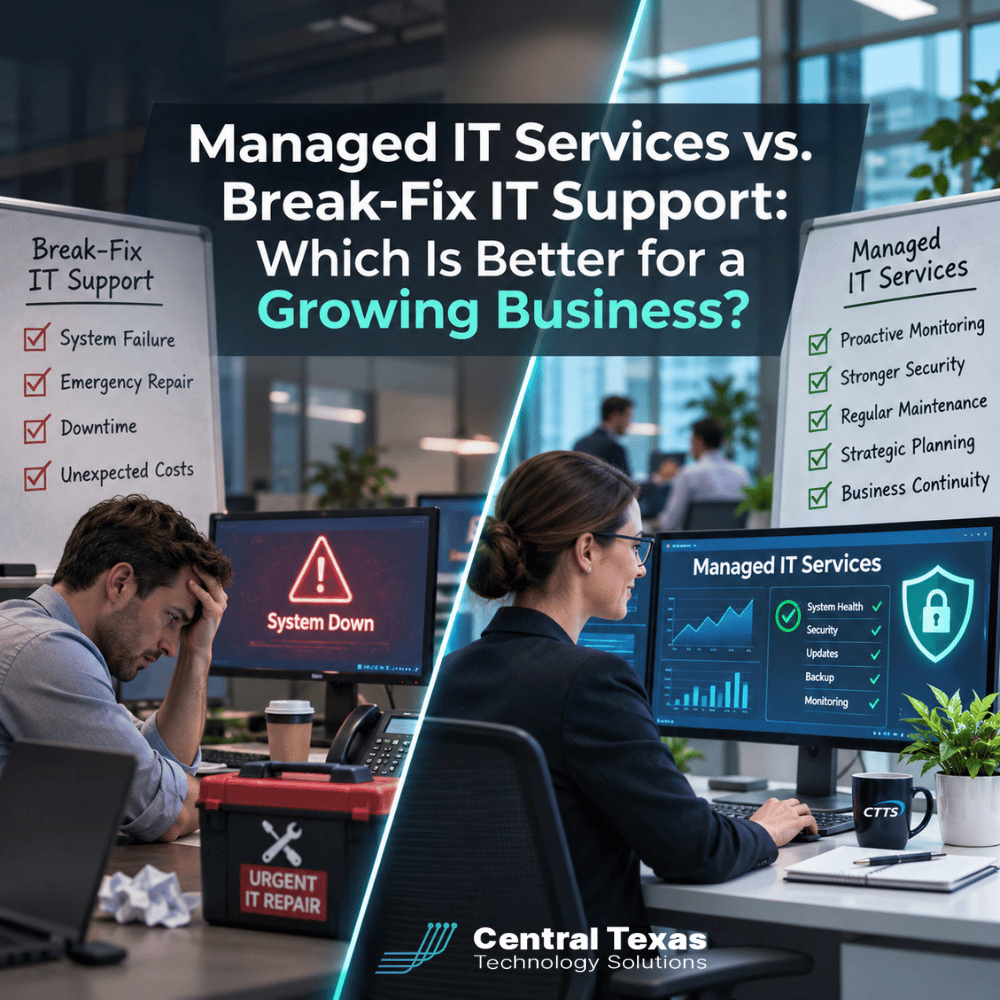
Why pay a monthly fee for IT services when you can simply call someone whenever something breaks? It's a reasonable question, especially for business owners trying to control expenses.
The answer depends on how much your business relies on technology and what happens when that technology stops working.
Break-fix IT support addresses problems after they occur. Managed IT services take a different approach, focusing on preventing problems, protecting systems, and planning for future needs.
Both approaches have their place. However, as businesses grow, the cost of unexpected downtime, cybersecurity threats, and recurring technical problems can make reactive IT support increasingly expensive.
Understanding the differences can help you choose an approach that supports your business today and prepares it for tomorrow.
What Is Break-Fix IT Support, and How Does It Work?
Break-fix IT support follows a straightforward model: something breaks, you call an IT technician, and you pay to have it repaired.
There is generally no ongoing service agreement or monthly management fee. Instead, businesses pay for individual service calls, troubleshooting, repairs, and sometimes emergency assistance.
For example, if an employee's computer stops working, you contact an IT provider. The technician diagnoses the problem, makes the repair, and bills you for the work.
This approach offers several advantages:
-
No recurring monthly commitment: You pay for services when you need them.
-
Flexibility: You can choose different providers for different problems.
-
Lower initial expenses: Businesses with minimal technology needs may spend less on occasional repairs.
However, break-fix support has an important limitation: the provider is typically called after a problem has already disrupted your business.
A failed server, compromised email account, or network outage may have been developing for weeks before anyone noticed.
By the time a technician arrives, employees may already be unable to work, customers may be affected, and valuable business data could be at risk.
How Managed IT Services Take a Proactive Approach
Managed IT services replace the traditional repair-first relationship with ongoing technology management.
Instead of waiting for something to fail, a managed services provider (MSP) continuously monitors supported systems, performs preventive maintenance, addresses security vulnerabilities, and helps businesses plan their technology investments.
CTTS offers this approach through Complete Care Coverage, which focuses on keeping business technology reliable, secure, and aligned with operational needs.
Depending on the service agreement, proactive IT management typically includes several important functions.
Proactive Monitoring and Maintenance
With managed network services, IT professionals monitor network performance and system health to identify potential problems before they cause major interruptions.
Routine maintenance, software updates, and equipment monitoring help reduce avoidable failures.
For example, detecting a storage system approaching capacity may allow an IT provider to address the issue before employees lose access to important files.
Ongoing Cybersecurity Protection
Cybersecurity threats do not wait until a business requests technical assistance.
A proactive approach to cybersecurity services includes maintaining security controls, addressing vulnerabilities, monitoring for suspicious activity, and helping employees recognize threats.
Although no provider can eliminate every cybersecurity risk, consistent oversight helps reduce exposure to preventable incidents.
Employee Help Desk Support
When employees experience technical difficulties, timely assistance matters.
Ongoing IT help desk services provide a defined process for resolving everyday problems, such as software errors, account access issues, and connectivity failures.
Instead of searching for an available technician, employees have an established support resource.
Strategic Technology Planning
Managed IT services also help businesses make informed decisions about equipment replacement, software investments, security improvements, and future growth.
This planning component is especially valuable because it connects technology spending to business objectives rather than individual emergencies.
Managed IT Services vs. Break-Fix IT: Comparing the Costs
One of the biggest objections to managed IT services is the monthly expense.
Why commit to a recurring payment when you might go several months without needing repairs?
The problem with this comparison is that it focuses only on the cost of IT service, not the total cost of technology problems.
Consider a hypothetical business with 20 employees.
If a network outage prevents everyone from working for four hours, and the average employee costs the company $35 per hour, the direct labor cost of that interruption could reach $2,800.
That calculation does not include lost sales, missed deadlines, customer frustration, or emergency repair charges.
A single serious outage can easily cost more than several routine service calls.
The two approaches also handle expenses differently.
| Cost Factor | Break-Fix IT Support | Managed IT Services |
|---|---|---|
| Payment structure | Pay per incident or repair | Recurring monthly fee |
| Preventive maintenance | Usually purchased separately | Typically included |
| Emergency repairs | Additional, sometimes higher charges | Coverage depends on agreement |
| Cybersecurity | Often separate or limited | Ongoing protection and oversight |
| Budget predictability | Variable and difficult to forecast | More predictable |
| Technology planning | Usually requested as needed | Ongoing strategic guidance |
| Downtime prevention | Limited proactive involvement | Focus on identifying and reducing risks |
Managed IT services are not automatically cheaper for every business. However, they can provide greater financial predictability and reduce the operational costs associated with recurring problems.
It is also important to review what a managed services agreement actually covers. Hardware purchases, major projects, and certain third-party services may still involve additional charges.
When Break-Fix IT Support May Be Enough
Not every business needs comprehensive managed IT services.
For a very small operation with limited technology, occasional support may be a reasonable choice.
Break-fix IT can make sense when:
-
The business has only one or two computers.
-
Technology interruptions have little impact on operations.
-
Systems contain minimal sensitive business information.
-
The owner can tolerate delays while waiting for repairs.
-
Basic security, updates, and backups are already being handled reliably.
For example, a small business that primarily uses a laptop for scheduling and basic administrative tasks may not need the same level of ongoing IT management as a company with 30 employees and several interconnected systems.
However, even businesses using break-fix support need reliable data backup and recovery procedures, security updates, and appropriate account protection.
Paying only when something breaks should not mean ignoring preventive maintenance or cybersecurity.
The key question is whether the business can manage those responsibilities effectively without ongoing professional oversight.
When Managed IT Services Become More Valuable for Growing Businesses
As businesses expand, their technology environments become more complicated.
Additional employees, new locations, cloud applications, remote access, and increased security requirements create responsibilities that are difficult to manage through occasional repair calls.
Several warning signs suggest it may be time to consider managed IT services.
1. Technology Problems Are Interrupting Productivity
If employees regularly experience slow computers, network interruptions, or recurring software problems, reactive repairs may only address the symptoms.
Ongoing monitoring and maintenance can help identify underlying causes and reduce repeated disruptions.
2. Your Business Handles Sensitive Information
Healthcare organizations, law firms, and professional services companies frequently manage confidential information that requires careful protection.
Construction companies, manufacturers, and nonprofits also depend on secure systems to protect financial records, project information, donor data, and daily operations.
These businesses may benefit from consistent security oversight, documented procedures, and technology management that supports applicable compliance requirements.
3. Your Company Is Adding Employees or Locations
Growth introduces new technology challenges.
Businesses expanding across Austin, Georgetown, Cedar Park, and Pflugerville may need standardized equipment, secure connections, consistent employee onboarding, and centralized IT oversight.
A managed services provider can help establish systems and procedures that scale with the organization.
4. IT Expenses Are Becoming Unpredictable
Frequent emergency repairs, unexpected equipment replacements, and repeated service calls make budgeting difficult.
Managed IT services can help businesses establish more consistent operating expenses while planning separately for major upgrades and equipment purchases.
5. Nobody Is Responsible for Long-Term IT Planning
Perhaps the clearest warning sign is that technology decisions happen only when something goes wrong.
Without an IT strategy, businesses may continue using outdated equipment, overlook security weaknesses, or purchase systems that do not work well together.
Proactive IT management helps leadership anticipate these challenges instead of reacting to them.
How to Choose the Right IT Support Model for Your Business
Choosing between managed IT services and break-fix support should involve more than comparing hourly rates and monthly fees.
Start by evaluating how technology affects your operations.
Ask yourself:
-
How much would an hour of downtime cost? Consider employee productivity, customer service, missed opportunities, and operational delays.
-
Who monitors our systems and security? Determine whether someone is consistently responsible for updates, vulnerabilities, backups, and emerging problems.
-
How often do we experience recurring IT issues? Frequent problems may indicate that individual repairs are not addressing underlying causes.
-
Do we have a technology plan for the next two years? Growth, equipment replacement, and new software should be anticipated rather than handled as emergencies.
-
Are our IT expenses predictable? Review both direct support costs and the business impact of unexpected failures.
The answers can reveal whether your current support arrangement is meeting your needs.
For some businesses, occasional technical assistance remains sufficient. Others may benefit from a combination of internal IT resources and outside expertise.
But when technology becomes essential to daily operations, proactive management often provides greater value than simply paying someone to fix what breaks.
Stop Waiting for IT Problems to Disrupt Your Business
Break-fix IT support can work when technology needs are simple and interruptions are manageable. But as your business grows, relying exclusively on reactive repairs can introduce unnecessary risk, unpredictable expenses, and lost productivity.
CTTS helps Central Texas businesses move beyond reactive IT support with proactive management, reliable technical assistance, and technology planning designed around their business goals.
Ready to find out whether managed IT services make sense for your company?
Schedule a free IT consultation with CTTS today and let's discuss your business technology needs.
Frequently Asked Questions About Managed IT vs. Break-Fix Support
Is managed IT more expensive than break-fix IT support?
Managed IT services involve a recurring fee, while break-fix support generally charges for individual incidents. A business with very few technical problems may spend less using break-fix support.
However, managed services include preventive work, monitoring, security oversight, and ongoing assistance that would otherwise need to be purchased or handled separately. Businesses should compare their total technology expenses, including downtime and emergency repairs, rather than looking only at monthly fees.
Can a small business benefit from managed IT services?
Yes. Small businesses often lack dedicated internal IT employees, making them especially dependent on outside technical expertise.
Managed IT services can provide access to professional support, ongoing cybersecurity protection, and technology planning without requiring a full internal IT department.
The decision depends on how heavily the business relies on technology, the sensitivity of its information, and the consequences of system failures. Even a small company may benefit from proactive management when downtime directly affects revenue or customer service.
Does managed IT support eliminate downtime and cybersecurity risks?
No IT provider can guarantee that systems will never fail or that a cybersecurity incident will never occur.
However, proactive monitoring, regular maintenance, security controls, and recovery planning can reduce the likelihood and impact of many common problems.
The goal is not to promise perfect technology. It is to identify risks earlier, resolve issues more efficiently, and help the business recover when unexpected events occur.
Contact CTTS today for IT support and managed services in Austin, TX. Let us handle your IT so you can focus on growing your business. Visit CTTSonline.com or call us at (512) 388-5559 to get started!
Looking for clarity on your next IT move? These articles will help:
Managed IT Services vs. Hiring Another Internal IT Employee: Which Makes More Sense?
Local IT Provider vs. National Managed Service Provider: Which Is Better for a Texas Business?
Microsoft 365 Business Premium vs. Enterprise Plans: What Does a Growing Business Actually Need?
VPN vs. Zero Trust Network Access: What Should Businesses Use for Remote Work?
Co-Managed IT vs. Fully Managed IT: Which Model Is Right for Your Business?